Contents · 7 sections
Feeling your Nuss bar click, pop or shift a little is usually normal: hospitals say the bar and its stabilizers move slightly as your chest wall moves, and that this can go on for as long as the bar is in. A real displacement, where the bar slips or rotates out of position, is uncommon and looks different: a change in the shape of your chest, new pain, or a bar end you can suddenly feel or see.
Use the table below to sort what you’re feeling. If it’s sudden and comes with severe chest pain, fever or trouble breathing, stop reading and go to the emergency department.
What the bar is and how it’s placed: see my guide to the Nuss procedure. I’m not a doctor, and your surgeon’s instructions come before anything here.
Normal, call your surgeon, or go to the emergency department
These rows come from named hospital sheets. Your own hospital’s list wins if it differs.
| What you notice | What to do | Source |
|---|---|---|
| Clicking, popping or a shifting feeling when you move, sneeze or stretch, without new pain | Normal. Mention it at your next visit if it worries you | Children’s Mercy Kansas City calls a popping or clicking sound or sensation normal, from movement of the bar and stabilizers, and says it may come and go the whole time the bar is in. Texas Children’s also calls it normal |
| The bar shows more in the first weeks, while you’ve lost some weight | Usually normal | Texas Children’s: some patients lose 5 to 10 lb after surgery, the bar may be more noticeable, and it becomes less obvious as the weight comes back |
| Swelling and bruising around the cuts and along the bar | Usually normal for several weeks | Texas Children’s |
| A bar end you can newly feel or see under the skin, with no weight loss to explain it | Call your surgeon. Don’t wait for removal day | My rule. A bar end in a new place can mean the bar has shifted |
| A change in how your chest looks, new or worse chest pain, any injury to the chest | Call your surgeon | Children’s Hospital of Philadelphia (CHOP) call list |
| Fever above 101.5 °F (38.6 °C), more redness or swelling at the cuts, any drainage | Call your surgeon | CHOP. Infection and bar movement can go together (see below) |
| Pain your prescribed medicine doesn’t control | Call your surgeon | Texas Children’s |
| Sharp “pinches” of pain that last more than 24 hours or don’t ease with pain medicine | Call your surgeon. You may need a chest X-ray | University of Rochester Medical Center (URMC) |
| A loud pop that hurts | Call your surgeon | URMC: occasional popping is normal, a loud, painful one is a reason to call |
| A sudden change in how your chest looks, and/or severe unexplained chest pain, fever or shortness of breath | Go to the emergency department | Texas Children’s |
| Trouble breathing or turning blue | Call 911 | URMC |
Call 911 (999 in the UK) or your local emergency number now if you have any of these. Don’t drive yourself.
- palpitations that won’t stop
- palpitations with chest pain, shortness of breath, feeling faint or fainting
- sudden chest pain or pressure that doesn’t go away
- chest pain that spreads to your arm, neck, jaw or back
- chest pain with sweating, feeling sick, light-headedness or breathlessness
When you call, say you have a Nuss bar, when it was put in, and what changed. If you’re seen somewhere other than your surgical center, ask them to contact your surgeon. A chest X-ray is how teams see where the bar sits: Texas Children’s, for example, X-rays the chest right after surgery and again before you go home.
Why a bar can feel like it moves
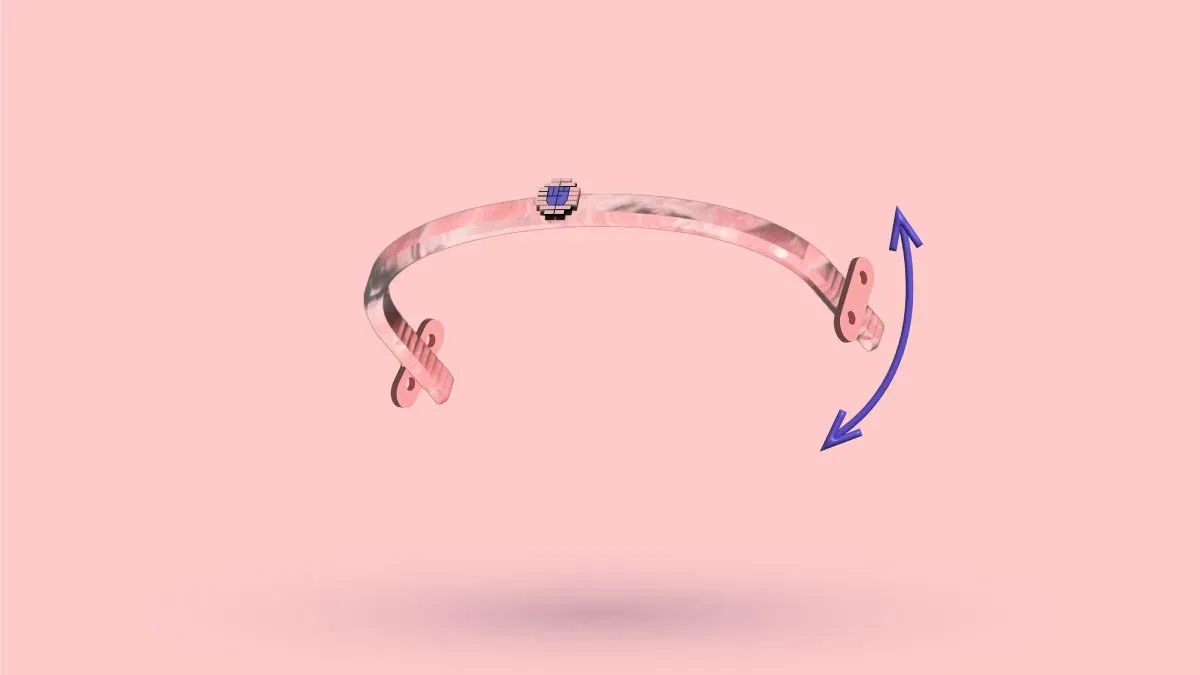
The bar sits behind the breastbone and rests on the ribs at each side. Its ends are fixed to the chest wall with a stabilizer plate, stitches around the ribs, or both, depending on the center, as the developers’ 2016 technique paper describes. Your chest wall moves with every breath, so the bar and stabilizers shift slightly against the tissue around them. That’s the clicking Children’s Mercy describes, and URMC puts the popping down to the ribs sliding along the bar.
Texas Children’s draws the line clearly: some rotation of the bar is expected, but too much rotation may bring back the original dip and need another operation.
In this Johns Hopkins Medicine video from 2014, pediatric surgeon Fizan Abdullah answers whether patients will feel the bar after the procedure.

How often does a Nuss bar really move?
In studies, “bar displacement” usually means the bar moved enough to need another operation, not a click you can feel. The rates depend on era, technique and age:
| Study or source | Who | Bar displacement |
|---|---|---|
| Nuss developers, 2016 technique paper | Their current fixation, stabilizer plus rib stitches | Under 1% |
| CHKD complication table, 1987 to 2012 (same paper) | 1,463 first repairs, including the early learning years | 3.7% needed revision |
| 2024 Pectus Care Guidelines | Consensus figure | About 1% |
| Eldredge 2026, ten US centers | 532 patients under 21, repaired 2022 to 2023 | 1.6% needed another operation within 90 days |
| Kelly 2013, US multicenter study | 327 patients at 11 centers, mostly Nuss, 182 with full follow-up | 7% late displacement behind the breastbone |
| Johns Hopkins adults, 1998 to 2011 | 98 adults, median age 30.9 | 4.1% needed another operation |
| 2025 review of 13 studies | 23 years of reports | 0.9% to 33.3% |
The review found rates varied with age, chest wall stiffness, bar length and technique, and that stabilizers and other fixing methods lowered them. In an Amsterdam cohort of 695 Nuss patients treated from 1999 to 2024, 5.6% needed another operation for a dislocated bar, and those cases were associated with infection. That’s why fever, redness or drainage sits on the call list above.
Do activity restrictions prevent it?
Less clearly than you might expect. Hospitals give restrictions to protect the bar while it settles, and Texas Children’s says exactly that. But in the ten-center US study of 532 patients under 21, the 127 given no restrictions had a displacement rate of 0.8%, against 1.7% in those with restrictions, a difference that wasn’t statistically significant. The groups also differed in technique: everyone without restrictions had cryoablation (nerve freezing for pain), more of them had their breastbone lifted during surgery, and fewer had stitches around the ribs. The study looked back at records rather than assigning patients to groups. The authors suggest restrictions may be unnecessary, and one of the centers, Children’s Health in Dallas, has since dropped them.
My rule: follow your own surgeon’s restrictions. Their plan was chosen for how your bar was fixed, and this study covered only patients under 21. Adults have stiffer chests, and the 2025 review lists age and chest wall stiffness among the risk factors for a moved bar.
What happens if the bar has moved
If an X-ray shows the bar has shifted, the usual fix in these studies is another operation to reposition or replace it. How urgent that is depends on how far it moved and whether your chest shape has changed, and that’s your surgeon’s call. A shifted bar end pressing on the skin, or a chest that has visibly changed, isn’t something to leave until the planned removal.
How long the bar stays in
Most Nuss bars come out after about 2 to 3 years. The guidelines say about 3 years and advise against leaving one in for life. Removal is usually same-day surgery through the same side cuts. When it comes out, what recovery involves and the real risk figures are in my guide to Nuss bar removal.
Where to go from here
- You’re worried about a feeling right now. Use the table at the top, and call your surgical team when in doubt.
- You’re recovering and want a plan. I sell a phase-by-phase post-surgery program for people living with the bar. Your hospital’s restrictions come first.
- You’re still deciding on surgery. Take my free 1-minute quiz for a sense of where your chest stands and which route fits.
Sources
- Pectus Excavatum Post-Operative Recommendations. Children’s Mercy Kansas City. [cited 2026 Oct 30]. Read it
- What to Expect: The Nuss Procedure. Texas Children’s Hospital. 2021 [cited 2026 Oct 30]. Read it
- Nuss Procedure. Children’s Hospital of Philadelphia. [cited 2026 Oct 30]. Read it
- Nuss Surgery. University of Rochester Medical Center, Golisano Children’s Hospital. [cited 2026 Oct 30]. Read it
- Nuss D, Obermeyer RJ, Kelly RE. Nuss bar procedure: past, present and future. Ann Cardiothorac Surg. 2016;5(5):422-33. Read it
- Pectus Excavatum Surgery: Will I Feel the Bar? Q&A. Johns Hopkins Medicine (YouTube). 2014 Jul 28 [cited 2026 Oct 30]. Watch it
- Dunning J, et al. Pectus Care Guidelines. Eur J Cardiothorac Surg. 2024;66(1):ezae166. Read it
- Eldredge RS, et al. J Pediatr Surg. 2026;61(1):162520. Read it
- Kelly RE Jr, et al. J Am Coll Surg. 2013;217(6):1080-9. Read it
- Sacco Casamassima MG, et al. Ann Thorac Surg. 2016;101(4):1338-45. Read it
- Ahmed HS, et al. J Chest Surg. 2025;58(3):85-98. Read it
- van Braak H, et al. Eur J Pediatr Surg. 2026;36(5):385-92. Read it
- Advancing pectus care: study supports eliminating post-Nuss restrictions. Children’s Health, Dallas. 2026 Jun 3 [cited 2026 Oct 30]. Read it
Surgery moved the sternum. What decides how you look and feel a year out is the posture, breathing and loading you rebuild around it.
- Staged from week one to bar removal
- Breathing work that restores capacity
- What to lift, and when it is safe to

This article is for educational purposes only and does not constitute medical advice. Always consult a qualified healthcare professional before starting any treatment plan. View full disclaimer →