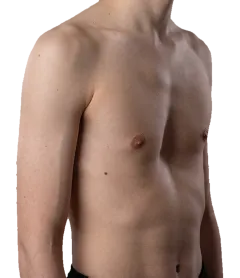
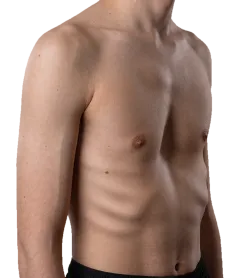
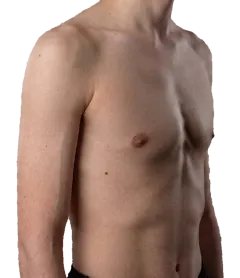
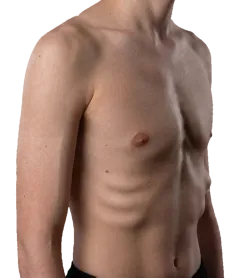
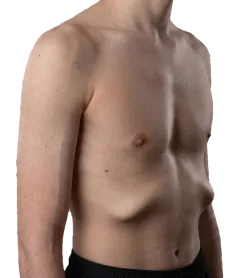
The non-surgical route for a sunken chest.
Your breastbone sits deeper than the ribs around it, so the middle of your chest looks like a dip or a hollow. It's the most common chest wall condition there is, and if your chest is flexible, it moves without surgery.





Joined by 1,000+ people fixing their chest without surgery, since 2015
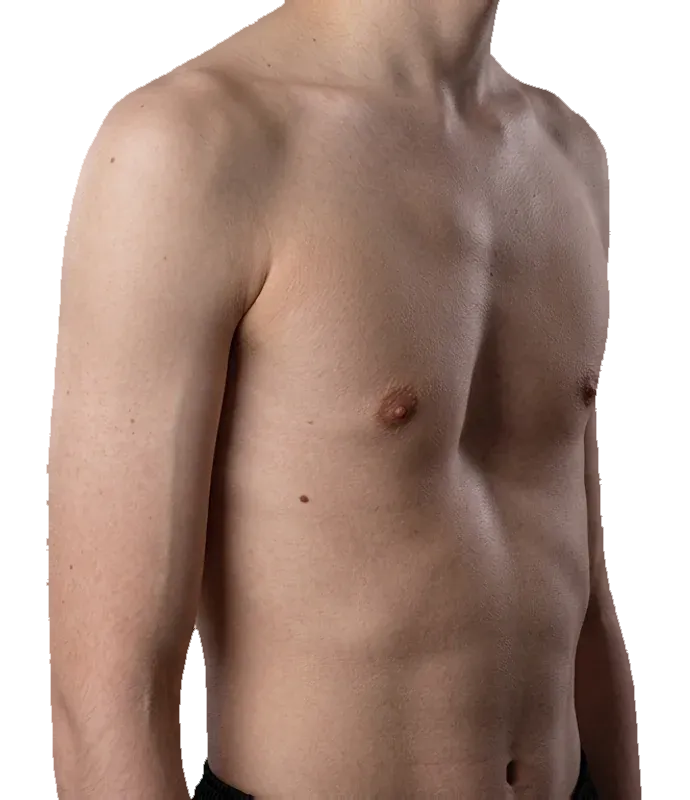
In plain words.
Cartilage, not bone
Costal cartilage is the springy strip that joins each rib to the breastbone. Yours grew longer than it needed to and pushed the sternum inward. Cartilage stays pliable for years, and that's the reason a bell can lift it.
It usually gets deepest in your teens
A dip that was barely there at ten often gets deeper fast during a growth spurt. That's also when the chest moves most easily, so starting early is worth a lot.
Flexibility beats severity
How deep the dip is matters far less than how much it gives when you press on it. A deep but springy chest usually responds better than a shallow, rigid one.
You didn't cause it. Not with bad posture, not by skipping push-ups as a kid, not by sleeping face-down. And it isn't automatically a case for surgery. Surgery is the right answer for some chests. But in a 278-patient review of vacuum bell therapy, only 15.5% went on to have it, and none of them came from the group that reached an excellent correction.
Read the full guide: what pectus excavatum is and how severe yours is
Steady lift, for enough hours, over enough months.
A vacuum bell seals against the chest and pulls the sternum outward. Hold it there long enough and often enough, and the cartilage remodels around the new position instead of springing back to the old one. There's no trick to it. Two things decide the outcome: how flexible your chest is on day one, and how many hours a week you actually wear the bell. Training and breathing work hold what the bell gains. On their own they change how the chest looks, but the bell is what moves the sternum.
- Patients reviewed
- 278
- A single-centre review of vacuum bell therapy. Chest wall flexibility and a milder starting depth were the strongest predictors of an excellent correction.
- Compliant vs not
- 28% vs 16%
- Patients who averaged about 28 hours a week corrected nearly twice as much as those who didn't. Weekly hours were the strongest single predictor of success.
- Went on to surgery
- 15.5%
- In the same review. None of them came from the group that got an excellent result with the bell.
Start at the bottom.
They're in order, cheapest first. Each one adds something the one below it doesn't. Most people start at 01 and stop when their chest doesn't need any more.
- 01The free pectus excavatum planThe whole method written out: what the research shows, who it works for, and a three-phase plan you can start tonight.AddsEverything you need to start, without owning any equipment.Free
- 02Vacuum bellThe device that does the lifting, built to your chest measurements and shipped to you.AddsThe mechanical part. This is the step where the sternum actually starts to move.$399
- 03Vacuum Bell GuidePressure, session length, weekly hours, skin care, and how to progress each of them without going backwards.AddsA schedule. Without one, a bell is a gadget you own, not a plan you're following.$29
- 04PE Exercise ProgramSixteen weeks of training and breathing, written in gym and home versions.AddsMuscle and posture to hold the position the bell opens up, and to fill out a frame that makes the dip look deeper than it is.$67
- 05Pectus Excavatum CourseComing soonThe complete non-surgical method on video, in order, with the reasoning behind every step.AddsBeing shown, not told, plus the judgement calls a written plan can't cover.$197
- 061-on-1 coachingI build your plan around your measurements and severity, fit your equipment, and rewrite the plan every two weeks.AddsMe, looking at your chest specifically. You can message me in the Trainerize app between check-ins.$199/mo
None of this is behind a price.
Long answers on a sunken chest, written out in full. No sign-up and no email for any of them. Start with whatever you want to know.
- What it isPectus Excavatum (Sunken Chest): What It Is and Your Options15 min
- TrainingPectus Excavatum Exercises: Bench Press, Running and Gym16 min
- Vacuum bellVacuum Bell Therapy for Pectus Excavatum: Results and Risks18 min
- BreathingPectus Excavatum Breathing Exercises: Balloon and Trainer12 min
- PosturePectus Excavatum Brace: Types, Evidence and Who It Suits14 min
- SurgeryPectus Excavatum Surgery: Nuss vs Ravitch, Recovery, Risks17 min
- After surgeryNuss Bar Removal: When It Comes Out, Recovery and Risks12 min
- SymptomsCan Pectus Excavatum Cause Heart Problems? The Research14 min
- SurgeryRavitch Procedure for Pectus Excavatum: Recovery and Risks17 min
Transformations
& Real Stories
Read them by rating, or by what people actually got out of it - the transformations, the honest reviews, and the messages that land in my inbox every week.




"I came across your blog about a year ago and I just want to say how much you've changed my life for the better. I thought it was going to be another average article, but the tips you gave were things I hadn't heard of before. Now I've improved so much and im more confident then ever."
"read the blog for months before i actually did anything with it. no coach, no brace, just the stuff in the articles done properly. i feel a lot better now and the photos say the rest"
"Two months in and I've put on 3 kg of muscle. My chest doesn't cave the way it used to when I'm standing relaxed, and that alone was worth it."
"the bell leaves a red ring on your chest the second you take it off, and nobody warns you about that. it fades within the hour and the skin has never been an issue since. 100% satisfied - the sternum sits higher than it has my whole life"
"He knows more about this than the two consultants I paid to see, which says more about them than it does about him. Showed my GP the 9 month photos and he asked me for the website. Half a star off because the time zones make the calls a nightmare from Ireland."
"watched the youtube for six years before i spent a single cent. bought the program, did it properly for 7 months, and the only thing i actually regret is the six years"
"Had the flare since i was about 14 and just assumed that was my ribcage, permanently. Brace plus the breathing drills and my mrs asked when i'd lost weight. I hadn't lost anything, it's just the ribs sitting where they should now."
"first call he told me straight up itd take a year and id hate months 2 through 5. he was right about both lol. 12 months on and my PC is flat. took my shirt off at the beach in january without doing the whole towel thing"
"didnt know you could be breathing wrong for 21 years. thats the whole thing right there. flare started going down on its own once i stopped breathing into my shoulders, which is not what i paid for but ill take it"
"the brace is made really good, i wear it under the t-shirt at school and nobody has noticed in 4 months. my mother was crying when we compare the photos. sorry for my english"
"ive bought like four programs for this over the years and quit every one of them by week two. finished this one. i think its cus you cant move on until you can actually hold the position, so theres never that thing where you're guessing if youre ready or not"
"My son is 15 and had started keeping a shirt on in the pool, which is how I worked out something was wrong in the first place, because he certainly wasn't going to tell me. He would never have stuck with the brace on his own. It was the fortnightly check-ins that did it - he didn't want to turn up with nothing to report. Six months now and the bump has visibly come down. He swims without the shirt."
"I went in wanting to debunk it, honestly. Started opening the citations one at a time and they were real papers that said what he said they said. That is a depressingly low bar and nowhere else online clears it."
Shared with each client's permission.
Did I help you with your pectus?
Share your before & after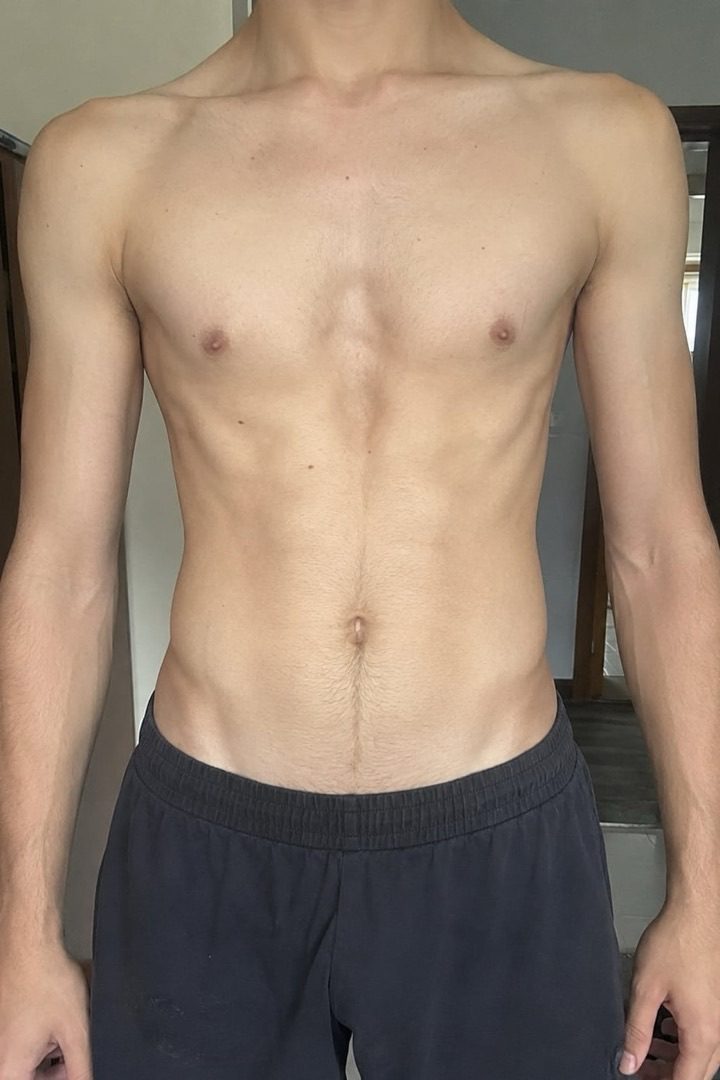 Before
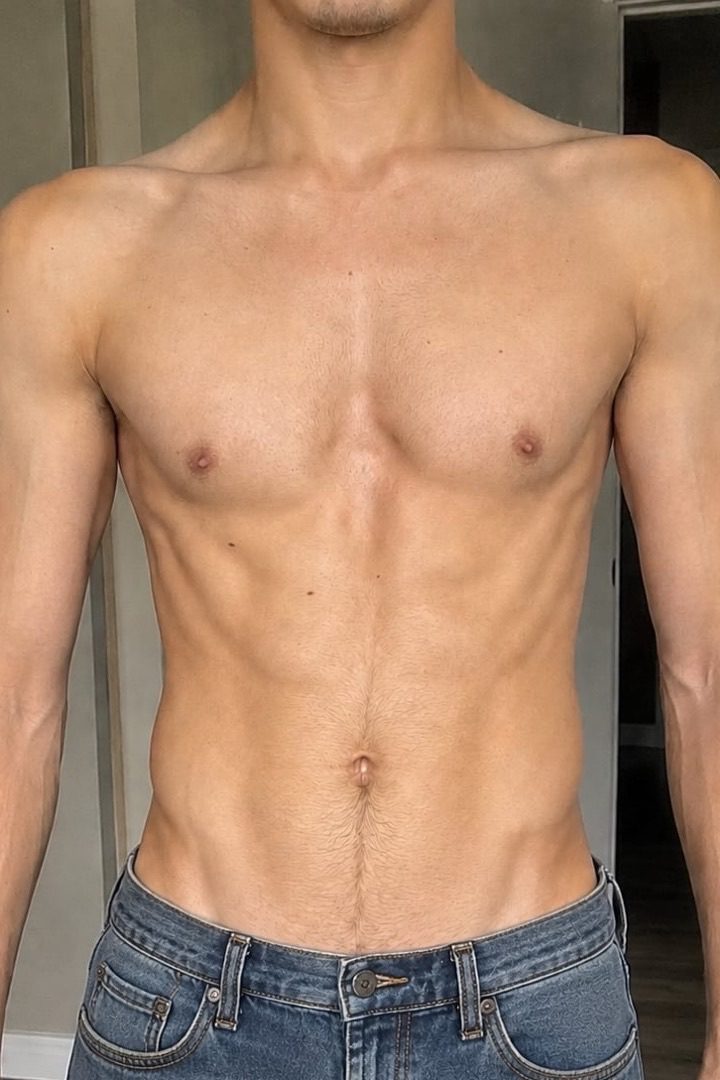 After
 Before
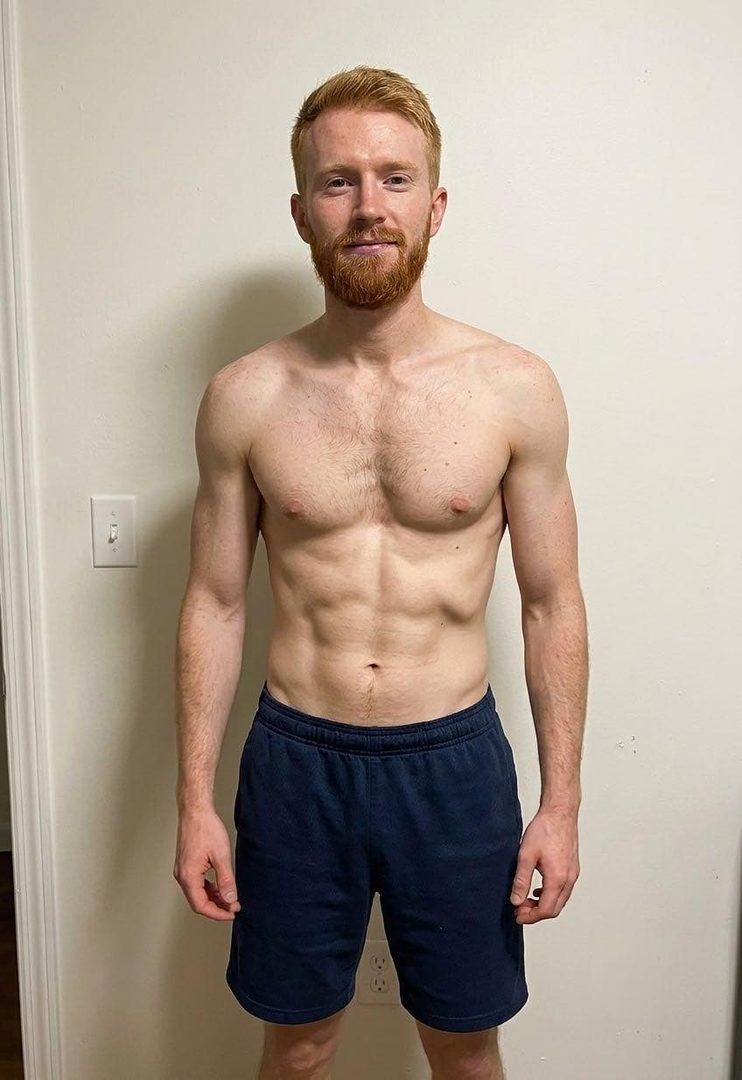 After

“I'm 32. Everything I ever read said the window on this shuts at 18 and after that you either get cut open or you live with it. Nine months, 5 kg on, 1 cm off the depth. Nobody is more annoyed about the wasted decade than me.”
 Before
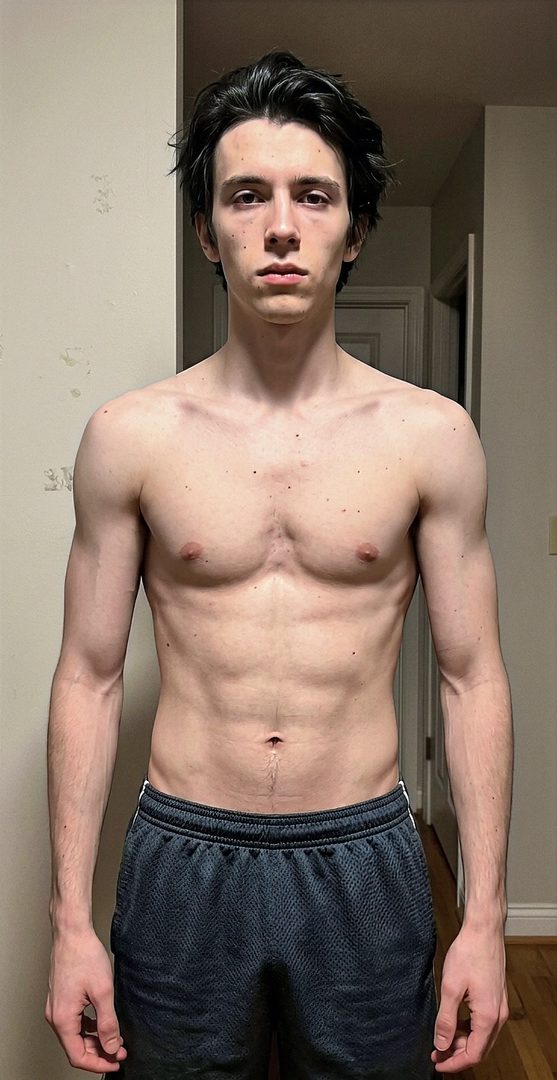 After

“came in skinny with a deep dip and ribs that stuck out at the bottom. six months, 4kg up. funny thing is nobody says anything about the dip, its the flare going down that people actually noticed”
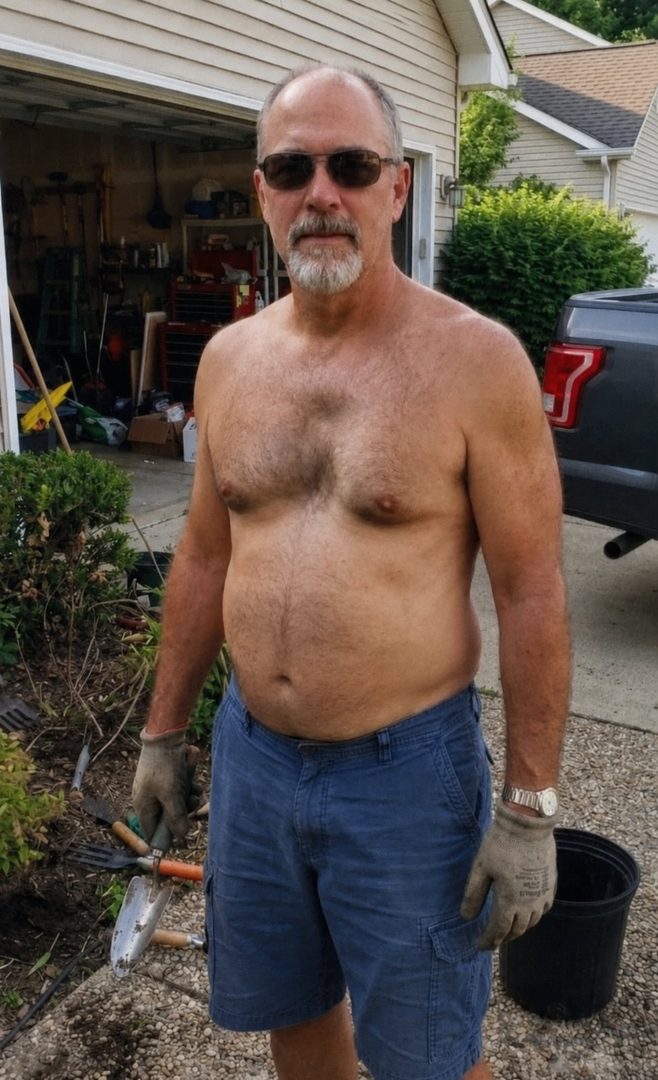 Before
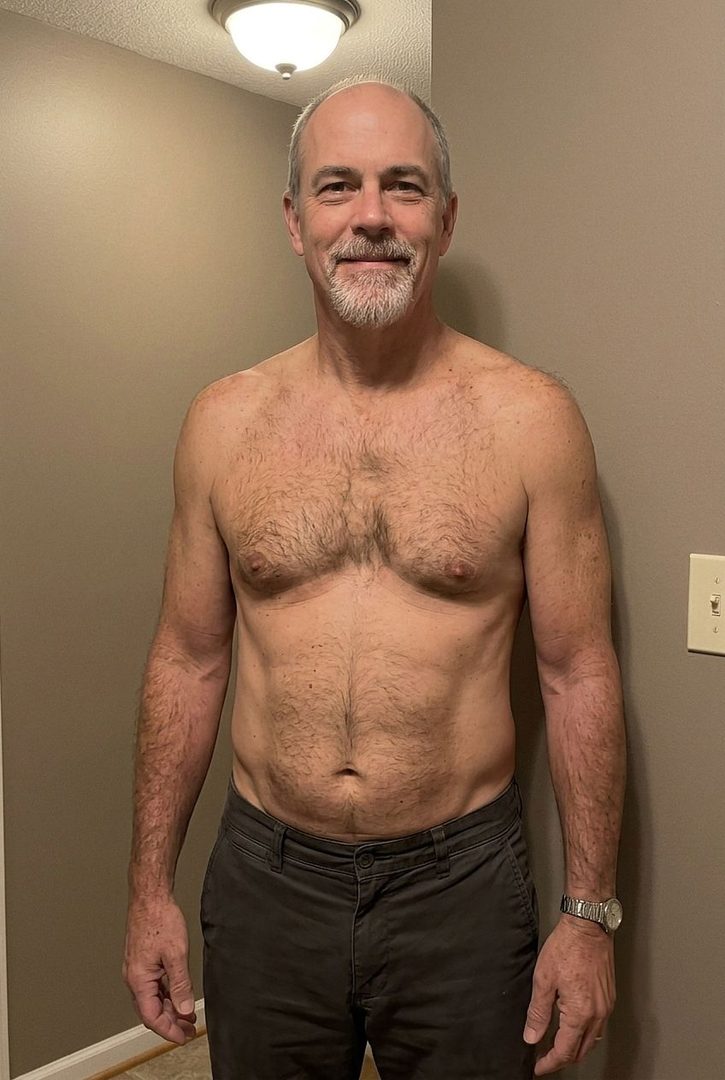 After

“I'm 52. I have both a bump and a dip, which I'm told is unusual, and I've had the pair of them since I was a boy. Nine kilos off in five months and for the first time my chest looks like one chest. I did not expect to be sorting this out at my age, but there we are.”
PE pectus excavatum · PC pectus carinatum · RF rib flare
Drag each slider to compare.Tap any case to open and compare. Published only with the client's written consent.
The ones I get most.
Am I too old for this to work?
Older chests are stiffer, so they take longer and often correct less. But the compliance study concluded that for a highly compliant patient, therapy can be effective regardless of age or severity. The cases on this page include men in their thirties. Age changes how long it takes and how far it goes. It doesn't change whether it's worth trying.
How long before I see anything?
Most people notice the dip filling slightly within two to three months, and measure a real change in chest depth somewhere between month four and month nine. It's slow, and it doesn't move in a straight line. Photograph and measure once a month. Checking the mirror every day tells you nothing.
Can exercise alone fix it?
Not the sternum. Training builds the chest, back and shoulders around the dip. That changes how it looks, sometimes a lot, and it's worth doing. But bone and cartilage move under sustained mechanical pull, and that's the bell's job. Anyone selling you exercises as a complete correction is overselling.
Do I need the bell if my case is mild?
Mild and flexible is the type that responds best, so the bell is, if anything, a better bet for you than for a severe case. Still, start with the free plan. If a mild dip mostly bothers you because of how it looks, training alone may take you far enough.
Is a vacuum bell safe?
At sensible pressure it's well tolerated. Expect redness that fades within an hour, and sometimes a little swelling early on that passes. Stop and reassess if you get bruising that doesn't go away, broken skin, chest pain, dizziness or breathlessness. If you have a known heart, lung or connective-tissue condition, clear it with a doctor before you start.
Should I just have surgery?
For a rigid or severe chest, or when the dip is pressing on the heart or lungs, surgery is a legitimate answer and often the better one. A surgeon should assess you for that. What I object to is being told surgery is the only option before anyone has checked if your chest is flexible enough to move without it.