Contents · 10 sections
My bottom ribs used to sit so far forward that you could read them through a t-shirt. They came down, and not because anyone operated on me.
Most of what you will read about flared ribs treats them as a bone problem. For the majority of people they are not. They are what a ribcage looks like when the diaphragm has stopped sitting over it, and that is trainable.

First, check that it is actually rib flare
A lot of people arrive at this page having diagnosed themselves from a bad photo. Two checks sort it out in about a minute.
The resting check
Stand relaxed in front of a mirror, arms at your sides, and breathe out fully. Not a polite exhale - push the last of the air out until your stomach tightens on its own.
If the lower ribs settle flat against your torso at the bottom of that exhale, you do not have a structural flare. You have a breathing pattern that keeps your ribcage parked in the inhaled position. That is the most common version and the most responsive one.
If the bottom ribs still jut past the line of your waist at full exhale, keep reading. There is something structural underneath.
What a flared ribcage looks like next to a normal one
A normal costal margin angles gently inward and sits flush with the torso, so the softest part of your outline is the waist. The ribs are there, and on a lean person you can see them, but they follow the body rather than interrupt it.
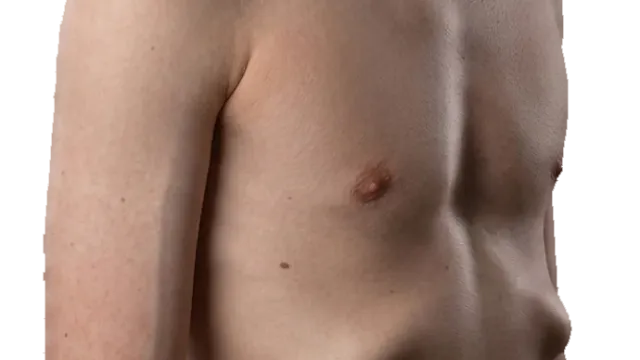
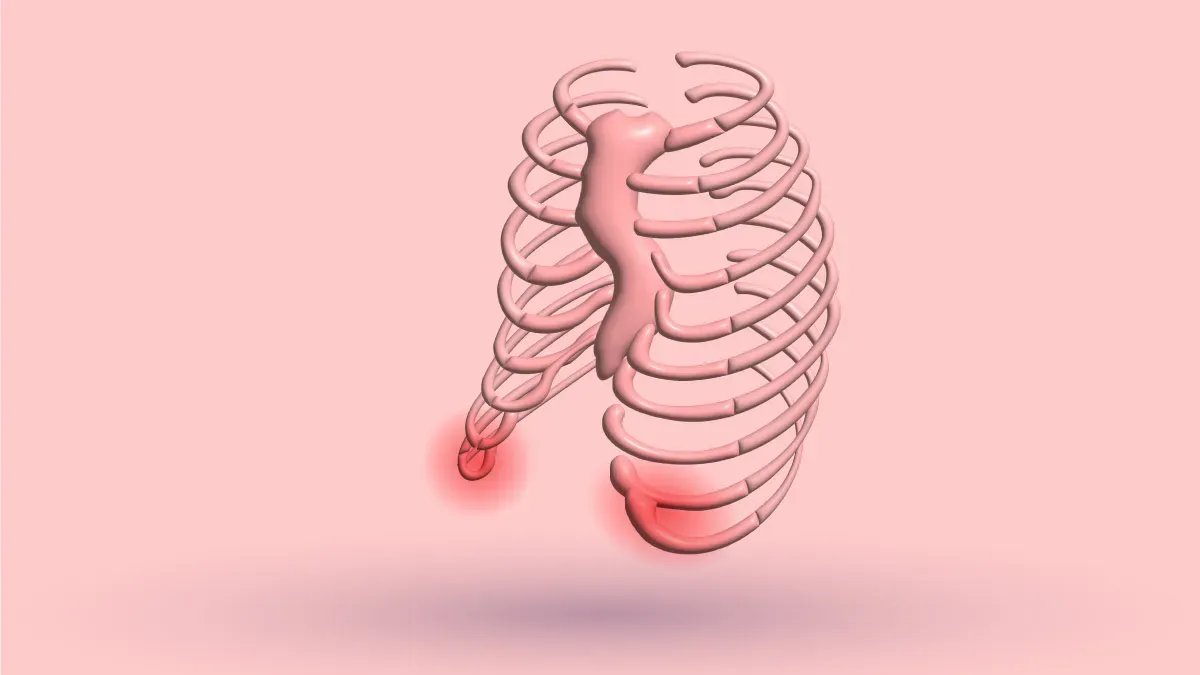
A flared margin does the opposite. The bottom ribs turn outward and upward, so the widest point of your torso is the base of your ribcage instead of your hips or shoulders. In profile the front of the lower chest sits ahead of the abdominal wall.
| Normal costal margin | Flared costal margin | |
|---|---|---|
| Widest point of torso | Shoulders or hips | Base of the ribcage |
| Margin at full exhale | Settles flat to the torso | Still protrudes |
| Angle of the lower ribs | Turns inward and down | Turns outward and up |
| Gap from ribs to pelvis | Short | Visibly long, front of the body looks open |
| Through a t-shirt | Not visible | Two bumps either side of the sternum |
The confusing part is that being lean makes a normal margin visible, and people mistake visibility for flare. If your ribs show but the outline of your torso still narrows below your chest, they are just ribs.
The compression test
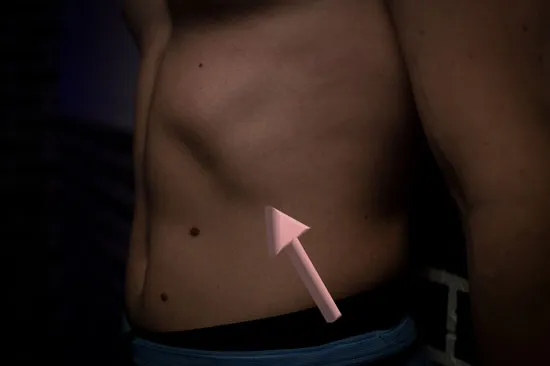
Press the protruding ribs inward with the flats of your hands, firmly but without forcing. If the margin gives and the contour improves, the chest wall is still flexible, and flexible chest walls respond to pressure and to training.
If it barely moves, the cartilage has stiffened. That does not mean nothing can be done, but it does change which tools are realistic and it makes the conversation about bracing or surgery a real one rather than a last resort.
Age is the variable that matters most here. Costal cartilage stiffens as you get older, which is why the same approach that reshapes a fifteen-year-old’s ribcage does much less on a forty-year-old’s.
Find out which kind you have
Three different things get called rib flare. They need different work, which is why generic rib flare advice fails so often.
Flare that comes with pectus excavatum
This is my case, and it is the one this site knows best. A 2021 Brazilian study split pectus excavatum into three patterns: a deep depression with minimal flare, a depression and flare in equal proportion, and minimal depression with dominant flaring.
That third pattern is mine, and the study made a point that matches what I hear constantly - the flare, not the dip, is often the patient’s main complaint. Dr. Antonio Vendrami Malucelli, who has evaluated more than 2,400 pectus patients, noted that around half of them had flared ribs.
The mechanism is straightforward. The sunken sternum leaves the diaphragm without a flat surface to pull against, so it drags the lower costal cartilage outward instead. Fix the breathing mechanics and you take the outward pull off. You do not reshape the sternum by breathing, but you do stop it being made worse.
If this is you, the pectus excavatum hub covers the parent condition, and the flare work below still applies.
Flare that is really overextension
Here the ribs are a normal shape. The lumbar spine is over-arched and the pelvis is tipped forward, which opens up the distance between the bottom of the ribcage and the top of the pelvis. The ribs are not sticking out. They are being carried up and away from the pelvis.
You can tell this one apart quickly: lie on your back with your knees bent, flatten your lower back into the floor, and breathe all the way out. If the flare largely disappears in that position, it was postural.
This version responds fastest of the three, and it responds to positioning rather than to anything heroic.
Flare from scoliosis or a structural cause
A rotated thoracic spine turns one side of the ribcage outward and the other inward. That is why flare is so often one-sided, and why it is more common on the left.

Left-side flare tends to travel with a right lumbar rotation and a compensating left thoracic rotation. The ribs on the left rotate externally and the ones on the right tuck in, which is also why one shoulder often sits higher than the other.
If your flare is clearly one-sided, get the spine assessed before you spend six months on breathing drills. Symmetrical work on an asymmetrical structure does not do much. A congenital difference or an old rib fracture belongs in the same category - worth having someone qualified look at it first.
What tends to travel with it
Rib flare rarely turns up on its own, and the things that come with it are often what push people to do something about it.
The pattern I see most is a set of linked findings rather than a list of separate problems. Shoulders that sit forward and rounded. A head carried in front of the body. Tight chest muscles alongside a back that cannot generate much. A lower back that arches more than it should, and a stomach that looks distended even on someone lean, because the front of the torso is being held open.
Two of these are worth singling out. The first is breathing. If your ribcage is parked in the inhaled position you never fully empty your lungs, so you breathe shallowly and often, from the top of the chest. People describe it as never quite getting a satisfying breath.
The second is shoulder function. Your shoulder blade has to glide across the back of your ribcage, and it needs a ribcage that is the right shape and in the right place to glide on. When that is off, the shoulder borrows range from elsewhere, which is why scapular winging and nagging shoulder pain turn up so often alongside a flare.
None of this is dangerous by itself. It is a reason to treat the flare as a mechanical problem worth solving rather than purely a cosmetic one.
The one thing that actually closes a flare
Every method that works, works by the same mechanism, and it is worth understanding rather than memorising exercises.
Your diaphragm is not just a dome. A section of it lies flat against the inner wall of your lower ribs, and that contact area is called the zone of apposition. When the zone is intact, the diaphragm pulls the lower ribs down and in as it contracts.
When your ribcage is stuck in an inhaled position, that contact area shrinks. The diaphragm loses its purchase on the ribs, the abdominal wall loses its leverage, and nothing is left holding the bottom of the ribcage down. The flare is the visible result.
So the whole job is: get the ribcage down, then learn to breathe without letting it come back up. Everything below serves that.
Being straight with you about the evidence here - there are essentially no controlled trials of conservative rib flare correction. This is reasoning from mechanism, not from trial results, and anyone quoting you a success percentage is inventing it.
Get the ribs down first
Lie on your back, knees bent, feet flat. Exhale through pursed lips as though you are blowing out candles, and keep going past the point where you would normally stop.
Somewhere near the end of that exhale your abdominal wall engages on its own and you will feel the lower ribs drop. That position, at the bottom of the exhale, is the position you are trying to teach your body to live in.
Now breathe in without losing it. That is the hard part, and it will feel like you cannot get enough air at first. You can - your body is simply unused to breathing from a ribs-down position.
Then learn to keep them there under load
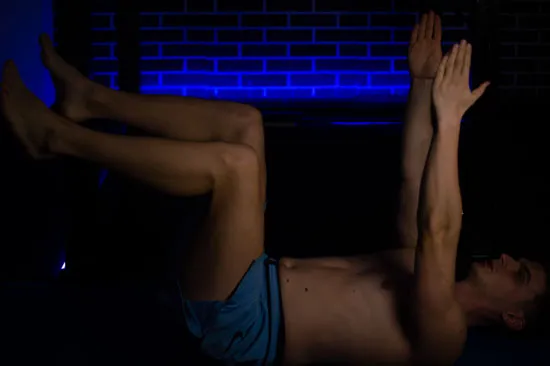
The core work that matters for rib flare is anti-extension work: exercises where the job is to stop the lower back arching and the ribs lifting. The dead bug is the clearest example. Ribs stay down, lower back stays in contact with the floor, and a limb moves without any of that changing.
This is why crunches do nothing for flare. Crunches train the abs to shorten. What you need is abs that hold a position while you breathe and move, which is a different quality entirely.
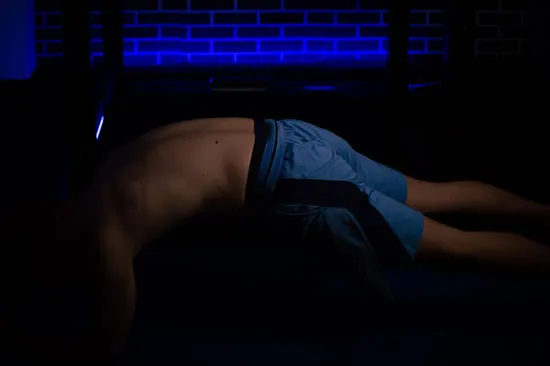
The same principle governs the plank with a posterior pelvic tilt, the side plank with a reach, and the overhead reach with the ribs held down. In each one the ribcage and pelvis are being stacked and taught to stay stacked.

Overhead movement deserves its own mention. If you lift your arms and your ribs flare to let them go up, you have found your restriction. Practising overhead reaching without letting the back arch transfers directly into pressing, pull-ups and anything else you do overhead.
Every exercise I used, with sets and reps, is in rib flare exercises. I have also written the full progression out as a free plan: the non-surgical rib flare plan gives you the phases, the order and how to measure whether it is working. No email required.
Free up what is holding the ribs open
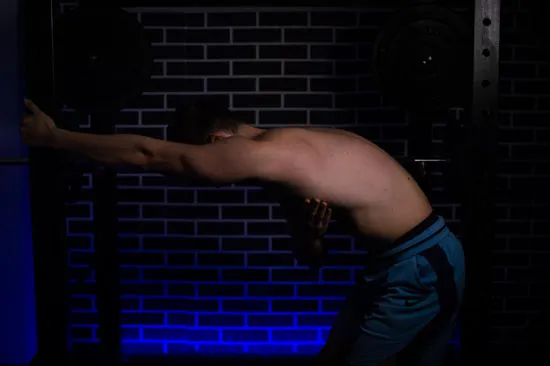
Tight lats pull up on the pelvis and hold the ribcage open, so nothing you do at the front will hold if the back is locked. A doorway lat stretch held for around a minute a side, and the same for the pectorals, is enough to make the breathing work possible.
One warning about foam rolling: stay off the lower ribs themselves. That area is thinly covered and easy to injure. Roll the lats high, near the armpit, and leave the costal margin alone.
Hold the position when you are not training
This is the part that separates people who fix a flare from people who own an impressive collection of exercises.
Your ribs are in the flared position for the sixteen hours a day you are not training. Twenty minutes of good work does not outvote that. What changed things for me was carrying the position around: a gentle abdominal engagement while walking, sitting, standing in a queue, holding it as long as I could and then letting go.
Set a recurring alarm if you need to. When it goes off, breathe out fully, let the ribs settle, and carry on. It is unglamorous and it is the single highest-return habit in this article.
Where braces and bandages fit
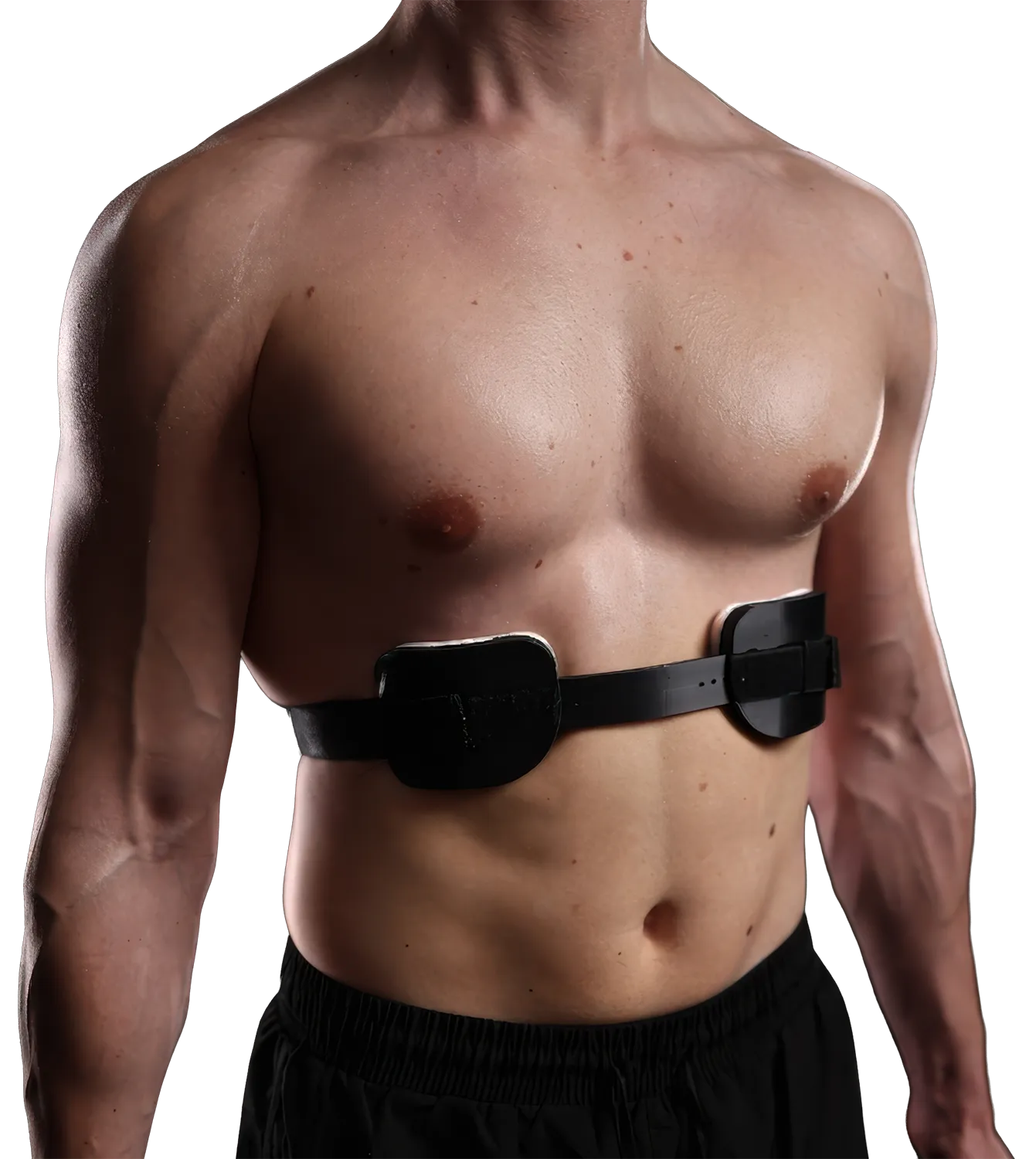
External compression is a real option, and it works on the logic of Wolff’s law: bone and cartilage remodel in response to consistent load. It only works while the chest wall is still flexible, which brings you back to the compression test at the top of this page.
That is me in the brace above. The pads sit on the costal margin itself, not on the sternum, which is the difference between a rib flare brace and the carinatum braces people often buy by mistake.
Prof. Dr. Mustafa Yüksel, founder of the Chest Wall International Group, treated rib flare surgically until 2018, when his team adopted a bandage treatment instead. He has said publicly that he observed patients correcting within three to six months, that the bandage needs to be worn at least eight hours a day, and that it becomes harder to treat this way with age.
That last point is the one to take seriously. If you are young and your chest wall passes the compression test, this is the window. If you are in your thirties or older with a stiff margin, expect compression to do less.
A 2021 study reported that protruding ribs could be treated with a CDTA 2 orthosis, and bracing is generally paired with the training rather than used instead of it. The two are not alternatives. Compression changes the structure slowly; the breathing and core work changes what holds the structure day to day.
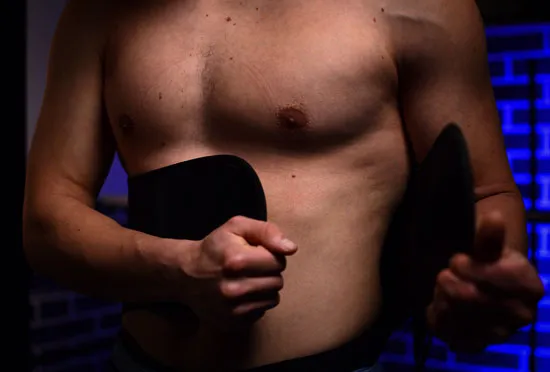
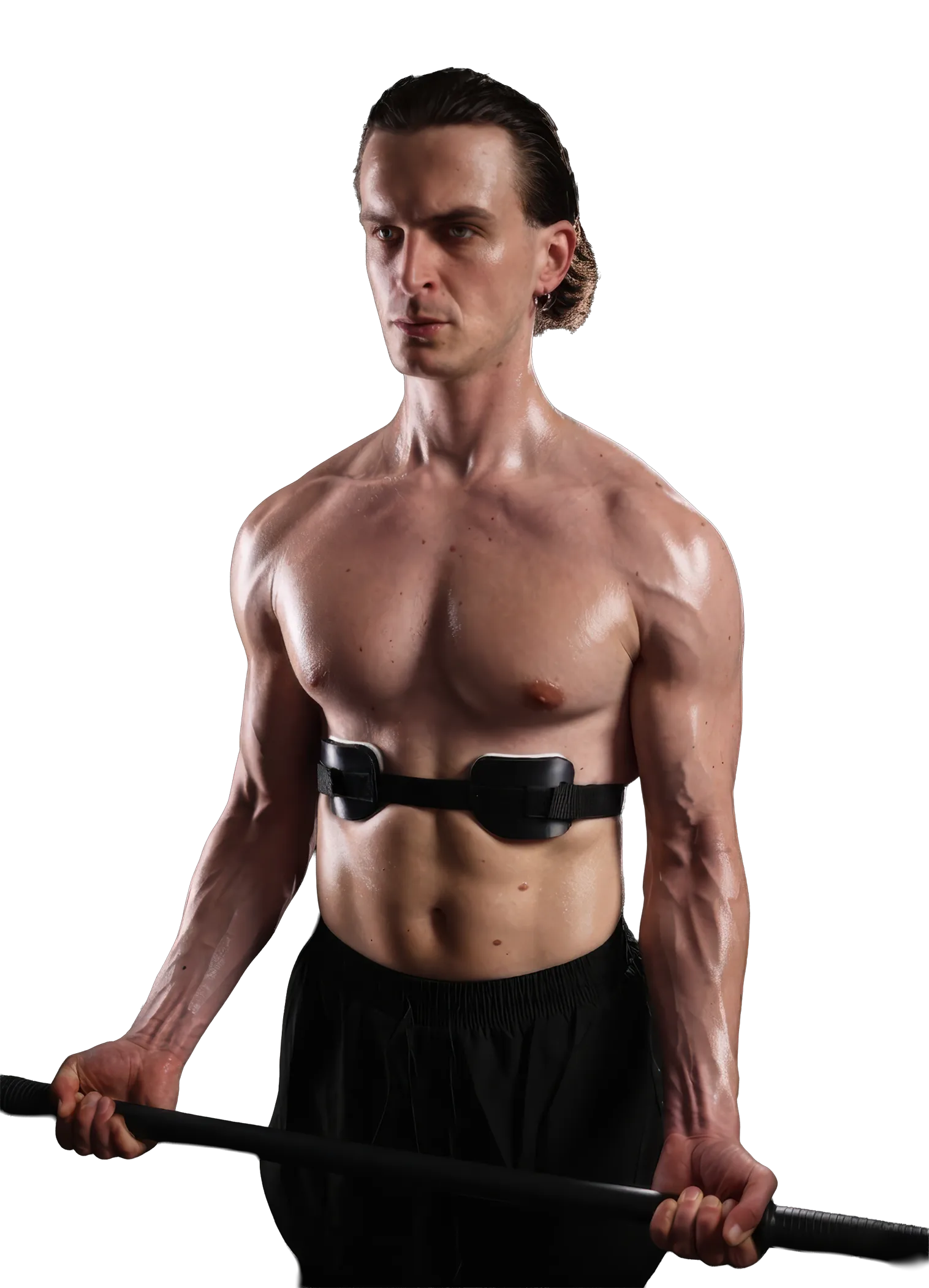
Which is why I trained in it. The brace is doing the slow structural work in the background while the session does the part that teaches your body to hold the ribs down on its own, and wearing it under a t-shirt makes the hours easy to accumulate.
If you want the detail on fit, wear time and what to expect, the rib flare brace page covers it properly.
When surgery is the honest answer
Most people reading this do not need surgery. Some do, and pretending otherwise helps nobody.
A point worth knowing if you are heading for pectus surgery anyway: correcting the excavatum does not reliably correct the flare. Dr. Shyam Kolvekar, a consultant cardiothoracic surgeon in London, has explained that the Nuss procedure moves the sternum forward and often lifts the costal margin enough to reduce the flare, that in some people it disappears, and that occasionally severe flare still needs bracing afterwards. Surgeons generally cannot predict which outcome you will get.
Some patients see the flare stay the same or look worse after a Nuss, because the sternum has moved forward and the costal margin has not. Where that happens, a subperichondrial partial resection of the costal arch cartilage can be added.
For flare with no other deformity, there is a minimally invasive operation developed specifically for it, since most surgical techniques for flare were designed as add-ons to pectus repairs rather than as standalone procedures.
Raise it with a chest wall specialist rather than a general surgeon. Rib flare on its own is not something most surgeons see often.
What actually happened to my ribs

I kept my shirt on at pool parties in summer heat and invented reasons why. That went on for years, mostly because I assumed it would sort itself out and partly because I could not find anyone treating it as fixable.
Surgery was not open to me in any case. My Haller Index came in under 3.25, so insurance would not cover it, and the activity restrictions afterwards did not fit a life built around training.
What changed it was an appointment with Dr. Blagoja Gjorgjieski, a physiatrist and yoga professor at the hospital in my hometown of Prilep, who told me the flare could be improved without surgery. The work was breathing mechanics, core strength, posture, and consistent bracing, run for a long time rather than run hard.
The flare came down and the chest and shoulder pain went with it. I am not going to give you a millimetre figure, because I did not measure it properly at the time and inventing one would be worse than saying nothing.
How long this takes
Longer than you want, and the honest answer depends on which kind you have.
Postural flare, the overextension version, changes fastest. People often see a visible difference within weeks, because nothing structural has to remodel - you are changing where your ribcage is parked.
Structural flare is a different timescale. Yüksel’s three to six months with the bandage is the closest thing to a published figure, and it applies to compression on a flexible chest wall in a younger patient. Training alone, without compression, is slower.
Two things predict the outcome more than anything else: how flexible your chest wall is when you start, and whether you carry the position through the day rather than only during exercise. Age drives the first. You drive the second.
Frequently asked questions
Is rib flare dangerous?
On its own, no. It is a mechanical and cosmetic issue for most people. What can matter is what comes with it - a compromised breathing pattern, shoulder and lower back pain from a ribcage that is not stabilising the spine well, and in one-sided cases the spinal rotation underneath. If you have chest pain, breathlessness or a clearly asymmetric ribcage, get assessed properly rather than self-treating.
Can rib flare actually be fixed?
The postural kind, yes, and often substantially. The structural kind improves rather than disappears, and how much depends on how flexible your chest wall is and how old you are. Anyone promising a complete fix without examining you is guessing.
Are flared ribs genetic?
The chest wall shape you start with is largely inherited, and pectus excavatum runs in families. The breathing pattern and posture that turn a mild shape into a visible flare are not inherited. That split is why two people with the same underlying build can look very different.
Is rib flare permanent?
Not in the sense people usually mean. Cartilage remodels slowly under consistent load, which is the whole basis of brace therapy, and the postural component can change at any age. What is true is that the older you are, the stiffer the cartilage and the more of the change has to come from position rather than from remodelling.
Why is only one of my ribs flared?
Almost always spinal rotation, most commonly a thoracic rotation that turns the left ribs outward. It can also follow an old rib fracture or a long-standing habit of sitting twisted. One-sided flare is the case that most needs assessing rather than self-training, because symmetrical exercises will not correct an asymmetric structure.
Will ab exercises fix flared ribs?
Crunches and sit-ups will not, and can make the appearance worse by shortening the front of your torso while leaving the ribcage where it is. Anti-extension work will help, because it trains your abs to hold the ribcage down rather than to curl it forward.
Does the Nuss procedure fix rib flare?
Sometimes. It moves the sternum forward and frequently lifts the costal margin enough that the flare reduces or goes. It is not reliable, surgeons cannot predict it in advance, and in some patients the flare is unchanged or looks more prominent afterwards because the sternum has moved and the margin has not.
I have pectus excavatum too. Which do I work on first?
The same work serves both. Restoring the zone of apposition and building anti-extension core strength is the foundation of non-surgical pectus work and of flare work. If you are using a vacuum bell for the excavatum, the flare work runs alongside it rather than competing with it.
Can I still fix this as an adult?
Yes, with a realistic target. The postural component responds at any age. The structural component responds less as cartilage stiffens, so an adult should expect improvement rather than resolution, and should weigh compression earlier rather than treating it as a last step.
Do rib belts or binders work?
A purpose-made compression brace fitted for chest wall deformity is a different object from a generic rib belt. Generic binders apply pressure in the wrong place, restrict breathing, and work against the diaphragm mechanics you are trying to restore. If you are going to use compression, use something designed for this.
If you want the exercises in order rather than as a list, the free rib flare plan lays out the phases and how to measure progress. If you are not certain which of the three kinds you are dealing with, rib flare treatment without surgery walks through the whole route from free to hands-on, and the rib flare course puts all of it in order on video.
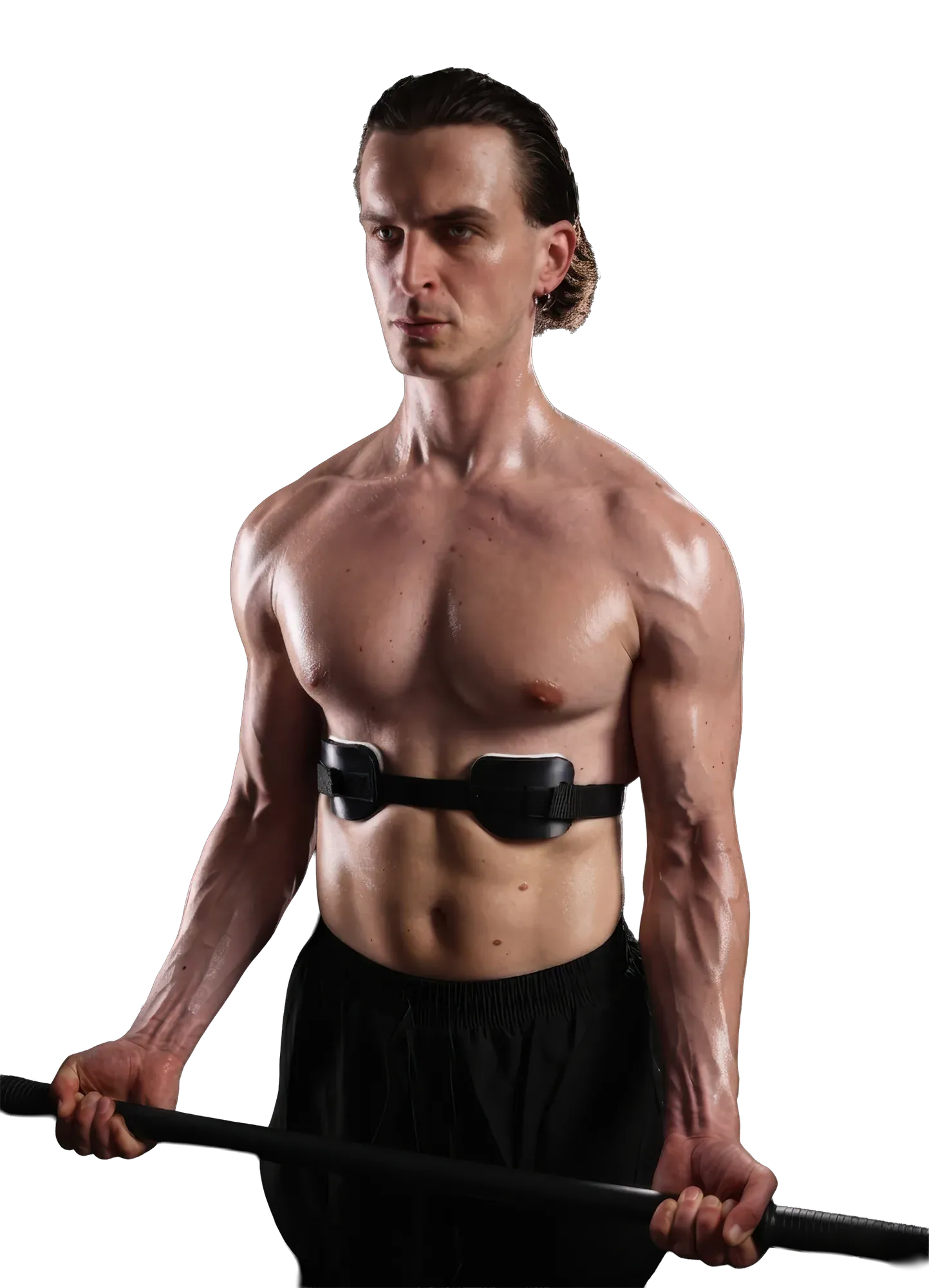
Flared ribs are a breathing and bracing problem before they are a core problem. The course is the sequencing that closes them, in the order it has to happen.
- The diaphragm work that pulls ribs down
- Anti-extension core that holds the position
- How to tell a flare from a carinatum

This article is for educational purposes only and does not constitute medical advice. Always consult a qualified healthcare professional before starting any treatment plan. View full disclaimer →