Contents · 11 sections
Someone told you to blow up balloons, or you found a breathing routine online, and you’re hoping it will push your chest out. It won’t. Breathing exercises don’t lift your sternum, the breastbone that sits too far back in pectus excavatum, and the dip only looks shallower while your lungs are full.
Breathing work still has a real job. It trains the muscles you breathe with, and some surgical teams pair it with the vacuum bell and build it into recovery after the Nuss procedure. Below: the safety rules, three drills with the source of every dose, and where breathing fits around a bell, a brace or surgery.
I had pectus excavatum, diagnosed at 15, and corrected it without surgery over about three years. The result was visible and measurable, but not complete. I’m a Level 5 certified personal trainer, not a doctor, so my own suggestions are labelled as my coaching.
What breathing exercises can and can’t do
In October 2026 I searched PubMed for pectus excavatum studies of breathing exercises, balloons or breathing trainers. I couldn’t find a trial of any of them on their own, or anything showing that breathing moves the sternum.
The closest is a trial of 50 children in Ankara comparing home breathing and posture exercises with and without hospital exercise sessions, measuring breathing-muscle strength. It finished in May 2026 and has no published results yet.
The rest comes from outside pectus. In a review of 46 studies in healthy people, breathing-muscle training improved endurance performance, and reviews of athletes point the same way. Your diaphragm, the dome-shaped muscle under your lungs that does most of the work at rest, responds to training too: in healthy adults, it got moderately thicker.
| Breathing work can | Breathing work can’t |
|---|---|
| Strengthen the muscles you breathe in with | Lift your sternum or lower your Haller index |
| Improve endurance in healthy people and athletes (not yet studied in pectus) | Replace a vacuum bell, a brace or surgery |
| Give you a slower, calmer, fuller breath | Replace your hospital’s breathing plan after surgery |
| Help you practise holding the lower ribs down |
Why the dip looks shallower when you breathe in
The Haller index is a number from a chest scan: the width of your chest divided by the distance from your breastbone to your spine. The higher it is, the deeper the dip, and it changes with your breath.
| Scan taken at | Median Haller index (47 patients before surgery) |
|---|---|
| A full breath in | 3.96 |
| A breath out | 5.09 |
| A quiet breath-hold | 5.16 |
In that MRI study from Cincinnati Children’s, 8 of the 11 patients under 3.25 on a full breath in were over 3.25 on the breath out. 3.25 is a common threshold for surgical referral, so the same chest can land on either side of it. A 2023 real-time MRI study of 56 patients found the index higher on the breath out in 55 of them, by a median of 1.1, varying with how deeply people breathed in. The authors recommend measuring at the end of a quiet breath out.
So the shallower look on a big breath is your chest changing shape with the air inside it, and it goes back when you breathe out. Measure at the end of a relaxed exhale, never straight after a breathing session, lying flat with no pressing, as in my measurement guide.
Before you start
See a doctor first if you have a diagnosed heart or lung condition, a Haller index above 3.25 with symptoms, previous chest wall surgery, pain, breathing difficulty, unchecked symptoms, or Marfan or Ehlers-Danlos syndrome, the same list as in what pectus excavatum is.
Ask before forceful blowing or a breathing trainer if you’ve had a collapsed lung (a pneumothorax), have a perforated eardrum, or had chest surgery recently. The evidence is thin (one report of two cases, a CT study finding small air blisters on the lungs of teenagers with chest wall deformities, and trainer makers’ warnings), but it’s enough for me to say ask first. The signs of a collapsed lung are in my post on smoking with pectus excavatum.
Children and breathing trainers. I couldn’t find a study of resistance trainers in growing children with pectus excavatum, for or against. Ask your child’s doctor before buying one.
When to slow down or stop. Breathing too fast or too deep lowers the carbon dioxide in your blood, which MedlinePlus says can cause dizziness and tingling in the arms or around the mouth. If that happens, stop, slow down and breathe out through pursed lips. For chest pain, palpitations, or breathlessness far out of proportion to the effort, stop and get checked; pectus excavatum and the heart lists when to call emergency services. If a drill hurts, stop it.
Never in or near water. In New York State, 16 drownings and near-drownings between 1988 and 2011 were tied to dangerous breath-holding underwater, including deliberate fast breathing before going under. Healthy swimmers black out this way. No breath holds or fast breathing in a pool, a lake or the sea.
The routine, step by step
| Drill | How long, how often | Source |
|---|---|---|
| 1. Belly breathing | 5 to 10 minutes, 3 to 4 times a day to start | Cleveland Clinic |
| 2. 90/90 balloon breathing | 4 breaths per balloon, 5 balloons per session; once a day is my coaching | Boyle et al. 2010, not yet tested |
| 3. Breathing trainer | Your device’s instructions (studies: 30 breaths, once or twice a day) | 2024 review of swimmer studies |
My coaching: start with drill 1, add drill 2 once it feels natural, and treat drill 3 as optional.
1. Belly (diaphragmatic) breathing
This is Cleveland Clinic’s method:
- Lie on your back with your knees bent. Put one hand on your upper chest and the other just below your ribcage.
- Breathe in slowly through your nose so your stomach pushes out against the lower hand. The hand on your chest stays as still as possible.
- Tighten your stomach muscles and breathe out through pursed lips.
Cleveland Clinic suggests 5 to 10 minutes about 3 to 4 times a day to start, then more time, and later a light book on your stomach. It can feel tiring at first. Once it’s easy lying down, do it sitting in a chair.
Done when: the hand on your belly rises and falls and the hand on your chest barely moves.
2. Balloon breathing (90/90 with a ball)
This comes from a 2010 sports physical therapy paper whose authors say plainly it has not yet been studied or tested. Sensible, not proven.
You need a balloon and a ball about 4 to 6 inches (10 to 15 cm) across.
- Lie on your back with your feet flat on a wall, hips and knees bent to 90 degrees, and the ball between your knees.
- Hold the balloon in your left hand and put your right arm overhead.
- Tilt your pelvis back so your tailbone lifts slightly off the floor.
- Breathe in through your nose for 3 to 4 seconds.
- Breathe out slowly into the balloon for 5 to 8 seconds.
- Pause for 3 seconds with your tongue on the roof of your mouth, so no air comes back out of the balloon.
- Breathe in through your nose again without pinching the balloon.
- After the fourth breath, let the air out of the balloon. That’s one sequence. Do five.
The paper doesn’t say how often. My coaching: once a day.
Done when (my check): your lower ribs drop at the end of each blow and your neck and cheeks stay relaxed. The authors warn against straining either.
Common mistake (my coaching): puffing your cheeks, or letting air back out of the balloon while you breathe in. Blow more gently, or use an easier balloon.
3. A breathing trainer
Two devices get mixed up. An inspiratory muscle trainer makes you breathe in against resistance to strengthen the breathing muscles. An incentive spirometer isn’t a resistance device: you take a slow, deep breath and a marker shows how much air you pulled in, to keep the lungs open after surgery. This drill uses the trainer.
There’s no published pectus study of trainers yet. In a 2024 review of 13 studies in 277 swimmers aged 11 to 21, the usual protocol was 30 breaths, once or twice a day, 3 to 6 days a week, for 3 to 12 weeks, starting at about 50% of maximal inspiratory pressure (the hardest you can breathe in, measured in a clinic) and building toward 80%. It raised breathing-in strength but didn’t change the standard lung test results.
At home you won’t know that number, so start where your device’s instructions say. My coaching: when 30 breaths feel easy, move up a step. The rib flare and carinatum braces I sell include a breathing trainer (the vacuum bell box doesn’t), and its instructions come first too.
Done when (my coaching): you finish 30 steady, full breaths without dizziness, and the setting creeps up over the weeks.
How to fit it into a week
My coaching suggestion, not a tested programme:
| When | What |
|---|---|
| Every day | Belly breathing, at the Cleveland Clinic dose |
| 5 or 6 days a week | The balloon drill or a trainer session, not both |
| During vacuum bell sessions | A few minutes of belly breathing |
For a posture move that uses a deep breath, the chest-expansion exercise is in my pectus posture guide.
If you also have rib flare
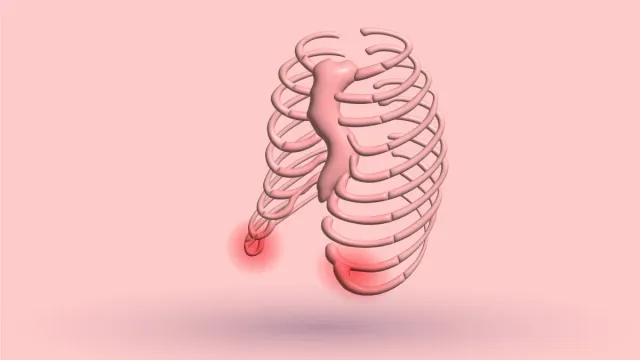
If your lower ribs stick out too, breathing has a more direct job. Part of your diaphragm lies flat against the inside of your lower ribs, an area called the zone of apposition, and your abdominal muscles pull the lower ribs down and in, as the same 2010 balloon paper describes. A long, full breath out, like the one in the balloon drill, is how you practise that ribs-down position. It hasn’t been tested as a flare treatment either.
The full flare routine, with doses, is on my rib flare exercises page, and my guide to flared ribs explains the different kinds. The rib flare brace I sell ships with a breathing balloon set and a breathing trainer for this work.
Breathing with a vacuum bell or brace
A vacuum bell is a suction cup worn on the chest that draws the breastbone forward. Breathing doesn’t replace it, but some surgical teams recommend it alongside. The developers of the Nuss procedure write that mild to moderate pectus excavatum can be managed with breathing exercises, posture work and aerobic exercise, plus the bell in selected patients. The University of Rochester’s vacuum bell page pairs the bell with deep-breathing and posture exercises, and says never to pump it to discomfort or pain.
Three studies added exercise to a device, two of them with breathing in the programme:
- Bell plus physiotherapy. In a 2020 randomised trial of 26 boys aged 11 to 18, co-authored by Prof. Mustafa Yüksel, the surgeon who reviews clinical content for mrpectus, half used the bell alone for 12 weeks and half added physiotherapy, which the trial registration says included segmental breathing exercises. The dip improved in both groups, and some chest measurements improved more with physiotherapy. So did posture, treatment satisfaction and physical quality of life.
- Bell plus posture exercise. A 2026 controlled study from Turkey added Schroth-based exercise to the bell. Posture and pectus-specific quality of life improved more; deformity severity didn’t.
- Brace plus exercise. In Haje’s 2021 series of localized pectus excavatum treated with a dynamic compression brace, the exercises, done at least 5 days a week in the brace, included blowing a balloon for 10 minutes. Regular exercisers had about four times the odds of a good result (odds ratio 4.05), an association with sticking to the whole programme, not proof the balloon did anything on its own.
In these studies, adding exercise reliably helped posture and how people felt. Extra change in the dip showed up in one bell trial and not the other, and none of them tested breathing on its own. My vacuum bell how-to covers the daily routine.
Before and after the Nuss procedure
In the Nuss procedure, a surgeon slides a curved metal bar behind the breastbone to push it forward.
Before surgery. In a Cochrane review of 12 trials in 695 adults having heart or major abdominal surgery, breathing-muscle training beforehand cut pneumonia and partly collapsed lung and shortened hospital stays by about 1.3 days. The evidence was low to moderate quality and none of it was pectus surgery, so ask your team. If they agree, my pre-surgery programme is a paid option.
After surgery, your hospital’s plan comes first. These are examples, not a protocol to copy:
| Hospital | What it asks for |
|---|---|
| SickKids, Toronto | Incentive spirometer, 10 breaths every waking hour for up to a week after discharge, then 2 or 3 coughs hugging a pillow |
| Children’s Hospital of Philadelphia | Incentive spirometer every hour while awake in hospital |
| Royal Papworth, UK | Sitting up: slow breath in through the nose, hold, “sniff” in a little more, breathe out through the mouth. Four or five per session, then a huff or cough with a pillow or rolled towel over the wound |
A US respiratory care guideline from 2011 recommends the spirometer only as part of a package with deep breathing, directed coughing, moving early and good pain control, not on its own.
Expect lung tests to dip first. FVC, from spirometry (the blowing test), is how much air you can blow out after your deepest breath, as a percentage of what’s expected. In a 2015 Istanbul study of 80 Nuss patients, also co-authored by Prof. Yüksel, FVC fell from 83.2% to 76.5% of predicted at 6 months while quality of life rose. In an 11-centre study, it rose from 87.9% to 92.6% one year after repair. In 34 patients in Japan, using a spirometer 4 times a day from day 5 went with about 1,404 mL breathed in at 3 months, against 900 mL in a later group that didn’t train.
When to go back to balloons or a trainer after the Nuss: I couldn’t find a source. Ask your surgeon.
Lung capacity and stamina
Why you may run out of breath sooner
Two things get called lung capacity. Spirometry measures how much air your lungs move. Stamina is measured as VO2max, the most oxygen your body can use in hard exercise, and it depends on your heart as well as your lungs.
Lung tests in pectus are lower on average but normal in many people. In more than 1,500 patients at one US surgical centre, lungs that can’t fill fully were about four times likelier with a Haller index above 7. The heart can be the limit too. In a study of 13 patients, upright cycling oxygen uptake was lower than in controls (1,480 vs 1,994 mL per minute), with less blood pumped per beat, and the authors put it down to the heart filling less when upright. No breathing drill has been shown to change that. My post on shortness of breath with pectus excavatum goes deeper.
Can you increase lung capacity with pectus excavatum?
Some, mostly through general fitness. In 14 Romanian children, a 12-week supervised exercise programme improved FVC, FEV1 (how much you blow out in the first second) and 6-minute walk distance. Their spirometry ended up matching healthy children’s, though the programme wasn’t breathing-only. In an Italian pilot study of 15 teenagers with pectus excavatum, how active people were predicted their VO2max.
So for stamina, breathing drills are a small extra next to aerobic training built up gradually. My pectus excavatum exercises guide covers running and sport. Skip breath-hold training: it brings the blackout risk above, and I found nothing to support it for pectus.
Quick answers
Is Wim Hof breathing good for pectus excavatum? There’s no pectus data, and it won’t move your sternum. A 2024 systematic review of 8 trials found it may reduce inflammation markers, with mixed effects on exercise performance. Its fast breathing is the kind that causes tingling and dizziness, and fast breathing before breath holds is the pattern behind the drownings above. If you try it, sit or lie down, never in or near water.
Do stomach vacuums help? I couldn’t find a pectus study of stomach vacuums (pulling your belly button in hard and holding it), and they won’t move the sternum. For holding the lower ribs down, see the rib flare section above.
Is blowing balloons good for your lungs? For some groups, in small studies outside pectus. Elderly smokers blowing balloons 3 times a week for 6 weeks improved some lung test results against no exercise, and children with chest infections blowing balloons 10 minutes a day for 2 weeks breathed more slowly and had better oxygen levels than with standard care alone.
Can breathing exercises help with anxiety? A little. A 2023 meta-analysis of 12 randomised trials found breathwork lowered self-reported stress slightly, with similarly small effects on anxiety, and the authors warn against the hype. More in pectus excavatum and anxiety.
How to tell it’s working
My coaching checks, not clinical tests:
- The hand check. Belly hand rises, chest hand stays still, without you thinking about it.
- The balloon. You get through five sequences with a relaxed neck and cheeks.
- The trainer. The setting creeps up over the weeks.
- Real life. The same walk or the same stairs feel easier.
Check the dip monthly, lying flat, at the end of a relaxed breath out, never right after a session. Don’t expect breathing work to change that number.
Where breathing fits
Breathing is the support act. A vacuum bell, a brace or surgery is what targets the dip, and my pectus excavatum treatment page walks through the options. My own correction came from about three years of daily vacuum bell use and structured training.
If you want to know where your chest stands and which route fits it, take my free 1-minute quiz.
Sources
- NCT07300748. Effectiveness of Cardiopulmonary Exercises for Children With Pectus Excavatum (Ankara Etlik City Hospital). ClinicalTrials.gov. [cited 2026 Oct 20]. Read it
- Illi SK, Held U, Frank I, Spengler CM. Effect of respiratory muscle training on exercise performance in healthy individuals: a systematic review and meta-analysis. Sports Med. 2012;42(8):707-24. Read it
- Birkemeier KL, et al. Breathe in… breathe out… stop breathing: does phase of respiration affect the Haller index in patients with pectus excavatum? AJR Am J Roentgenol. 2011;197(5):W934-9. Read it
- Gräfe D, et al. Pectus excavatum in motion: dynamic evaluation using real-time MRI. Eur Radiol. 2023;33(3):2128-35. Read it
- Hyperventilation. MedlinePlus, US National Library of Medicine. Reviewed 2024 Jul 23. Read it
- Boyd C, et al. Fatal and nonfatal drowning outcomes related to dangerous underwater breath-holding behaviors: New York State, 1988-2011. MMWR Morb Mortal Wkly Rep. 2015;64(19):518-21. Read it
- Diaphragmatic breathing. Cleveland Clinic. Reviewed 2022 Mar 30. Read it
- Boyle KL, Olinick J, Lewis C. The value of blowing up a balloon. N Am J Sports Phys Ther. 2010;5(3):179-88. Read it
- Carvajal-Tello N, et al. Effects of inspiratory muscle training on lung function parameter in swimmers: a systematic review and meta-analysis. Front Sports Act Living. 2024;6:1429902. Read it
- Nuss D, Obermeyer RJ, Kelly RE. Pectus excavatum from a pediatric surgeon’s perspective. Ann Cardiothorac Surg. 2016;5(5):493-500. Read it
- Vacuum bell. Golisano Children’s Hospital, University of Rochester Medical Center. [cited 2026 Oct 20]. Read it
- Alaca N, Alaca I, Yüksel M. Physiotherapy in addition to vacuum bell therapy in patients with pectus excavatum. Interact Cardiovasc Thorac Surg. 2020;31(5):650-6. Co-authored by Prof. Mustafa Yüksel. Read it
- NCT04167865. Effects of Exercise Therapy on Pectus Excavatum (Acibadem University), the registration for the 2020 vacuum bell and physiotherapy trial. ClinicalTrials.gov. [cited 2026 Oct 20]. Read it
- Kandemir B, Yagci G, Uysal S, Akkas Y, Erbahceci F. The effects of Schroth-based exercise therapy in adolescents with pectus excavatum: a controlled clinical trial. Prosthet Orthot Int. 2026 (online ahead of print). doi:10.1097/PXR.0000000000000545. Read it
- Haje DP, Haje SA, Volpon JB, et al. Localized pectus excavatum treated with brace and exercise: long term results of a Brazilian technique. Acta Ortop Bras. 2021;29(3):143-8. Read it
- Katsura M, et al. Preoperative inspiratory muscle training for postoperative pulmonary complications in adults undergoing cardiac and major abdominal surgery. Cochrane Database Syst Rev. 2015;(10):CD010356. Read it
- Physio after Nuss bar procedure. AboutKidsHealth, The Hospital for Sick Children. Updated 2025 Mar 13. Read it
- Nuss procedure. Children’s Hospital of Philadelphia. [cited 2026 Oct 20]. Read it
- Physiotherapy information after pectus surgery (PI 155). Royal Papworth Hospital NHS Foundation Trust. Read it
- Restrepo RD, et al. Incentive spirometry: 2011. Respir Care. 2011;56(10):1600-4. Read it
- Kuru P, Dudakli A, Mursaloglu H, Arikan H, Oktay A, Yüksel M. How pulmonary function changes after pectus excavatum correction surgery. Asian Cardiovasc Thorac Ann. 2015;23(8):945-9. Co-authored by Prof. Mustafa Yüksel. Read it
- Kelly RE Jr, et al. Multicenter study of pectus excavatum, final report: complications, static/exercise pulmonary function, and anatomic outcomes. J Am Coll Surg. 2013;217(6):1080-9. Read it
- Noguchi M, et al. Does aggressive respiratory rehabilitation after primary Nuss procedure improve pulmonary function? J Pediatr Surg. 2020;55(4):615-8. Read it
- Kelly RE, Obermeyer RJ, Nuss D. Diminished pulmonary function in pectus excavatum: from denying the problem to finding the mechanism. Ann Cardiothorac Surg. 2016;5(5):466-75. Read it
- Zhao L, et al. Why is exercise capacity reduced in subjects with pectus excavatum? J Pediatr. 2000;136(2):163-7. Read it
- Amăricăi E, et al. Assessment of children with pectus excavatum without surgical correction. Wien Klin Wochenschr. 2019;131(5-6):126-131. Read it
- Casatori L, et al. Differential influence of physical activity on cardiopulmonary performance and stroke volume assessed at cardiopulmonary exercise test in pectus excavatum: a pilot study. Front Physiol. 2022;13:831504. Read it
- Almahayni O, Hammond L. Does the Wim Hof Method have a beneficial impact on physiological and psychological outcomes in healthy and non-healthy participants? A systematic review. PLoS One. 2024;19(3):e0286933. Read it
- Jun HJ, et al. Effects of breathing exercises on lung capacity and muscle activities of elderly smokers. J Phys Ther Sci. 2016;28(6):1681-5. Read it
- Subramanian NS, et al. Effectiveness of balloon blowing on respiratory parameters among children with lower respiratory tract infection: a quasi-experimental study. J Pharm Bioallied Sci. 2025;17(Suppl 2):S1239-41. Read it
- Fincham GW, et al. Effect of breathwork on stress and mental health: a meta-analysis of randomised-controlled trials. Sci Rep. 2023;13:432. Read it
Everything I know about correcting a chest without surgery, in one book - exercises, posture, breathing, flared ribs and vacuum bell work.
- 1,127 pages across 93 chapters
- 741 scientific references
- Instant download, lifetime access

This article is for educational purposes only and does not constitute medical advice. Always consult a qualified healthcare professional before starting any treatment plan. View full disclaimer →