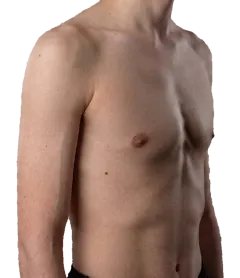
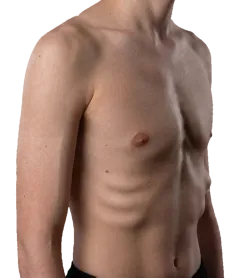
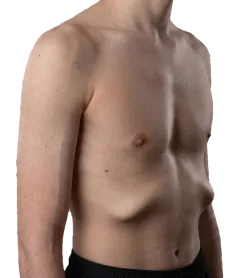
Contents · 13 sections
One person tells you you’ll need an operation. Another sells you a suction cup. Both sound sure. The evidence is less sure than either of them.
Neither route suits everyone. In the only head-to-head study, 57 patients in Korea who picked their own route, surgery moved the chest about twice as much, from a deeper start, and the bell had fewer, milder complications. The bell suits younger, milder, flexible chests and people who can wear it daily for a year or more. Fainting, palpitations, chest pain or a squeezed heart go to a surgeon first. And it isn’t either-or: some centers use the bell before and during the operation.
Where I stand: I was diagnosed with pectus excavatum in 2012, at 15, declined surgery, and corrected my chest over about three years of daily vacuum bell use and structured training. The change was visible and measurable, but not complete. I’m not a doctor, and I make and sell my own custom vacuum bell, so weigh my view accordingly. I’ve held both routes to the same criteria, and choosing surgery is not a failure.
Vacuum bell vs surgery at a glance
Four rows carry a scoped edge: two from one small, self-selected study with a deeper surgery group, plus serious harm and health-system cost. The rest are unresolved or depend on your chest.
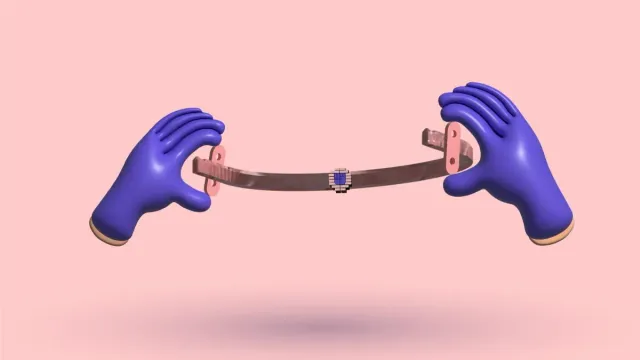
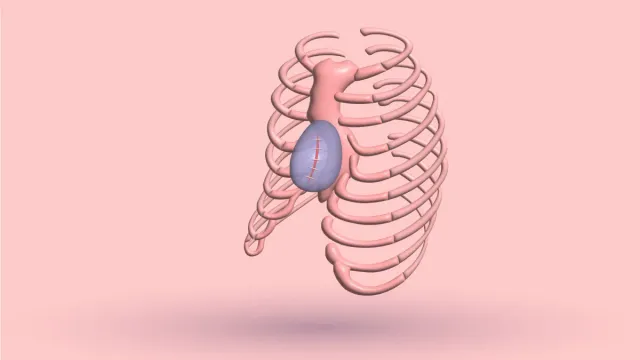
Surgery here means the Nuss procedure: a curved steel bar slid behind the breastbone through small side cuts, taken out two to three years later. The Ravitch, an open operation that removes overgrown cartilage, comes in where its evidence differs. Who qualifies, and other operations, are in my pectus excavatum surgery guide.
| Vacuum bell | Surgery (Nuss unless noted) | How sure is this? | |
|---|---|---|---|
| What it is | A suction cup worn daily at home | A steel bar behind the breastbone, removed later | Description |
| Who it suits | Younger (about 11 or under), milder, flexible chests | Severe, stiff or symptomatic chests; often at 12 to 16 | Routing, not an edge |
| How much it moved the chest | Breastbone up about 13 mm at 1 year | Up about 29 mm | Edge: surgery, one small self-selected study, deeper start |
| Share with a good result | 11% to 52.5% “excellent” across 27 studies | 95.8% good or excellent, one US center | Unresolved: different definitions and patients |
| Complications in the comparison | 4 of 33, all minor | 7 of 24 | Edge: bell, same self-selected study |
| Serious harm | None permanent or severe in the reviews | Rare: death about 0.03% | Edge: bell |
| Time | Hours a day for 12 to 24 months or more | Days in hospital, about 3 months to most activity | Unresolved: different kinds of burden |
| Who stops | About 30% to 34% in two reports | Not comparable: one operation | Unresolved |
| Does it last | 2 of 86 successes relapsed, Amsterdam | 1.4% reoperated for recurrence, one US center | Unresolved: different measures |
| Cost to a health system | £468 to £503 per patient | £13,513 | Edge: bell, NHS Scotland 2022/23 estimate |
| What you pay in the US | Coverage varies; one big insurer calls it unproven | Depends on your coverage | Unknown: no out-of-pocket data for either |
| Evidence base | Mostly retrospective series | Large series and registries | No randomized head-to-head trial |

The one study that compared them
The only head-to-head comparison I found is a 2021 study from Korea University Anam Hospital. It was retrospective, a look back through records rather than a planned trial. It covered 57 patients treated from 2016 to 2020: 33 wore a bell at least an hour a day for over a year, and 24 had a Nuss and the bar removed. Both groups averaged about 16, 91% were male, and patients chose their own treatment.
It measured the Haller index, the chest’s width divided by the distance from breastbone to spine on a scan. Above 3.25 is a common threshold for referral to a surgeon.
- Starting point. The Nuss group’s chests were deeper: a Haller index of 4.24 on CT, against 3.6.
- One year later. The final index wasn’t significantly different: 2.88 after the Nuss, 3.01 after the bell.
- How far each moved. About twice as far after surgery. The index fell by 1.31 against 0.58, and the breastbone rose 28.75 mm against 13.02 mm.
- Complications. 7 of 24 after the Nuss: fluid around the lung in 3, a collapsed lung (pneumothorax) in 2, a wound infection and a bar that moved. 4 of 33 with the bell, all minor skin problems or chest tightness.
The authors wrote that the bell “showed comparable outcomes” for selected patients who prefer to avoid an operation. True of where the groups ended up, not of how far they traveled. Haecker, of the Basel bell team, calls the study’s statistical approach “debatable” in a 2024 review and survey, and notes that no randomized or prospective comparison exists.
Results: how much each changes the chest
Both routes improve most chests, but each counts success its own way, so the rates can’t be lined up.
The bell. A 2026 systematic review of 27 studies and 2,644 patients aged 3 to 20 found an excellent correction in 11% to 52.5%, with definitions varying, and some improvement in 60% to 80%. In the seven studies since 2018 reviewed for the June 2025 recommendation of SHTG, Scotland’s health technology group, about 20% to 50% of patients selected for the bell had a positive outcome.
The Nuss. In the developers’ series of 1,215 patients at Children’s Hospital of The King’s Daughters (CHKD) in Norfolk, Virginia, published in 2010, 95.8% had a good or excellent result when the bar came out, and 1.4% needed another operation because the dip came back.
With different patients, eras and definitions, this isn’t a fair head-to-head. My interpretation: surgery is the more predictable way to change the chest’s shape, while the bell’s result depends much more on how young you start and how long you keep going.
Does it last? In Amsterdam, 2 of 86 bell successes (2.3%) relapsed over a median of 64 months. In a Children’s Mercy Kansas City survey 9.6 years after a Nuss, 30.7% noticed some sinking, but only 26% replied.
Risks and side effects
The bell’s side effects are mostly skin-deep and temporary. Surgery’s serious risks are rare but real, and its smaller problems common. On serious harm, the bell has the edge.
The bell. In Basel’s series of 140 patients, published in 2016, skin irritation was reported in 13.6%, localized pain in 12.1% and bruising (hematoma) in 7.1%. In a 2025 Amsterdam series of under-18s, 22.8% had complications, all minor, mainly skin. Haecker’s 2024 review found none permanent or severe in the literature, and the 2026 systematic review found none severe. SHTG says children need a parent or carer supervising.
A contraindication makes a treatment unsafe. The bell’s include bleeding disorders, Marfan syndrome or other aortic disease, heart conditions and conditions that weaken bone. A 2025 Swiss scoping review also counts a dip deeper than 3 cm, a very uneven chest and marked rib flare against it.
The Nuss. According to the 2024 Pectus Care Guidelines, a pneumothorax happens in up to 20%, the bar moves in about 1%, and the risk of death is about 0.03%. The CHKD Nuss Center says it “can be a painful surgical procedure”. Cryoablation, a nerve-freezing pain treatment, left the chest numb for a median of 6 months in 121 Cleveland Clinic patients reported in 2025.
Risk rises with age. In US billing data on 360 Nuss patients from 2016 to 2018, a complication was recorded in 30.6% at 12 to 17, 45.2% at 18 to 29 and 62.1% at 30 and over, minor problems included. Full complication tables are in my Nuss procedure guide.
Time: daily wear vs recovery
The bell takes hours every day for a year or two. Surgery takes weeks of recovery, months of limits and a second operation. Which is lighter depends on your life.
The bell. Scotland’s service advises at least 2 hours a day for 12 months and longer, though SHTG says the evidence can’t settle the ideal daily time.
The Nuss. In US data on 12 to 21 year olds from 2016 to 2020, the median hospital stay was 3 days, often 1 to 2 with cryoablation. Strict limits last about 6 weeks, and the guidelines put full upper-body activity at about 3 months. The bar stays about 2 to 3 years, and pectus bar removal is often day surgery.
Stopping is the bell’s hidden cost. In a 2022 Buenos Aires series of 186 patients, 34% withdrew. A Scottish chest wall specialist told SHTG that about 30% don’t complete treatment.
Cost and insurance
To a health system, the bell costs a small fraction of an operation. What you pay depends on where you live and your insurance; I couldn’t find it measured for either route.
Health-system cost is what treatment costs the service, not your bill. The only same-system comparison I found is SHTG’s estimate for NHS Scotland’s children’s service (ages 0 to 16), at 2022/23 unit costs:
| First-line route, NHS Scotland | Estimated cost per patient |
|---|---|
| Vacuum bell pathway, 12 months, device shared by two users, quarterly physio video calls | £468 to £503 |
| Conservative management only, physio check-ins up to 18 months | £192 |
| Nuss, including bar removal and follow-up | £13,513 |
| Modified Ravitch | £15,033 |
They leave out complications, so SHTG says the surgical figures may be underestimates, and any surgery after a bell that didn’t work. SHTG couldn’t run a cost-effectiveness analysis because the outcome data weren’t there.
In the US, Aetna’s Clinical Policy Bulletin 0272, last reviewed 17 April 2026, lists the vacuum bell as “experimental, investigational, or unproven”. It covers repair only with a CT Haller index above 3.25 plus an objective heart or lung finding; otherwise it’s cosmetic. That’s one insurer, and CHKD notes that some have paid for the bell in full or in part. US surgery costs are in my guide to Nuss procedure cost.
My bell is a one-time $399, built to your chest measurements, with a usage plan, direct support from me, free worldwide tracked shipping and 30-day returns from arrival (you pay the return postage). Other sellers’ prices are in where to buy a vacuum bell.
Which one fits you
Age, depth, flexibility, symmetry and symptoms point most chests one way; none decides it alone. For scale, SHTG says about 80% of people with pectus excavatum won’t have a chest severe enough to justify surgery.
Age
SHTG ties bell success to starting at about 11 or younger, and Haecker writes that under 10, the bell “seems to represent the first step”. The Nuss developers recommend about 12 to 14, and CHKD’s median patient is 15. Teenagers sit where the routes overlap.
How deep and how flexible
In bell series from Virginia (2018, 2025) and Buenos Aires (2022), the odds were highest with a dip of about 1.5 to 1.8 cm or less. Flexibility isn’t settled: a chest that gives when pressed predicted an excellent result in the 2018 Virginia study, but Amsterdam found lower success in flexible chests.
The first fitting tells you something. A 2026 London study of 240 children enrolled only those whose chest lifted at the first fitting, and Basel supervises every first application, so ask for the same.
Uneven chests and girls
SHTG says the bell may not seal on some asymmetric chests, and that breast development may get in the way. In Amsterdam, 11 of 28 girls stopped as their breasts grew. For asymmetric chests, the guidelines give their strongest recommendation to the Ravitch procedure and its variations, and rate the two operations as similar in risk and effectiveness.
Symptoms and heart or lung concerns
In a 2019 cardiac MRI study of 20 adults awaiting surgery in Milan, the heart pumped about 10% more blood per beat while the bell was on, an immediate effect. I couldn’t find lasting heart or lung data for the bell to set against surgery’s. Heart compression with a Haller index above 3.25, a dangerous heart rhythm problem, and fainting or near-fainting carry the guidelines’ strongest surgical recommendations, so they go to a surgeon first.
Adults
Adult bell evidence is thin: Haecker expects 24 to 36 months for moderate, stiffer chests, and I couldn’t find an outcome series of adults alone. Surgery works in adults, despite more complications: a Mayo Clinic Arizona series of 361 adults treated 2010 to 2015 reported success in 96.5% at 18 to 29 and 88.7% at 30 and over. The guidelines say the Ravitch has slightly fewer complications in adults, mainly fewer repeat operations for a moved bar.
Combining the bell and surgery
You don’t have to choose once. Surgeons use the bell before, during and after the Nuss, on small evidence.
Trying the bell first
Of 127 Nuss patients in Basel, operated from 2000 to 2016, 27 had used the bell first for a median of 17 months and stopped because it hadn’t worked. Their hospital stay, complications, bar movement, time with the bar and long-term satisfaction were no different. It’s one retrospective study, I’ve read only its abstract, and Haecker is among its authors.
The Nuss developers’ own center, CHKD, also gave the bell to 218 people from 2008 to 2018 who didn’t meet its surgical criteria or didn’t want surgery; its 2022 report says the bell did better in younger, less severe cases.
My view: for a mild, symptom-free, flexible chest, trying the bell first is reasonable, and it doesn’t close the door to surgery.
When to stop trying the bell
A 2025 systematic review of 20 studies in children says surgery should be considered if there are no visible results after 6 to 12 months. Treat that as the point to take your measurements and photos to a specialist, not an automatic switch.
While you wait for surgery
In Amsterdam, 4 of 15 under-18s waiting for a Nuss no longer needed it after using the bell, and the authors say bell use while waiting “should be encouraged”. In a 2024 Russian series of 15 patients aged 8 to 17, bell use before surgery cut the average dip from 28.0 mm to 6.7 mm; it’s tiny, and I’ve read only the abstract. If you’ve chosen surgery, I also sell a pre-surgery program.
During the Nuss procedure
Some surgeons put a sterilized bell on the chest during the operation, off-label, to lift the breastbone away from the heart before the bar passes. In 50 patients aged 9 to 28 in Basel, from 2005 to 2010, there was no injury to the heart, its lining or the mammary vessels, and a 2019 review reported only temporary mild bruising across 131 patients.
That Russian series also used the bell during surgery and reported no complications in 14 of its 15 patients. The 15th, who had had previous surgery through the breastbone (a sternotomy), had massive bleeding from a heart injury. The abstract doesn’t attribute that injury to the bell. Whether to use a bell during your operation is your surgeon’s call.
After surgery
The 2025 Swiss review lists the bell as one way surgeons correct a mild recurrence after surgery. I couldn’t find outcome data for that use. More on preventing recurrence after surgery, and I sell a post-surgery program.
When to see a surgeon first
Some chests need a doctor before a bell.
See a doctor before you start any device, brace or exercise program if any of these apply to you:
- chest pain
- fainting or nearly fainting
- breathlessness at rest or with light effort
- palpitations or an irregular heartbeat
- a diagnosed heart or lung condition
- Marfan syndrome or Ehlers-Danlos syndrome, or a doctor has raised either
- previous chest surgery
- a Haller index above 3.25 together with symptoms
- symptoms that nobody has checked yet
None of these means you’ll need surgery. They mean someone should look at your heart and lungs before you go further. An index above 3.25 is a common referral threshold, not an emergency.
A vacuum bell isn’t a treatment for a compressed heart. More in pectus excavatum and heart problems.
What the guidelines say
The 2024 Pectus Care Guidelines call the bell “a safe conservative treatment for patients with pectus excavatum”, “best in less marked defects and in younger patients” (Class IIa, their second-highest grade). For surgery, beyond the heart indications above, they say people affected psychologically benefit, after an assessment. Supportive care is enough for the majority of patients, they say, and they have no graded recommendation on trying the bell first.
SHTG says the bell “should be available as a non-surgical treatment option for selected people” whose chest affects their physical or psychological wellbeing, decided by a multidisciplinary team. It calls the evidence limited and mainly retrospective; Scotland has fitted nearly 400 bells since 2018. In England, an NHS interim policy published in April 2023 funds surgery for very severe pectus excavatum with potentially life-threatening complications, an estimated 5 to 10 patients a year.
Prof. Mustafa Yüksel, who reviews medical content on this site, co-authored a 2025 survey of 100 surgeons, Chest Wall International Group members and other specialists, run from November 2024 to January 2025. Their most common reasons to operate were a severe deformity (88.9%), a Haller index above 3.25 (78.8%), psychosocial distress (77.8%) and symptoms (77.8%), and the authors conclude that significant variation remains.
I couldn’t find a study comparing satisfaction or quality of life between the two.
My verdict, by situation
There’s no overall winner. These are my views, not medical advice.
- A child about 11 or under, with a mild, flexible chest and no symptoms. My view: the bell’s case is strongest here. Get a specialist assessment and a supervised first fitting, and plan for a year or more.
- A teenager with a moderate chest. My view: both routes are on the table. If you try the bell, set a review date at 6 to 12 months before you start.
- A severe, stiff, asymmetric or symptomatic chest. My view: see a surgeon first; an uneven chest may suit the Ravitch.
- An adult with a mild to moderate chest. My view: the bell is worth discussing if your chest still gives a little and you have the hours. Expect years, and a partial change.
- Already booked for a Nuss. My view: don’t cancel because of a blog post, mine included. Ask your surgeon whether the bell is worth using while you wait.
- Mostly bothered by how it looks or feels. My view: that counts, and both routes are legitimate answers; more in pectus excavatum and mental health.
What to do next
Measure first, whichever way you lean, so every later conversation runs on numbers. My guide to measuring pectus excavatum at home shows how.
To see how significant your chest is and which route fits, take my free 1-minute quiz. If surgery is the route, my list of pectus excavatum surgeons by country is a starting point, and every route without an operation is on my pectus excavatum page.
Give whichever you choose honest time. Surgical recovery runs in weeks to months, and change with a bell in months to years.
Sources
- Jung Y, et al. Surgical versus vacuum bell therapy for the correction of pectus excavatum: a comparison of 1-year treatment outcomes. J Chest Surg. 2021;54(6):473-9. Read it
- Haecker FM. 20 years clinical application of the vacuum bell for conservative treatment of pectus excavatum: past, present, future. J Thorac Dis. 2024;16(8):5285-98. Read it
- Kumar B, Jain V, Dhua AK. Efficacy and safety of vacuum bell therapy in pectus excavatum: a systematic review of clinical outcomes. J Indian Assoc Pediatr Surg. 2026;31(1):4-19. Read it
- Vacuum bell device for the correction of pectus excavatum: SHTG Recommendations. Scottish Health Technologies Group. 2025 Jun [cited 2026 Oct 25]. Read it
- Kelly RE, et al. Ann Surg. 2010;252(6):1072-81. Read it
- Cruz-Centeno N, et al. Eur J Pediatr Surg. 2024;34(4):333-7. Read it
- Haecker FM, Sesia S. Vacuum bell therapy. Ann Cardiothorac Surg. 2016;5(5):440-9. Read it
- van Braak H, et al. J Pediatr Surg. 2025;60(2):161891. Read it
- Sesia SB, Sesia N, Haecker FM. J Thorac Dis. 2025;17(10):9161-77. Read it
- Dunning J, et al. Pectus Care Guidelines. Eur J Cardiothorac Surg. 2024;66(1):ezae166. Read it
- Nuss Center Frequently Asked Questions. Children’s Hospital of The King’s Daughters. [cited 2026 Oct 25]. Read it
- DiFiore JW, et al. J Pediatr Surg. 2025;60(1):161904. Read it
- Mack SJ, et al. J Thorac Dis. 2022;14(4):952-61. Read it
- Toselli L, et al. J Pediatr Surg. 2022;57(11):550-4. Read it
- Clinical Policy Bulletin 0272 (pectus excavatum and pectus carinatum). Aetna. Last reviewed 2026 Apr 17 [cited 2026 Oct 25]. Read it
- Monti L, et al. J Thorac Dis. 2019;11(12):5398-406. Read it
- Jaroszewski DE, et al. Ann Thorac Surg. 2016;102(3):993-1003. Read it
- Muff JL, et al. Failed preoperative vacuum bell therapy does not affect outcomes following minimally invasive repair of pectus excavatum. Pediatr Surg Int. 2021;37(10):1429-35. Read it
- Kelly RE Jr, et al. Recent modifications of the Nuss procedure. Ann Surg. 2022;275(2):e496-502. Read it
- Khalifa MA, et al. Pediatr Surg Int. 2025;41(1):321. Read it
- Haecker FM, Sesia SB. J Laparoendosc Adv Surg Tech A. 2012;22(9):934-6. Read it
- Haecker FM, et al. Interact Cardiovasc Thorac Surg. 2019;29(4):497-502. Read it
- Shominova AO, et al. Russian Journal of Pediatric Surgery. 2024;28(1):33-42. Read it
- Interim clinical commissioning urgent policy statement: pectus surgery (PR00394), v0.2. NHS England. 2023 Apr [cited 2026 Oct 25]. Read it
- Ateş U, Evin E, Bahadır K, Altınörgü E, Fırat S, Çakmak M, Yüksel M. Pediatr Surg Int. 2025;41(1):302. Read it Co-authored by Prof. Mustafa Yüksel.
The prep work before a repair: the breathing capacity and back strength that make the first week after surgery survivable and the result hold.
- Breathing capacity built before the bar
- Back and postural work for recovery
- What to have ready before the date

This article is for educational purposes only and does not constitute medical advice. Always consult a qualified healthcare professional before starting any treatment plan. View full disclaimer →