Contents · 10 sections
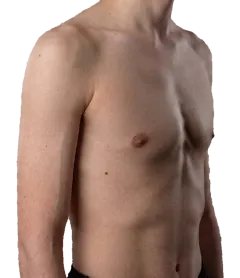
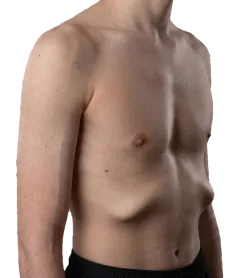
If you have pectus excavatum, you probably know the routine. The band rides up, the cups gap at the bottom, and the piece of the bra between the cups hovers over your chest instead of touching it. Standard fitting advice says that middle piece should lie flat. On a sunken chest, it often can’t.
That’s the first thing to accept, and it’s good news. A centre that floats over the dip is fine as long as the band and the cups are doing their job. Below you’ll find a fit check built for your chest, the styles to try first depending on where your dip sits, and how to tell when the problem isn’t the bra at all.
A quick word on who’s writing. I was diagnosed with pectus excavatum at 15 and spent about three years correcting it without surgery, so I know this chest well. I’m also a man, and I’ve never worn a bra. So the bra advice here isn’t mine. It comes from breast-health researchers at the University of Portsmouth, from women with pectus who wrote down what worked for them, and from a bra-fitting blogger who asked around for one of them. I’ll tell you whose advice is whose.
Why bras misbehave on a sunken chest
A standard bra is built for a flat breastbone. Most of its support comes from the band that runs around your ribs. At the front, the centre panel between the cups, which fitters call the gore, rests against the breastbone and keeps the front steady. One of the basic fit checks from the University of Portsmouth’s Research Group in Breast Health is a centre front that sits flat against your body.
That’s the one check your chest is likely to fail. On a sunken chest the gore lands over the hollow, has nothing to rest on, and floats. The underwires have a similar problem. Their inner ends are shaped for a flat breastbone and meet a dip instead.
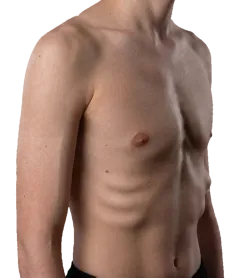
Then there are the lower ribs. Two women with pectus I quote below, one writing on Bratabase and one writing in to a bra-fitting blog, both describe lower ribs that stick forward as well as a sunken centre. Ribs like that can make it hard to get the band to sit level. If your lower ribs do this, I’ve written more about flared ribs.
Breasts also change how visible the dip is, and that has a side effect. Boys and men are referred for pectus excavatum three to five times more often than girls and women. Yet when researchers measured the chest CT scans of nearly 2,700 adults in the Dallas Heart Study, they found it slightly more often in women (0.5%) than in men (0.3%), as Biavati and colleagues reported in 2020. The authors suggest that breast development and modesty may hide the dip in women. That’s their explanation, not a proven fact. But it fits what a good bra does. It makes the dip harder to see, for you and for everyone else.
A fit check that works for your chest
Bra fit isn’t only about looks. Writing for The Conversation, Portsmouth researcher Joanna Wakefield-Scurr summarised studies linking badly fitting bras to neck, back and shoulder pain, chafing, grooves worn into the shoulders by straps, and women avoiding exercise.
Portsmouth’s general checks still work for you, with one change in the middle. Here’s the version adapted for a sunken chest. Put every bra you try through all five.
- The band is level and firm. Portsmouth’s rule is that the underband should sit level all the way around your ribs, feel firm, and stay level as you move. On your chest this matters even more, because the gore isn’t steadying the front. The band has to do more of the work. If it rides up at the back or tips over your lower ribs, nothing else will fit right. One woman with pectus excavatum who wrote a fitting guide on Bratabase found that the usual trick of trying the band on backwards told her little, because her lower ribs stick out.
- All of each breast is inside the cup. Portsmouth says the breasts should be fully enclosed. The Bratabase writer adds a check worth copying: gently press the wire back against your chest wall. If some breast tissue ends up under or outside the wire once it’s pressed in, the cup is too small, even if it looked fine in the mirror. If the top of the cup overflows when you press, the cup is too small as well. She says pressing carefully has never damaged a bra.
- The wires follow your breast crease and don’t dig in. Portsmouth’s rule is that the underwire follows the natural crease of your breast. On a sunken chest the inner ends may not touch you, and that’s expected. What you don’t want is a wire pressing into bone. Venusian Glow, a bra-fitting blog that put a reader’s pectus question to a Polish bra-fitting forum, suggests bras without very hard underwires. The Bratabase writer bends her wires to sit closer to her ribcage. With bent wires she can get the centre fairly flat, but her bras still look a bit roomy in the middle, and she’s fine with that.
- The centre can float, but your breasts shouldn’t push it away. A gap between the gore and your breastbone is fine if the first three checks pass. Venusian Glow told its reader that the wires will often not sit flat on the sternum, and that this is okay when support and comfort are good. Alysa Miller, an artist with pectus excavatum, describes the same floating gore. Know which gap you’re looking at, though. A centre hovering over the hollow is your chest. A centre your breasts push forward, away from your body, is the cups, and Portsmouth’s advice for a front that lifts away is to try a cup size up. A centre that presses painfully into your chest isn’t fine either.
- The straps aren’t doing the lifting. Portsmouth says straps should feel comfortable without digging in, and that they keep the bra in place but aren’t the main support. If you find yourself tightening them to get lift, go back to check 1 and look at the band again.
If your breasts are different sizes, run checks 2 and 3 on each side separately. More on that below.
Which styles to try first
I couldn’t find a single study that tested bra styles on women with pectus excavatum. So treat the table below as a starting shortlist, built from how bras work and from what women with pectus report. It isn’t a ranking. And expect to try a lot of bras. Venusian Glow points out that two very similar models from the same brand can fit completely differently.
| Style | Why it can work on a sunken chest | When it doesn’t |
|---|---|---|
| Plunge (low centre) | The gore is short and sits low, so less of the bra has to bridge the dip. Venusian Glow suggests trying plunges, and so does a lingerie affiliate guide. | The Bratabase writer got poor support from plunges, because the low centre ended right where her ribcage was deepest. |
| Full cup | The Bratabase writer had her best results with full cups, against the usual advice. | The taller centre has more distance to cover over the dip, so the gap can be bigger. Two of the three bra-fitting guides I read suggest plunges instead. |
| Wireless or soft cup | There’s no metal to press into the hollow or catch on your ribs. | Less shape and lift. Without a wire, the band carries even more of the support, so check 1 decides whether it works. |
| Longline | The band is deeper and spreads across more of your ribcage. Some women on bra forums suggest a longline with a wide band for pectus. | If your lower ribs stick forward, a long band has to sit right over them. Try one on before you buy several. |
| High-neck or high front | Fabric covers the upper chest, so a lower neckline shows fabric rather than the dip. | The tall front floats over the dip just like a full cup. |
| Sports bra | Built to stop bouncing. Badly fitting bras are linked to women avoiding exercise, so a sports bra that fits is worth the effort. | A sports bra with a tall, solid front floats over the dip like any other. Run the same five checks. |
| Padded, or with removable pads | Pads fill a cup that looks empty because of the dip or a smaller side. Removable pads let you adjust each side on its own. | Stiff pre-shaped cups keep their own shape. Where your chest doesn’t match that shape, they gap. |
For what goes over the bra, I’ve covered tops and necklines in how to hide pectus excavatum.
Start with where your dip is deepest
Plunge or full cup is the real disagreement among the women who’ve written about this, and the Bratabase writer’s explanation gives you a way to choose. Stand side-on to a mirror and find where your chest is deepest.
- Deepest point sits low, roughly where a plunge’s centre would end. A plunge may land right in it, as it did for her. Start with full cups.
- Deepest point sits higher up. A plunge’s short centre stays below the dip. Start with plunges.
- Wires hurt wherever they sit. Start with wireless and put your effort into the band.
This rule comes from one woman’s experience plus basic bra mechanics. It tells you what to try first, and that’s all it can tell you.
Sizing: use the tape as a starting point only
Portsmouth’s researchers say the traditional fitting method doesn’t give the best fit, and they’d rather teach women what a good fit looks like than let a tape measure decide. Wakefield-Scurr also notes that measurements are thrown off by breathing, posture and how slim you are, and that sizes aren’t consistent between brands. A sunken chest adds one more problem on top. Here’s how to use the tape anyway:
- Stand straight with your arms at your sides and breathe normally.
- Measure your band while wearing a bra, following its band around your ribs. The Bratabase writer does this because her ribcage curves too much to give a consistent underbust number on bare skin.
- Measure around the fullest part of your bust.
- Look the numbers up on each brand’s own size chart, not a generic calculator.
Then assume the cup result might be too small. The Bratabase writer found the bust measurement underestimated her breast volume, and only later noticed it also understated how far her breasts project, because her chest is sunk in. Venusian Glow’s reader said much the same from the mirror: her breasts looked smaller than they were, because they didn’t sit out in front of the rest of her silhouette.
So order a few sizes around your result, put each one through the five checks, and send back what fails. Venusian Glow gave its reader the same advice and admitted it’s tedious and ties up money for a while. Once a size works, try other models in that size.
Uneven or smaller breasts
Papers from surgeons who operate on women with pectus excavatum keep coming back to the breasts. In a 2015 Mayo Clinic series of 47 women who had their chest repaired, the authors note that adult women may have underdeveloped or uneven breasts, and breast appearance was a concern for nearly half. A 2024 study followed 28 women with pectus excavatum who had breast implants to enlarge their breasts, even out uneven breasts and improve the look of the chest. And a 25-year French surgical series of 301 women given custom implants for chest wall deformities, most of them pectus excavatum, found that a second breast operation was common, especially when there was little breast tissue.
These are women who went to a surgeon, so the numbers don’t tell you how common uneven breasts are in pectus overall. They do tell you it’s a recognised pattern with this chest, not a fitting failure on your part.
For fitting, check each side on its own. Run the wire-press check on the left and on the right. If a cup fits one breast and gaps on the other, a removable pad on the gapping side evens out the shape under clothes. If you’re considering implants, I’ve written about plastic surgery and implants for pectus. That’s a decision for you and a surgeon, and it’s a legitimate one.
First bras for teenage girls
For a girl whose breasts are still growing, start with comfort: soft fabric, no underwire, not much structure. She doesn’t need heavy support yet. Check the fit again as she grows, using the same five checks, and expect the size to change.
If she’s self-conscious about the dip, a bra and the right tops can change how her chest looks in clothes. They won’t change the chest itself. For the bigger picture, I cover pectus excavatum in girls and women separately, and if it’s affecting how she feels about herself, there’s a piece on self-confidence with pectus. If you’d like a sense of how significant her dip is, the free quiz at the end of this page takes about a minute.
If you have pectus carinatum
If your breastbone sticks out instead of in, the problem flips. The gore and the wires press on the ridge instead of floating over a hollow. The only bra guide I found that covers it, a lingerie affiliate site, suggests wireless bras, or accepting a centre that doesn’t sit flat rather than forcing it down. That’s one source with a commercial interest, so treat it as a starting idea. The band, cup and strap checks above still apply. For more on the condition itself, see pectus carinatum in women.
Spending: where it’s worth it
This part is my opinion, not research. Don’t spend much until you know your size and which style works on your chest. An expensive bra that fails the five checks is a worse bra than a cheap one that passes them. Start with plain basics in black, white or nude before buying anything on trend, and ask other women with pectus what they wear.
Once you’ve found bras that fit, look after them. Bras stretch over time and stop giving the support they did when new. Hand-washing when you can helps them last.
When it isn’t a bra problem
A bra changes how your chest looks and feels under clothes. It doesn’t change the chest.
Some signs have nothing to do with fit. The Cleveland Clinic notes that pectus excavatum leaves less space in the chest, which can limit heart and lung function. The symptoms it lists include getting short of breath during exercise, chest pain, palpitations and an irregular heartbeat. If that sounds like you, see a doctor. I’ve gathered more on pectus excavatum symptoms here. And if you’ve recently had chest surgery, ask your surgical team what to wear while you heal. I haven’t found reliable guidance to give you on that.
If you want to change the chest rather than hide it, start by finding out where you stand. My free 1-minute quiz gives you a sense of how deep your chest is and which non-surgical route fits your case. Be ready for an honest timeline. Structural change is measured in months and years. Mine took about three years of daily work, and the result was visible and measurable, but not complete.
Either way, needing a few rounds of trying on doesn’t mean something is wrong with you. Standard bras are designed for a flat breastbone, and yours isn’t one. Fit the band, fit the cups, let the centre float, and keep going until you find the ones that work.
Sources
- Biavati M, et al. PLoS One. 2020;15(5):e0232575. Read it
- Research Group in Breast Health. University of Portsmouth. [cited 2026 Oct 19]. Read it
- Wakefield-Scurr J. Wearing an ill-fitting bra isn’t just uncomfortable, it’s bad for your health. The Conversation. 2018 Aug 15. Read it
- Bra fitting with pectus excavatum. Bratabase (user entry). 2014 Jan 20. Read it
- Pectus Excavatum. Cleveland Clinic. [cited 2026 Oct 19]. Read it
Correcting the chest takes months. Not letting it run your social life in the meantime is its own piece of work, and it is trainable.
- Body image work that is evidence-based
- Scripts for the conversations you dread
- Shirt off in public, worked up to properly

This article is for educational purposes only and does not constitute medical advice. Always consult a qualified healthcare professional before starting any treatment plan. View full disclaimer →