Contents · 11 sections
Every study I found that counts boys and girls with pectus carinatum (pigeon chest) has more boys, usually several times more. Then one UK series turns the picture around. Among 430 children seen by one surgeon in Southampton between 1998 and 2022, the 66 girls developed the ridge earlier than the boys (at 10 against 14 years) and were more likely to arrive in pain (44% against 26%), Bough and colleagues reported in 2025.
So yes, women and girls get it. Cleveland Clinic puts pectus carinatum at about 1 in 1,000 people and says it’s more common in men than women. The catch is that nearly every treatment study is mostly boys, so much of what you’ll read was measured on a male chest. Below, how it shows with breasts, symptoms, timing for girls, bracing, surgery, implants, pregnancy and confidence. Where nobody has studied something, I say so.
About me. I had pectus excavatum, the sunken kind, not carinatum. I was diagnosed at 15 and corrected it without surgery over about three years, visibly and measurably but not completely. I’m not a doctor, and I’m a man, so none of this is my experience of a female chest. It’s the research, and each number comes with the group it was measured in.
If your chest sinks in rather than sticking out, go to pectus excavatum in women instead.
How common pigeon chest is in women, and how girls differ
There’s no reliable count for women alone. What exists are clinic and treatment series that split their patients by sex:
| Study | Who was counted | Girls or women |
|---|---|---|
| Bough 2025, Southampton, UK | 430 children referred to one surgeon, 1998 to 2022 | 66 (15%) |
| Shang 2021, China | 767 children, all braced | 171 (22%) |
| Fonkalsrud 2004, UCLA, US | 154 patients operated on for carinatum with symptoms, since 1970 | 35 (23%) |
| Kuru 2016, Istanbul (co-authored by Prof. Yüksel) | 73 of 96 patients operated on by one surgeon, 2006 to 2013, reached by phone | 8.2% (91.8% male) |
| de Beer 2018, review of 8 bracing studies | 1,185 braced patients | 13% (87% male) |
| Emil 2026, Montreal | 241 braced children who could be assessed, 2011 to 2021 | 6.3% (93.7% male) |
| Kang 2014, Korea | 86 braced patients in a survey on wearing the brace | 7 (8.1%) |
Boys outnumber girls in every one of these. In the four bracing groups, girls are 6% to 22%, and bracing is the usual first treatment, so most of what’s known about it was learned on boys. I haven’t pooled them into one ratio, because they count different people: referrals, braced patients and surgical patients, in different countries. Prof. Mustafa Yüksel, who reviews medical content on this site, co-authored the Istanbul study.
The Southampton series is one surgeon’s referral clinic, reviewed from records, and one author fits braces for a living, which the paper declares. Still, it’s the biggest girls-against-boys comparison I found. If you’ve read that pigeon chest shows up later in women, in this series the girls’ ridges appeared earlier.
What it looks like on a female chest
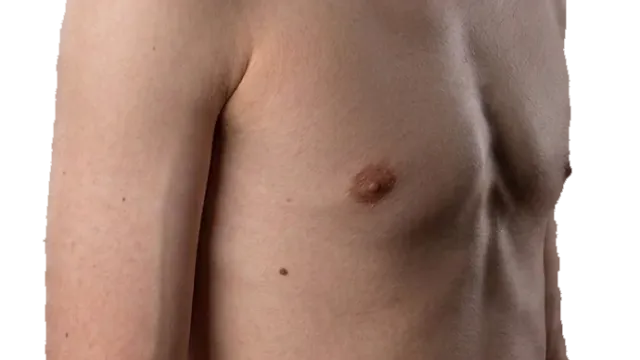
Pigeon chest is a breastbone pushed forward by rib cartilage that grows too long for its frame (cartilage overgrowth). The bump usually sits on the lower breastbone. An upper bump below the collarbones is rare and stiffer, and one side can stand out more. Types, causes and a home press test are in what pectus carinatum is. In the Southampton series, most had a lopsided (asymmetric) bump, more often on the right.
Breasts change the picture. A private surgeon-led chest wall clinic in London writes that breast development can partly hide the deformity and make it harder to assess, and that breast asymmetry is common in carinatum, so it plans for that in brace fitting and surgery. That’s a clinic’s description, not a measured rate. I found no study that measured breast position or size in women with pectus carinatum.
My reading, not a finding: with a lopsided bump, one breast sits on chest wall that’s further forward, so your breasts can look uneven or set apart even if they’re a similar size. Whether it’s the chest, the breasts or both is something an examination can answer and a mirror can’t.
One pattern is worth knowing by name. Poland syndrome is an underdeveloped or missing chest muscle on one side, often with an underdeveloped breast on that side and sometimes rib or hand changes, says a 2021 review. It can come with a chest wall deformity. If one breast is much smaller and the muscle above it looks thin or absent, raise it with a doctor. In Amsterdam’s 10-year bracing cohort, Poland and Marfan syndrome went with poorer results.
I found no research on how pigeon chest shows in clothes. With bras, the centre panel (the gore) and the underwires can press on the ridge instead of lying flat. Fit checks are in my bra guide, which has a carinatum section.
Symptoms, and when to see a doctor
Cleveland Clinic says most people with pectus carinatum have no symptoms, and some get chest pain with certain activities or positions. The University of Rochester’s chest wall centre says it isn’t typically linked to heart or lung problems.
Pain is where girls stand out. In the Southampton series, 44% of the girls came in with pain, against 26% of the boys. A referral clinic sees the children someone was worried enough to bring in, so that describes them, not every girl with a bump.
The London clinic describes pain or tenderness that’s often worse lying face down or when something presses on the breastbone. It also notes that some patients have mitral valve prolapse, a heart valve that bulges back slightly as it closes, which can cause palpitations and warrants a heart ultrasound (echocardiogram) if suspected.
When to see a doctor first
See a doctor before you start a brace or an exercise plan if you have:
- chest pain that is new or getting worse
- real breathlessness, not just being unfit
- palpitations
- a bump that is changing fast
- a diagnosed heart or lung condition
- Marfan syndrome or Ehlers-Danlos syndrome, or a doctor has raised either
- previous chest wall surgery
- symptoms nobody has checked yet
Breast changes have their own list. The NHS says to see a GP if you have a lump in your breast or armpit, a nipple that turns in, dimpled skin on the breast, bloodstained discharge from a nipple, or any other unusual change in your breasts. Add one more from above: a breast that’s much smaller, with a thin or missing chest muscle above it.
Girls: growth spurts, breasts and the bracing window
Girls usually hit their growth spurt earlier than boys. The Merck Manual puts girls’ spurt between about 9½ and 13½, peaking between 11 and 12½. For boys it’s about 12 to 16, peaking at 13 to 14. That fits the Southampton finding that girls’ ridges showed up earlier.
The growth spurt matters for bracing, and the studies set limits at both ends. Amsterdam’s 10-year study of 631 braced patients concluded that bracing before the growth spurt should be discouraged. In Calgary, among 98 braced patients, those who started before Tanner stage IV corrected in 4.2 months on average, against 8.0 months for later starters. Tanner stages are the five steps doctors use to rate how far puberty has got. In girls, breast development is one of the things rated, and stage IV is the last step before full adult development.
Putting those together, my own reading is that a girl’s best bracing window probably opens earlier than a boy’s, and it overlaps the years her breasts are developing. No study I found tested a bracing age for girls, so I won’t give you one. If a girl’s bump is growing, get it assessed while she’s still growing, and let her and a specialist decide when.
Your options, by what each one changes
Some options move the breastbone. Others only change how your chest looks.
| Option | Moves the breastbone? | Changes the look? | What’s different for women |
|---|---|---|---|
| Posture and training | No | Changes posture and the muscle around the bump, not the bump | No women-specific study found |
| Brace | Yes, on a chest that still gives | Yes, when it works | Girls are 6% to 22% of the braced groups above. Pads can be sized to breast size in one system. Effects on breast development not studied |
| Ravitch operation | Yes | Yes | Can be done through cuts under the breasts (one small series that doesn’t say how many had carinatum). No significant breast asymmetry after repair in one surgeon’s female series (both chest types) |
| Reverse Nuss | Yes | Yes | One published case in a woman, with breast implants later. Where the side cuts go is worth asking about |
| Breast implants | No | Yes | Low-profile implants preferred on chests that stick out, in one clinic’s series |
Training builds the frame around the bump, not the bump itself. That side is covered in pectus carinatum exercises.
Bracing with breasts: what’s known and what isn’t
A carinatum brace is a frame with a pad that presses on the high point of the bump, worn for months while the cartilage reshapes. Hours, costs, results and choosing one are in my pectus carinatum brace guide. This section covers what changes when there’s breast tissue in the way.
What the studies cover
Mostly boys, as the bracing rows in the table show. Two bracing cohorts tested sex as a possible factor. What they linked to longer treatment or failure was bump height, high starting pressure, asymmetry, older age and a smaller early drop in pressure. Sex wasn’t on the list.
That isn’t proof a brace works as well for you. With girls a small minority in these studies, a difference could easily go unseen. A 2023 journal letter is titled on exactly this, bracing in female patients, but it sits behind a paywall and I couldn’t read it, so nothing here relies on it.
Pads and breast tissue
One concrete detail comes from the FMF Dynamic Compressor, a pressure-measuring brace system from Argentina. In a 2016 technique paper, its developers write that it can use 1 to 3 pads depending on breast size, for comfort, and that the pads help girls with developing breasts tolerate the pressure. They designed it, so they’re describing their own product.
A London orthotics clinic put the difficulty plainly in a 2016 blog post: with women there is “less area in which to apply the brace’s necessary pressure.” The London surgical clinic above says it checks where the breasts sit relative to the brace’s contact points. At least two brace makers advertise designs for girls. I found no published outcome data for any of them.
What nobody has measured
Whether a brace affects breast development, or breast tissue at all. A PubMed search for bracing and breasts in carinatum (October 2026) turns up two papers, neither on breast effects. One US brace seller claims other braces may harm developing breast tissue. I found no study behind that, and none showing braces are safe for breast tissue either. Not studied isn’t safe, and it isn’t harmful. It’s a reason to ask.
Questions to ask before a fitting
- Where exactly will the pad sit, and does it stay on the breastbone or touch breast tissue?
- What should I wear underneath? Can I wear a bra under it, and which kind?
- How will you adjust the brace as my breasts grow?
- How often will you check my skin, including around and under the breasts?
- What do I do if a breast gets sore or the skin breaks?
- I’ve had breast surgery. Is it too soon? (The carinatum brace I sell asks anyone who’s had chest, heart or breast surgery in the last six months to speak to a doctor first.)
Surgery, scars and breast implants
Surgery is usually for a chest too stiff to brace, or when bracing has failed. For women, the extra questions are where the scars go and what happens to the breasts.
The Ravitch operation
The Ravitch removes the overgrown cartilage, not the ribs, sometimes cutting the breastbone to reposition it, often with plates holding it while it heals. At one Amsterdam centre, 92.4% of 105 patients had a successful result, 32.4% had complications and 6.7% needed more surgery.
One long record in women comes from Eric Fonkalsrud at UCLA. Of the 154 patients he repaired for carinatum with symptoms, 35 were women. In a separate series of female patients repaired over 33 years, 104 with excavatum and 21 with carinatum, 96% rated the result very good or excellent after a mean of six years. None had significant breast asymmetry after repair. That’s one surgeon, both chest types pooled, some of it decades old.
The scar can go under the breasts. A Turkish team repaired 12 female patients since 1991 through two 4 to 5 cm inframammary incisions, cuts in the fold under each breast. All 12 were satisfactory, with one seroma (a fluid pocket under the skin), one pneumothorax (air around a lung), no recurrence, and normal breast development and feeling. The abstract doesn’t say how many had carinatum, and its conclusion is about excavatum.
Reverse Nuss
The reverse Nuss, also called the Abramson procedure, places a curved bar over the front of the breastbone through cuts at the sides of the chest, pressing it back. A series using a similar bar, co-authored by Prof. Yüksel, covers 172 patients from 2006 to 2016 (mean age 17.3). It reports 93.8% excellent results at follow-up after bar removal, with the bar out after 2 to 3 years, and complications including pneumothorax, wire breakage, infection and severe pain. Its abstract doesn’t split results by sex.
In women, I found one published case: a 24-year-old in Romania with no heart or lung symptoms but a real psychological toll. She had a reverse Nuss, then implants for underdeveloped breasts 10 months later, with a satisfactory result. It’s one woman.
The side cuts raise a question. In a study of 13 girls who had a Nuss repair for excavatum before puberty, a cut straight across the side of the chest was followed by a dent in 4 of 8 breasts once they developed, and a bar tunnel above the muscle by a flattened lower fold in 6 of 10. None of the 8 breasts with an angled cut along the sixth rib and a tunnel under the muscle was deformed. That’s excavatum, not a carinatum rule, but ask any surgeon where the cuts will go relative to your breasts.
Breast implants
Implants change the look, not the bone. Fonkalsrud’s female series concluded that prostheses don’t help the physical symptoms. In a Turkish series of 406 women having breast augmentation at one clinic, 5 had carinatum (1.23%). For chests that stick out, the surgeon preferred low-profile implants, because high-profile ones over-project and make asymmetry stand out. With five women, that’s one surgeon’s approach.
Order is a surgeon’s call. The London clinic discusses breast surgery in stages or at the same time as the chest, and the Romanian case was staged. If you already have implants, ask whether they should come out first. One US centre found more infections when implants were in place during pectus repair in 456 women (447 with excavatum, 2 with carinatum), and in 2026 advised taking them out first and replacing them later. Nearly all of those women had excavatum, so for carinatum it’s a question to raise with your surgeon.
Costs and insurer rules are in my pectus surgery guide.
Pregnancy
I found no research on pectus carinatum and pregnancy. A PubMed search (October 2026) turns up 11 papers, all about syndromes or genetics, and Fonkalsrud’s 21 women with carinatum came with no pregnancy data. On breastfeeding I found nothing at all. So any effect is unknown, in either direction.
If you’re pregnant or planning to be, tell your obstetric team about your chest, and speak to a doctor before wearing any brace. The product page for my own brace says the same. My pregnancy page is mostly about excavatum, with a short carinatum section.
Confidence and how you see your chest
Girls seem to carry it harder. In a 2026 Ankara study of 50 children in brace treatment, girls reported more body-image disturbance and more social disadvantage than boys, while physical limitation was low and motivation high in both. Fifty children is a small group, so take it as an early signal.
How bad it looks doesn’t predict how bad it feels. A 2021 study compared 90 adolescents with carinatum, 90 with excavatum and 90 without either. How they rated the look of their own chest went with their physical and psychosocial scores. How severe the deformity was didn’t. It was co-authored by Prof. Yüksel, and the abstract doesn’t split results by sex.
So a mild chest can still weigh on you. That’s worth taking seriously, and it isn’t vanity.
Where to start
If anything on the red-flag lists fits you, see a doctor first. If you’re pregnant, start with your obstetric team. If your breasts and chest are uneven and you’re not sure why, a chest wall specialist can tell you whether it’s the chest, the breasts or both.
Otherwise, find out where you stand. My free 1-minute quiz points you to a next step that fits your chest. Then expect an honest timeline. Structural change is measured in months and years. In the bracing studies above, the active phase averaged roughly 4 to 8 months, and Calgary’s protocol then adds night wear until growth ends.
Sources
- Bough GM, et al. Pediatr Surg Int. 2025;42(1):56. Read it
- Pectus Carinatum. Cleveland Clinic. Last updated 2023 Aug 11 [cited 2026 Oct 20]. Read it
- Shang Z, et al. Biomed Res Int. 2021;2021:6942329. Read it
- Fonkalsrud EW, Anselmo DM. J Am Coll Surg. 2004;198(6):898-905. Read it
- Kuru P, et al. Korean J Thorac Cardiovasc Surg. 2016;49(1):29-34 (co-authored by Prof. Yüksel). Read it
- de Beer SA, et al. Semin Pediatr Surg. 2018;27(3):175-82. Read it
- Emil S, et al. Eur J Pediatr Surg. 2026;36(5):378-84. Read it
- Kang DY, et al. Interact Cardiovasc Thorac Surg. 2014;19(6):900-3. Read it
- Pectus carinatum. Pectus Clinic, London. [cited 2026 Oct 20]. Read it
- Hashim EAA, et al. Transl Pediatr. 2021;10(4):1008-19. Read it
- van Braak H, et al. Ann Thorac Surg. 2024;117(1):144-50. Read it
- Pectus carinatum. Center for Chest Wall Reconstruction, Golisano Children’s Hospital, University of Rochester Medical Center. [cited 2026 Oct 20]. Read it
- Breast lumps. NHS. Reviewed 2023 Jun 28 [cited 2026 Oct 20]. Read it
- Graber EG. Physical growth and sexual maturation of adolescents. Merck Manual Professional Version. Reviewed 2025 Jan [cited 2026 Oct 20]. Read it
- Lee RT, et al. J Pediatr Surg. 2013;48(1):184-90. Read it
- de Beer S, et al. J Pediatr Surg. 2023;58(8):1440-5. Read it
- Emil S, et al. J Pediatr Surg. 2017;52(1):124-9. Read it
- Martinez-Ferro M, et al. J Vis Surg. 2016;2:57. Read it
- Female pectus conditions. London Orthotic Consultancy blog. 2016 Jun (archived copy) [cited 2026 Oct 20]. Read it
- Fonkalsrud EW. Am J Surg. 2004;187(2):192-7. Read it
- Okay T, et al. Interact Cardiovasc Thorac Surg. 2004;3(1):95-8. Read it
- Yüksel M, et al. Ann Thorac Surg. 2018;105(3):915-23 (co-authored by Prof. Yüksel). Read it
- Ciurea M, et al. Chirurgia (Bucur). 2014;109(1):136-8. Read it
- Kimura H, et al. J Plast Reconstr Aesthet Surg. 2015;68(5):692-7. Read it
- Ors S. Aesthetic Plast Surg. 2017;41(6):1280-90. Read it
- Khedr AE, et al. J Am Coll Surg. 2026;243(1):130-40. Read it
- Beydeş M, et al. Pediatr Surg Int. 2026;42(1):409. Read it
- Alaca N, Yüksel M. Pediatr Surg Int. 2021;37(6):765-75 (co-authored by Prof. Yüksel). Read it
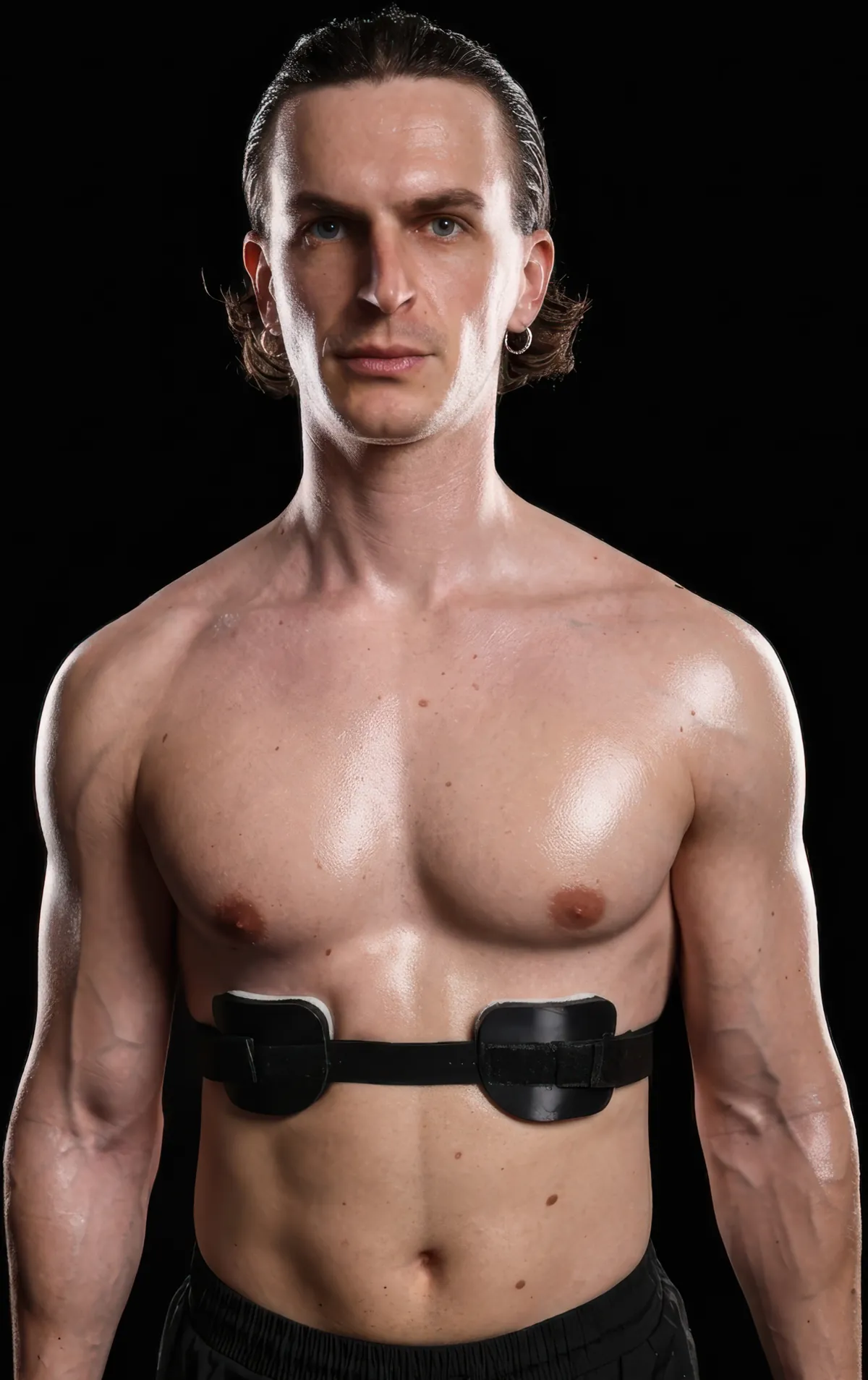
Compression alone is a device. The course is the fitting, the pressure calibration and the wear schedule that turn it into correction.
- Fitting and pressure calibration
- The wear schedule people actually hold
- The exercise pairing that keeps the result

This article is for educational purposes only and does not constitute medical advice. Always consult a qualified healthcare professional before starting any treatment plan. View full disclaimer →