Contents · 12 sections
Everyone’s in the pool and your shirt is still on. Or you’re in the changing room facing the wall, getting changed as fast as you can before anyone looks. People keep telling you it’s not that bad. It doesn’t help.
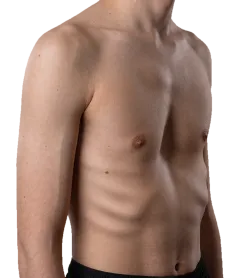
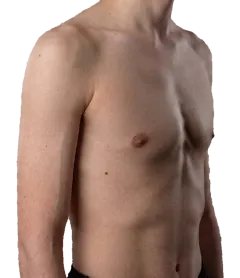
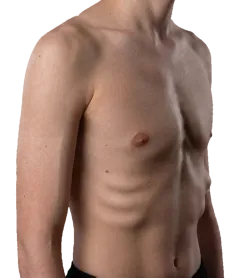
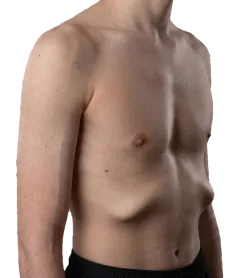
Confidence with pectus excavatum gets built one situation at a time: the changing room, then the pool, then the comment from a friend. It doesn’t have to wait for your chest to change. The research points the same way: how you see your chest matters more to how much it bothers you than how deep it measures. That’s useful, because how you see it is something you can work on this week.
I had pectus excavatum. I was diagnosed at 15 and corrected it without surgery over about three years, and the result was visible and measurable, but not complete. I’m not a doctor. Below, pectus studies explain why this hurts, and general body-image research, done in people without pectus, supplies most of what helps. I’ll say which is which.
Why your chest bothers you more than its depth suggests
Prof. Mustafa Yüksel, who reviews medical content on this site, co-authored a 2021 Istanbul study of 180 adolescents aged 10 to 18 with pectus, plus 90 without. Half had pectus excavatum and half pectus carinatum, where the chest sticks out. How the teenagers saw their own chest was linked to how they were doing physically and socially. How severe their chest measured wasn’t.
Other groups point the same way. In 129 people booked for pectus surgery in Tokyo, self-efficacy, your belief that you can handle things, was lower than in the general population, and none of the psychological scores tracked how severe the chest was. Across 264 patients aged 8 to 21 at 11 North American children’s hospitals, social and emotional functioning before surgery was unrelated to severity on CT. Depth isn’t irrelevant: in 215 Dutch patients, deeper dents went with more distress, but only weakly. Depth matters a little. How you see it matters more.
If you keep your shirt on, you have company. At one Houston hospital, 42% of 57 under-18s seen for pectus said they were uncomfortable taking their shirt off in public. Their quality of life and anxiety screening results didn’t differ by Haller index, a scan measure of how severe the chest is. A 2026 review of the research reports that 44% to 57% of adolescents with chest wall differences deliberately hide their chest: layering clothes, folding their arms, skipping swimming.
Most of these numbers come from clinic samples: people who went to a hospital about their chest, likely among the most bothered. Read them as “this feeling is common and real”, not “this is your future”. In a German group of 90 people seeking chest surgery, body image was far more disturbed than in a comparison group, but mental disorders weren’t more common. The distress is real. It doesn’t mean something is wrong with you.
Then there’s what the worry makes you do. Changing Faces, a UK charity for people who look different, describes self-confidence as situation-specific: you can trust yourself in one setting and not another. Feeling conspicuous can push you to cover up. My interpretation, and the idea behind the plan below: keeping the shirt on brings relief today and makes the next time a little harder, because you never find out it would have gone better than you feared.
Part of why it feels so big is the spotlight effect, our habit of overestimating how much other people notice us. In the original experiments, Cornell students in an embarrassing T-shirt guessed that more people had noticed it than really had. That was a T-shirt, not pectus, and it doesn’t mean nobody looks. The beach section below points to a way to test it on yourself.
Confidence doesn’t have to wait for your chest
Feeling better in your chest and changing your chest are two separate jobs, and they run on different clocks.
| When | What can change |
|---|---|
| This week | How you talk to yourself about your chest, how you stand in the moment, what you wear, one step on the ladder below, how much time you spend scrolling |
| Over months | Muscle, strength and body weight, and comfort on the harder steps of the ladder |
| Over months to years | The dip itself, if you choose to correct it: slow non-surgical correction, or surgery |
Training changes muscle, posture and strength, not where your breastbone sits (more in what training can and can’t change). Posture changes how deep the dip looks, not how deep it is.
Two honest limits. Self-help moves body image a little, not overnight: across 62 tests of body-image programmes in 3,846 people, the average improvement was small to medium. Those were general programmes, not pectus studies. And I couldn’t find a study testing confidence or body-image therapy in people with pectus. So the methods below are borrowed, and I’ll flag it each time.

How to get comfortable shirtless, step by step
The method is called exposure: small, planned steps into the thing you’ve been avoiding, repeated until it loses its charge.
The evidence first. A 2025 meta-analysis of trials found that deliberate body exposure, such as structured mirror exposure, moderately reduced body-image disturbance. A review of mirror exposure found it helped in trials, but most trials were small, few included men, and some reported adverse events. Both looked at people with body-image problems such as eating disorders or body dysmorphic disorder, not pectus. The ladder, the ratings and the move-up rule below are my rules, built on that idea.
- Write your ladder. List six to ten shirt-off situations, from the easiest to the one you dread most. An example, from the bottom up:
- In front of the mirror at home, whole body, for one minute. Each time, name at least two things you like, which is KidsHealth’s advice for teens.
- Shirt off around the house.
- A fitted T-shirt in public.
- Changing at the gym without hiding.
- Shirt off with one trusted friend.
- The pool or beach at a quiet time.
- Swimming at a busy time.
- A photo you don’t delete.
- Rate each step from 0 to 10, where 0 is no worry and 10 is the worst you can imagine.
- Start with a step that’s hard but doable. Around a 3 or 4 out of 10 is a good place. Not the 9.
- Repeat it. Do it several times over a week or two. Stay until the worry starts to ease, rather than leaving at its peak.
- Move up when a step feels about half as hard as it did at first. If it started at 6, wait until it’s around 3.
- Expect bad days. A step that felt easy on Tuesday can feel hard on Friday. Drop back one step, not to the start.
- Know your stop rule. If a step leaves you overwhelmed for the rest of the day, or checking the mirror or avoiding things is taking over, drop a step and talk to a professional. Where to start is in when it’s more than confidence.
At the gym and in the changing room
The gym is where your chest is most on show, and also a good place to build confidence.
In a meta-analysis of 2,991 children and teenagers, supervised physical activity improved self-concept and self-worth, more so in school and gym settings. Resistance training reduced depressive symptoms across 33 randomised trials, and anxiety symptoms in another review of trials. None of this was about pectus. In a lab study of 74 adults in New Zealand, people who sat upright through a stressful speech task reported higher self-esteem, better mood and less fear than people who slumped. That’s about how you feel in the moment, not about how others see you.
My rules for the changing room:
- Go at quieter times for the first few weeks, then at normal times.
- Treat changing as a ladder step. Change at a normal pace where you’d normally stand, not facing the corner.
- Walk in with a plan, so your attention stays on the workout.
- Train with a friend if you can, at least at first.
If you’re very skinny and that’s part of what bothers you, I’ve written about gaining weight with pectus. Before you train hard, check my list of reasons to see a doctor first.
At the beach or pool
What to wear, rash guards and the spotlight-effect exercise are all in how to hide pectus excavatum. Here’s how the ladder applies:
- Quiet first, then busy. An early or weekday swim before a packed Saturday.
- Take one friend who knows and doesn’t make a thing of it.
- Have a reply ready for a comment or a question. That’s the next section.
When someone comments on your chest
A reply you’ve practised comes out calmer than one you invent on the spot. In its guide to comments and questions, Changing Faces says people who comment on someone’s appearance are usually “thoughtless rather than malicious”, and suggests preparing three kinds of reply, from quietly confident to firmer to assertive.
Comments and jokes
Its options: walk away, let your face show you heard it, reply, or reassure yourself afterwards. If you reply, pick your lines now. Some to start from:
| What they say | Quietly confident | Firmer | Assertive |
|---|---|---|---|
| “What’s wrong with your chest?” | “Nothing’s wrong. My breastbone grew inward. You coming in?” | “It’s called pectus excavatum. I’m not getting into it right now.” | “That’s my body. Leave it.” |
| A joke about the dent | “Heard that one before. Your turn to jump in.” | “That one’s getting old.” | “Not funny. Drop it.” |
For afterwards, a line like “they saw my chest for two seconds, they don’t get the rest of my day” works better than replaying what you should have said.
Questions
People who ask usually mean no harm. Changing Faces lists four ways to answer, here with pectus lines:
- Decline: “It’s a chest thing. Not today.”
- Give some detail: “It’s called pectus excavatum. My breastbone grew inward, so there’s a dip in the middle.”
- Answer briefly and move on: “Just how my chest grew. Anyway, did you see the game?”
- Raise it yourself: “Heads up, my chest has a dip in the middle. Right, who’s swimming?”
If it keeps happening at school
In 337 children aged 6 to 16 seen at a hospital in Chengdu, China, being teased about pectus was one of the things linked to more psychological and social problems, as reported by parents. So don’t just put up with it.
KidsHealth’s bullying advice for teens: tell a trusted adult such as a parent, teacher or coach, report any threat of physical harm, stay with friends, and practise what you’ll say. You don’t have to sort it out alone.
For parents
Ask your teen directly how they feel about their chest. In the Houston study above, parents’ and children’s answers on quality of life and body image agreed only slightly, so don’t assume you know. University of Utah Health tells parents to listen, take their child’s feelings seriously, and get help from a qualified mental-health specialist if the distress is significant. My view: skip “it’s not that bad”. To them it is, and that’s what you’re responding to.
Social media and comparison
In one randomised trial, 220 Canadians aged 17 to 25 with symptoms of anxiety or depression who cut social media to an hour a day for three weeks felt better about their appearance than those who carried on as usual. One short study, not about pectus, but a cheap experiment to copy. My rule: set a daily app limit for two weeks and notice whether the mirror feels any different.
Changing Faces and KidsHealth both warn against comparing yourself with others, celebrities included. My view: the shirtless photos in your feed are chosen, lit, posed and often edited, so you’re comparing your bathroom mirror with someone’s best frame of the year.
If you want a comparison that helps, look up the celebrities with pectus excavatum.
How you talk to yourself about your chest
Across 59 studies, people with more self-compassion, treating themselves with the kindness they’d show a friend, had fewer body-image worries, and programmes that taught it beat comparison groups. Those studies were mostly in people with eating or body-image problems, not pectus.
The NHS advice on raising low self-esteem turns that into things you can do:
- Write down the belief and the evidence against it. “Everyone at the pool will stare at my chest” might get: “Last time, I couldn’t tell who’d looked. My friends were busy with each other.”
- List at least five positive things about yourself, including things other people have said.
- Answer yourself the way you’d answer a friend. You wouldn’t tell a friend their chest makes them a joke.
Changing Faces adds one more: when the negatives pile up, think of one thing you did this week that you’re pleased with. Going to the gym counts.
Staying motivated while correction is slow
Part of you may be furious that you have to do any of this, when your friends just take their shirts off. That’s fair, and you don’t have to argue yourself out of it first.
If you’re correcting your chest, it’s slow. Mine took about three years. My rules for staying with it:
- Count sessions, not mirror checks. A ticked-off session is progress. Checking the mirror ten times a day isn’t.
- Measure once a month, the same way each time. My home measurement guide shows how. Monthly numbers beat daily impressions.
- Keep the two jobs separate. Work on confidence now. Don’t make it wait for a number.
In a 12-week trial of 26 boys aged 11 to 18 in Istanbul, co-authored by Prof. Yüksel, the boys’ perception of their own chest improved with a vacuum bell alone and with physiotherapy added. The same 2026 review I mentioned earlier calls the data on the bell and psychological change limited, so I won’t promise the bell will make you feel better. More in vacuum bell therapy.
Surgery is a serious option and deserves respect. In the 11-hospital group above, social self-consciousness and body image improved after surgery. A 2023 meta-analysis of 7 studies (478 patients up to age 60) found self-esteem rose after the Nuss procedure, though its authors note little high-quality evidence. Options and recovery are in my pectus excavatum surgery guide.
When it’s more than confidence
Some worry about your chest is normal. It’s more than a confidence problem if the worry takes over your day, you check the mirror constantly or avoid mirrors completely, or your mood has dropped and stayed down.
Start with a GP or family doctor. In England, the NHS page above explains you can refer yourself to NHS talking therapies. For anxiety, low mood, body dysmorphic disorder and fuller help, see the psychological side of pectus excavatum.
If you’re thinking about hurting yourself, or you don’t feel safe, get help now. In the US, call, text or chat 988 any time, or text HOME to 741741. In the UK, call Samaritans free on 116 123, 24 hours a day. Anywhere else, findahelpline.com lists free helplines by country. If you’re in immediate danger, call your local emergency number.
Where to start
Pick the line that sounds like you.
- Taking your shirt off is the big one. Write your ladder tonight, using the step-by-step plan.
- Comments and teasing. Pick your three replies from when someone comments on your chest.
- A partner seeing your chest. That’s in dating with pectus excavatum.
- What to wear and swimwear. The beach and pool section links my clothing guide.
- You’re a woman with pectus. Start with pectus excavatum in women and girls.
- Your chest sticks out rather than in. Most of this still applies. The basics are in what is pectus carinatum.
- Thinking about correcting your chest. To see where yours stands and whether non-surgical correction is realistic, take my free 1-minute quiz.
- You want a structured version of this page. There’s my Confidence Program, a self-guided program based on cognitive behavioural therapy (CBT), with a 4-week daily plan. It’s my own product, and it doesn’t change your chest.
Whichever you pick, start smaller than feels necessary and give it weeks, not days. Confidence comes back one situation at a time. The chest, if you change it at all, takes months and years.
Sources
- Alaca N, Yüksel M. Pediatr Surg Int. 2021;37(6):765-75. Read it Co-authored by Prof. Mustafa Yüksel.
- Matsuda K, et al. JTCVS Open. 2024;19:355-69. Read it
- Kelly RE Jr, et al. Pediatrics. 2008;122(6):1218-22. Read it
- Janssen N, et al. Eur J Pediatr Surg. 2025;35(3):247-54. Read it
- Sutyak KM, et al. Surgery. 2025;185:109546. Read it
- Barmash EA, et al. Children (Basel). 2026;13(2):237. Read it
- Steinmann C, et al. Eur J Cardiothorac Surg. 2011;40(5):1138-45. Read it
- The effects of physical appearance on self-esteem when you have a visible difference. Changing Faces. [cited 2026 Oct 21]. Read it
- Gilovich T, Medvec VH, Savitsky K. J Pers Soc Psychol. 2000;78(2):211-22. Read it
- Alleva JM, et al. PLoS One. 2015;10(9):e0139177. Read it
- Weins H, et al. Behav Res Ther. 2025;194:104876. Read it
- Griffen TC, et al. Clin Psychol Rev. 2018;65:163-74. Read it
- Body Image and Self-Esteem (for Teens). KidsHealth (Nemours). Reviewed 2023 Jun [cited 2026 Oct 21]. Read it
- Liu M, Wu L, Ming Q. PLoS One. 2015;10(8):e0134804. Read it
- Gordon BR, et al. JAMA Psychiatry. 2018;75(6):566-76. Read it
- Gordon BR, et al. Sports Med. 2017;47(12):2521-32. Read it
- Nair S, et al. Health Psychol. 2015;34(6):632-41. Read it
- Handling comments and questions about your appearance. Changing Faces. [cited 2026 Oct 21]. Read it
- Ji Y, et al. Health Qual Life Outcomes. 2011;9:28. Read it
- Dealing With Bullying (for Teens). KidsHealth (Nemours). Reviewed 2023 Mar [cited 2026 Oct 21]. Read it
- Living with mild pectus excavatum. University of Utah Health. 2024 Mar 25 [cited 2026 Oct 21]. Read it
- Thai H, et al. Psychol Pop Media. 2024;13(1):162-9. Summarised in an American Psychological Association press release, 2023 Feb [cited 2026 Oct 21]. Read it
- Turk F, Waller G. Clin Psychol Rev. 2020;79:101856. Read it
- Raising low self-esteem. NHS. Page last reviewed 2023 Apr 11 [cited 2026 Oct 21]. Read it
- Alaca N, Alaca I, Yüksel M. Interact Cardiovasc Thorac Surg. 2020;31(5):650-6. Read it Co-authored by Prof. Mustafa Yüksel.
- Mohamed JS, Tan JW, Tam JKC. Ann Transl Med. 2023;11(12):407. Read it
- 988 Suicide & Crisis Lifeline. [cited 2026 Oct 20]. Read it
- Crisis Text Line. [cited 2026 Oct 20]. Read it
- Contact a Samaritan. Samaritans. [cited 2026 Oct 20]. Read it
- Find A Helpline. [cited 2026 Oct 20]. Read it
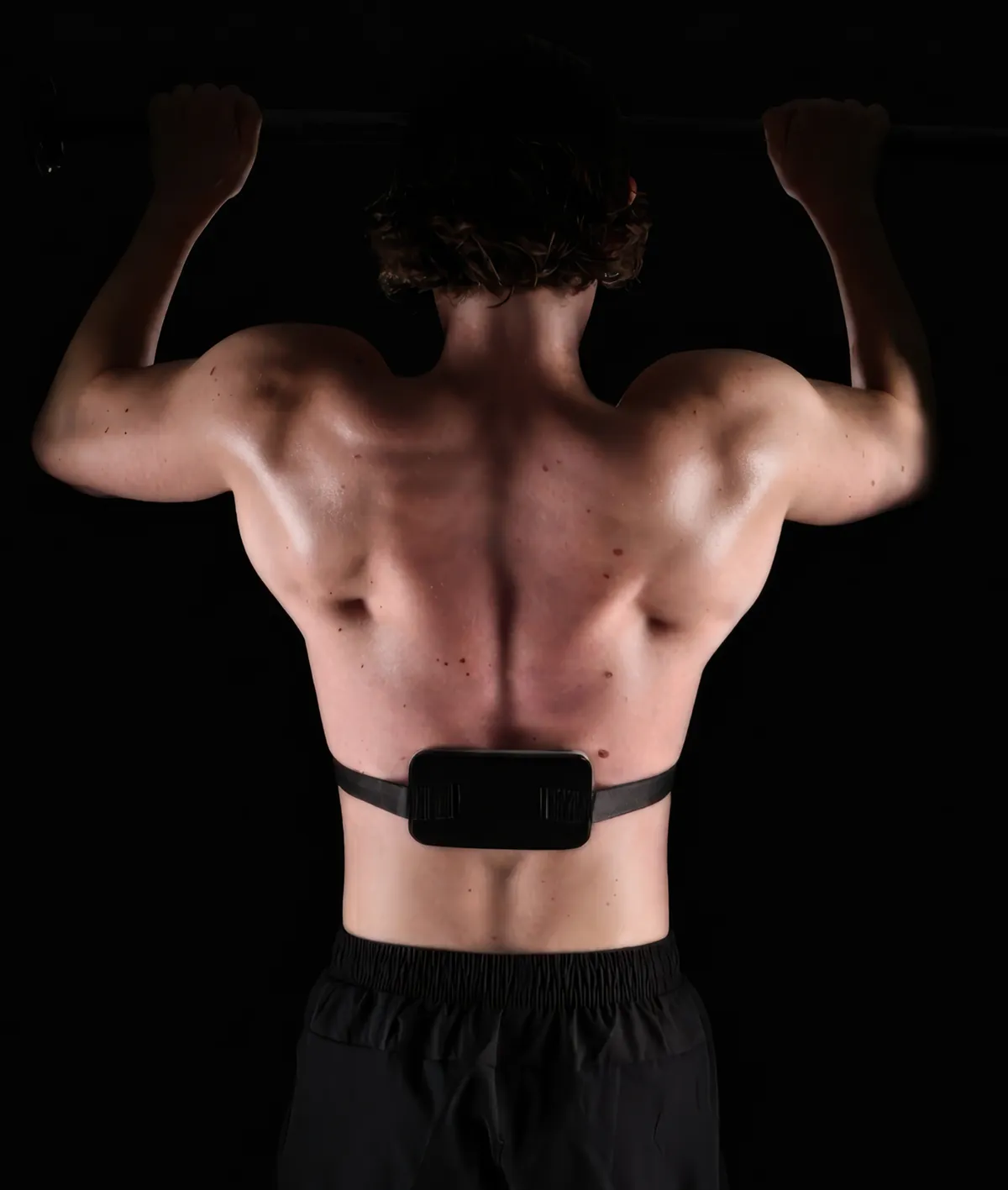
Correcting the chest takes months. Not letting it run your social life in the meantime is its own piece of work, and it is trainable.
- Body image work that is evidence-based
- Scripts for the conversations you dread
- Shirt off in public, worked up to properly

This article is for educational purposes only and does not constitute medical advice. Always consult a qualified healthcare professional before starting any treatment plan. View full disclaimer →