Contents · 9 sections
You’re at a party, a beach or a lake, and the shirts start coming off. Everyone else relaxes. You start working out how to keep yours on without anyone asking why, and for the rest of the day part of your head is busy with your chest instead of the people around you.
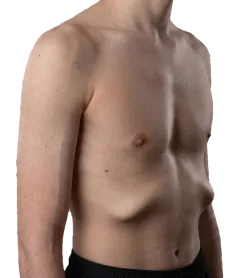
A sunken chest gives itself away through a few specific cues, and every trick below works on one of them. Every trick also has a limit. Clothes, posture, muscle, a tattoo or chest hair can change what people see, but none of them change the chest underneath. Hiding it is a perfectly good choice, and so is deciding to fix it later.
I was diagnosed with pectus excavatum at 15. I wore tight T-shirts I kept pulling down, and jackets when it wasn’t cold. Later I spent about three years correcting it without surgery. The result was visible and measurable, but not complete. I’m not a doctor. What follows is what helps in each situation, what each trick can’t do, and how to tell when hiding has stopped being enough.
Why a sunken chest shows, and what changes it
Three things give pectus away.
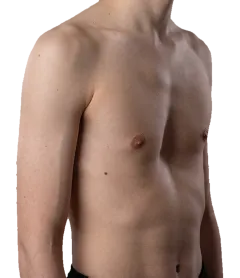
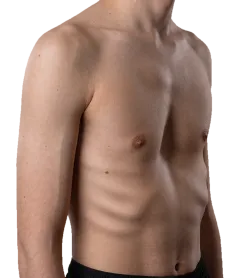
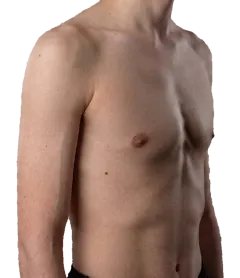
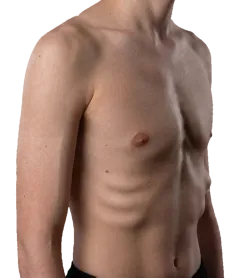
A shadow along the breastbone. Your breastbone (sternum) runs down the middle of your chest. When it sits lower than the ribs on either side, light from above or from the side leaves a shadow in the dip. It’s why your chest can look deeper under one light than another.
Fabric dropping into the dip. A thin T-shirt follows whatever is under it. Over a sunken chest it sags into the hollow, and a breeze pushes it in further.
Ribs and shoulders. Some people with pectus also have flared ribs, where the lower ribs stick forward. Rounded shoulders can make the upper chest look more hollow. Both change your outline in a T-shirt, even when the dent itself is covered.
Here’s the short version of what works on each.
| Situation | What helps most | Its limit |
|---|---|---|
| In a T-shirt | Heavier, looser fabric. A fitted undershirt or tank top underneath. | Two layers are hot in summer, and none of it helps once the shirt comes off. |
| Shirtless | Knowing others notice less than you think. Standing tall. Muscle on either side of the dip. | The dip is still there. Muscle frames it but can’t fill it. |
| Tattoo | Shading across the breastbone that breaks up the shadow. | Permanent, painful over bone, and the shape under it changes if you correct your chest later. |
| Chest hair | Keeping it, which softens the shadow. | It can stop a vacuum bell from sealing if you use one. |
| Long term | Posture work, balanced training, and gaining weight if you’re very lean. | Changes your outline, not the depth of the dent. |
Clothes that hide pectus excavatum in a shirt
What makes it more visible
Two things made my chest show through my clothes more than it needed to.
The first was thin T-shirts with a big print on the front. Every time I wore one, the front dropped into my dent, and on a windy day it was worse.
The second was tight T-shirts. I was a skinny hard gainer and, being honest, I wore them to look bigger. They also showed my ribs poking out at the bottom of my chest, so I was forever pulling the shirt down, and I ended up more self-conscious, not less.
Necklines matter a little too. A crew neck covers the top of your breastbone, while a deep V opens right onto it. And I’m not a fan of polos, because on me they make my pecs look oddly big.
What works
These days I wear heavy cotton T-shirts in an oversized cut, plus hoodies and sweatshirts. Heavy cotton holds its own shape instead of following yours, so it sits over the dip rather than sinking into it. The boxy cut covers flared ribs and makes your shoulders look broader. Jackets do the same job, which is probably why I wore one even when I didn’t need it.
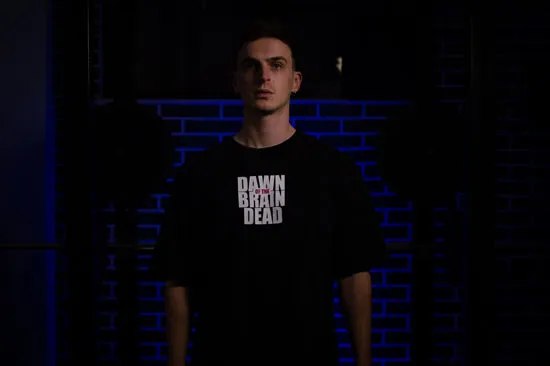
A print isn’t the problem by itself. On a heavy, loose tee like this one it sits flat. It’s the thin, clingy tees with a heavy print that sag.
Wear an undershirt or tank top
The simplest fix for fabric dropping in is a fitted layer underneath. A tank top or a tight undershirt under a heavier T-shirt gives the outer shirt a smooth surface to sit on, so it stops sinking into the dip. It worked for me, though two layers in summer are hard going. To see whether it’s worth it for you, take two photos in the same light, front and side, with and without the undershirt.
Why not wrap your chest
You’ll find advice to wrap an elastic (ace) bandage around your chest so clothes can’t fall in. This page used to suggest it. It shouldn’t have. I found it uncomfortable, and a bandage that isn’t wrapped just right bunches up when you twist.
The bigger problem is what tight wrapping does over time. In a survey of 1,800 adults who bind their chests, over 97% reported at least one problem they put down to binding, such as pain, breathing trouble or skin problems, and elastic bandages were linked to 14 of the 28 problems the researchers tracked. They were flattening breast tissue, not covering a dent, so it isn’t a perfect match. But tight elastic around your ribs is still tight elastic around your ribs, and a fitted undershirt does the same job without squeezing.
Will anyone notice?
Some people worry that a crease down the middle of a T-shirt gives them away. I don’t think it tells a stranger anything. Shirts crease, and I doubt someone who has never heard of pectus excavatum reads a crease as a sunken chest in a short conversation.
You can test this on other people. Look up a few celebrities with pectus excavatum shirtless, then find photos of them fully clothed, and see whether you could have told from the clothed ones.
If you’re a woman with pectus, a bra changes the picture, and I’ve covered that in bras for a sunken chest.
Shirtless at the beach, pool or gym
This is the hard one, because clothes can’t help, and if it’s eating at you, you’re not unusual. In a 2025 study of children seen for pectus at a Houston hospital, 42% of the 57 patients said they were uncomfortable taking their shirt off in public. Those were young people who had already gone looking for care, so it doesn’t describe everyone with pectus, but it shows the feeling is common.
What helps put it in proportion is that people reliably overestimate how much others notice them. Psychologists call it the spotlight effect. In the original experiments, Cornell students wore an embarrassing T-shirt into a room of other students and then guessed how many had noticed it. They guessed too high. That was students and a T-shirt, not people with pectus and a bare chest, so take it as a rule about attention, not proof that nobody looks. Some people will notice, usually fewer than you expect.
You can check this yourself. Next time you’re at a busy beach or pool, write down how many people you think will look at your chest. Then take your shirt off and walk the length of the place once. Count the people who actually look at your chest, not just at you, and write that number next to the first one. No camera needed, and please don’t film strangers. The point is to swap a guess for an observation.
On the day itself, stand tall and keep your attention on the people you’re with.
If it’s a partner seeing your chest that worries you most, I’ve written about dating with pectus excavatum.
Posture, muscle and body weight
None of these change the bone. All of them change the outline around it, which is what people see in a T-shirt.
Posture
Pectus often comes with a rounded upper back. In a 2024 study of 22 teenagers with pectus excavatum, they had more upper-back rounding and less spinal mobility than healthy teenagers. It’s a small study, so treat it as a pattern, not a rule.
Straightening up changes your outline. Your shoulders sit back, your chest faces forward and your shirt hangs better, but the breastbone stays where it is. When researchers compared chest scans taken standing and lying down in 21 people with pectus and 35 without, body position changed the chest measurements in both groups, but the depth of the dent didn’t change significantly. That’s standing versus lying down, not slouching versus standing tall, but it points the same way.
When I was diagnosed, my doctor suggested yoga and Pilates. What I got from them was body awareness. I started noticing every time I hunched over my desk at school. If you want somewhere to start, I’ve put together yoga for pectus excavatum.
Chest and shoulder training
Bigger pecs won’t fill the dent, and it helps to know why. Your main chest muscle, the pectoralis major, attaches along the front of the breastbone and the upper rib cartilages and runs out to your upper arm. It grows on either side of the midline, not across it. So more muscle frames the dip without filling it.
Framing still helps in clothes. When I trained seriously, my bigger chest muscles held my T-shirts out over the dent, and broader shoulders change your proportions so clothes hang better.
Train the whole chest, not just the “inner chest”. The muscle can’t grow across the middle, so build it evenly. My own rule is to pair every pressing session with rows and upper-back work, because the rounded posture above is the one you’re trying to leave behind. That’s my opinion, not something a study has tested. For exercise choices, see exercises for pectus excavatum.
Body weight
Many people with pectus are lean. In one Polish study, boys with pectus excavatum had a significantly lower body mass index than boys without it. Very low body fat leaves nothing to soften the edges of the dip, so if you’re underweight, gaining some weight can make it look less sharp. Gaining weight doesn’t have to mean gaining a belly. I was the skinny hard gainer, and I’ve written up how to gain weight with pectus.
Pectus excavatum tattoos: cover it, work with it, or wait
I don’t have any tattoos. As a teenager I considered a chest tattoo to cover my dent, so I understand why people search for this. A tattoo is the one option on this list that works shirtless without changing your clothes or your body. It’s also the only permanent one.
Can a tattoo hide pectus excavatum?
It can change what people look at, but not the shape. Shading that runs across the sternum breaks up the shadow line that makes the dip read, and a design with its own depth, like a 3D or blackwork piece, gives the eye something else to land on. Side light will still show the dip.
Design directions
There are three broad ways to go. These are approaches, not a ranking.
- Cover it. Bold shading, blackwork, or a 3D or illusion piece across the breastbone.
- Work with it. A design that uses the hollow as part of the image, so the dip becomes a low point the artist drew on purpose.
- Frame it. A piece that spans both pecs, so the eye reads the whole chest as one image instead of landing in the middle.
One thing to raise with your artist. A strictly symmetrical design on an uneven chest may make the unevenness easier to spot, because the eye compares the two halves. That’s my reasoning, not a study, so ask someone who has tattooed uneven chests what they’d do.
How much it hurts
Tattoo guides such as Tattoodo’s say chest tattoos hurt because there’s little padding over the sternum and the artist has to press. I haven’t found anything on tattooing a sunken breastbone specifically, so I can’t tell you whether the dip makes it better or worse.
If you might correct your chest later
If you correct your chest, with vacuum bell therapy (a suction cup worn over the breastbone to lift it over time) or with surgery, the shape under the tattoo changes. A design drawn to break up a deep shadow, or a 3D piece built around the hollow, was made for a chest you may not have anymore. An illusion of depth stops reading as depth once the depth is gone.
There’s a practical clash too. A vacuum bell seals against the skin of your chest, and a brace presses on it. You shouldn’t put either over a fresh tattoo. Healthline says the outer skin of a tattoo looks healed in about two to three weeks, while the deeper layers keep healing for months, up to a year. I haven’t found guidance on exactly when a bell can go back over a tattoo. At the very least, wait until the skin has fully healed, and ask your artist and your doctor before you start again.
My rule of thumb:
- Still deciding whether to correct your chest? Wait on a permanent piece over the breastbone. Tattoos away from your chest won’t get in the way.
- Decided against correction, or already finished? Design for the chest you have now.
Choosing an artist
Pick an artist who has worked on uneven surfaces. Before they draw anything, show them your chest in side light, where the dip is most obvious, so they design for how it really looks.
Chest hair: keep it or shave it?
If you’re trying to hide a dent, chest hair is on your side. It breaks up the shadow along the breastbone a bit like shading does in a tattoo. That’s my opinion, not something anyone has measured. A shaved chest shows muscle definition better, and it shows the dip better too.
The exception is a vacuum bell. Hair can stop the bell sealing properly, so it loses pressure. I shave my chest, and shaving fixed the pressure loss I was getting with my bell. The wear and care instructions for the Klobe bell from Braceworks, a Canadian supplier, say the same thing: if chest hair interferes with the seal, remove it.
When hiding starts running your life
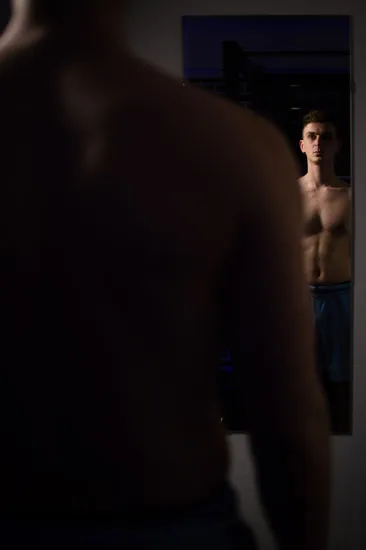
Hiding has a cost when it turns into checking. If you find yourself staring at your bare chest in the mirror, side-on, under different lights, step back and look at your whole body instead. Try not to let the mirror decide how your day goes. The UK charity Changing Faces has good guidance on appearance and self-esteem for people who look different.
If the checking takes up a lot of your day, or you’ve started avoiding mirrors completely, talk to a doctor or a therapist. The NHS lists both as signs of body dysmorphic disorder, where worry about how you look starts to take over. That doesn’t mean you have it, but it’s worth asking.
Before you go out, have a sentence ready for when the thought about your chest shows up. Something like: “My chest is less noticeable than I think. And if someone does see it, what’s the worst that can happen?” Or just remind yourself what tonight is actually about, which is the people you’re with.
And while you’re there:
- Be present in the conversation.
- Look the person you’re talking to in the eye.
- Remember you’re your own harshest critic.
- Your appearance doesn’t decide your worth.
Talk about it with someone you trust. Saying it out loud to one person can take some of the shame out of it. You’re also far from the only one. Estimates vary, but the Cleveland Clinic puts pectus excavatum at about 1 to 8 in every 1,000 people, more often in boys.
If anxiety is what drives the hiding, I’ve written about pectus excavatum and anxiety.
Hiding it or fixing it
Hiding is a valid choice. Plenty of people wear the right shirt, keep their chest hair and get on with their lives.
Correction is worth a look when hiding starts shaping your plans. You skip the beach every summer, you dread a partner seeing your chest, you avoid the gym changing room, or you’re putting off a tattoo until you know what your chest will look like.
Don’t judge this by how deep your dent is, because how much pectus bothers people doesn’t seem to follow how severe it is. In the Houston study, quality of life and anxiety screening didn’t differ between milder and more severe chests, measured by the Haller index (the usual measure of how severe the chest is). A 2024 study of 129 people waiting for surgery in Tokyo found that 43% screened positive for social anxiety disorder, with no link to how severe their chest was. A mild chest can bother you a lot, and that’s reason enough to look at your options.
Surgery is one of them. In a study of 264 patients aged 8 to 21 across 11 North American children’s hospitals, how patients were doing psychologically before surgery wasn’t related to how severe their chest was, and after repair their body image and social self-consciousness improved. 97% said surgery improved how their chest looked. I’ve covered pectus excavatum surgery separately.
Non-surgical correction is the other route, and it’s slow. Mine took about three years, and the result was visible and measurable, but not complete. Structural change is measured in months and years.
One thing comes first. If you have chest pain, get short of breath, have a known heart or lung condition, have had chest surgery before, have Marfan or Ehlers-Danlos syndrome, or have symptoms nobody has checked, see a doctor before you try anything else. I’ve listed the symptoms worth getting checked.
If you want to know whether correcting your chest is realistic, start with my free 1-minute quiz. It gives you a sense of how significant your chest is and which non-surgical route fits your case. Hide it, fix it, or hide it while you fix it. Just make it a decision rather than a habit.
Sources
- Peitzmeier S, Gardner I, Weinand J, et al. Health impact of chest binding among transgender adults: a community-engaged, cross-sectional study. Cult Health Sex. 2017;19(1):64-75. Read it
- Sutyak KM, Hebballi NB, Bidart Y, et al. Is it time to expand the surgical criteria? The psychosocial impact of pectus excavatum in pediatrics. Surgery. 2025;185:109546. Read it
- Gilovich T, Medvec VH, Savitsky K. The spotlight effect in social judgment: an egocentric bias in estimates of the salience of one’s own actions and appearance. J Pers Soc Psychol. 2000;78(2):211-22. Read it
- Mete O, Işik H, Pirinççi CŞ, et al. Spinal posture, mobility, and position sense in adolescents with chest wall deformities: a comparison of pectus excavatum, pectus carinatum and healthy peers. Pediatr Surg Int. 2024;40(1):178. Read it
- Suzuki T, Asakura K, Yamada Y, et al. Thoracic posture-related morphological changes in patients with pectus excavatum versus healthy controls. Eur J Cardiothorac Surg. 2024;66(5):ezae408. Read it
- How long does a tattoo take to heal? Healthline. Updated 2026 Mar 20. Read it
- Vacuum Bell wear and care instructions. Braceworks. 2022 Sep 23. Read it
- Effects of physical appearance on self-esteem. Changing Faces. [cited 2026 Oct 19]. Read it
- Body dysmorphic disorder (BDD). NHS. Page last reviewed 2023 Oct 18. Read it
- Pectus excavatum. Cleveland Clinic. [cited 2026 Oct 19]. Read it
- Matsuda K, Fujisawa D, Masai K, et al. Quality of life, psychological states, and personality traits in patients with pectus excavatum. JTCVS Open. 2024;19:355-369. Read it
- Kelly RE Jr, Cash TF, Shamberger RC, et al. Surgical repair of pectus excavatum markedly improves body image and perceived ability for physical activity: multicenter study. Pediatrics. 2008;122(6):1218-22. Read it
Correcting the chest takes months. Not letting it run your social life in the meantime is its own piece of work, and it is trainable.
- Body image work that is evidence-based
- Scripts for the conversations you dread
- Shirt off in public, worked up to properly

This article is for educational purposes only and does not constitute medical advice. Always consult a qualified healthcare professional before starting any treatment plan. View full disclaimer →