Contents · 10 sections
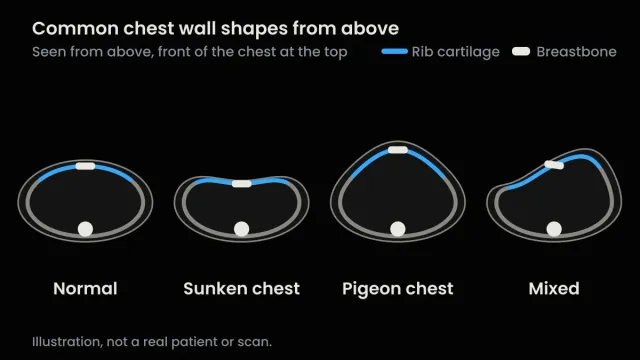
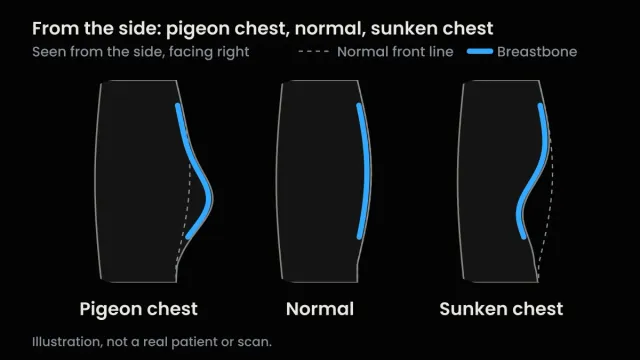
Pectus excavatum is a condition where the breastbone grows inward, leaving a dip in the front of the chest. You’ll also see it called sunken chest, funnel chest or concave chest. It can be a shallow dent you only notice in certain light, or a hollow deep enough that the middle of the chest looks scooped out.
If you’ve just noticed one in yourself or your child, start here. Most cases are mild, and most people with it have no physical symptoms at all, according to the 2024 Pectus Care Guidelines, a consensus written by cardiothoracic, pediatric surgery, orthopedic and Marfan societies. It isn’t caused by anything you did. A smaller group have a chest deep enough to affect the heart and lungs, and that group needs a doctor before anything else.
This guide helps you work out which group you’re probably in, what a severity number does and doesn’t tell you, and what each option actually delivers, with the real numbers.
I was diagnosed with pectus excavatum at 15. I declined surgery and corrected it over about three years of daily vacuum bell use and structured training. The change was visible and measurable, but not complete. I’m not a doctor, so the medical points here come with the study or clinical guide behind them.
What pectus excavatum is
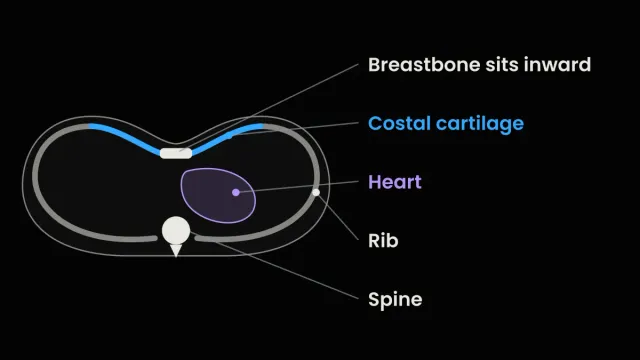
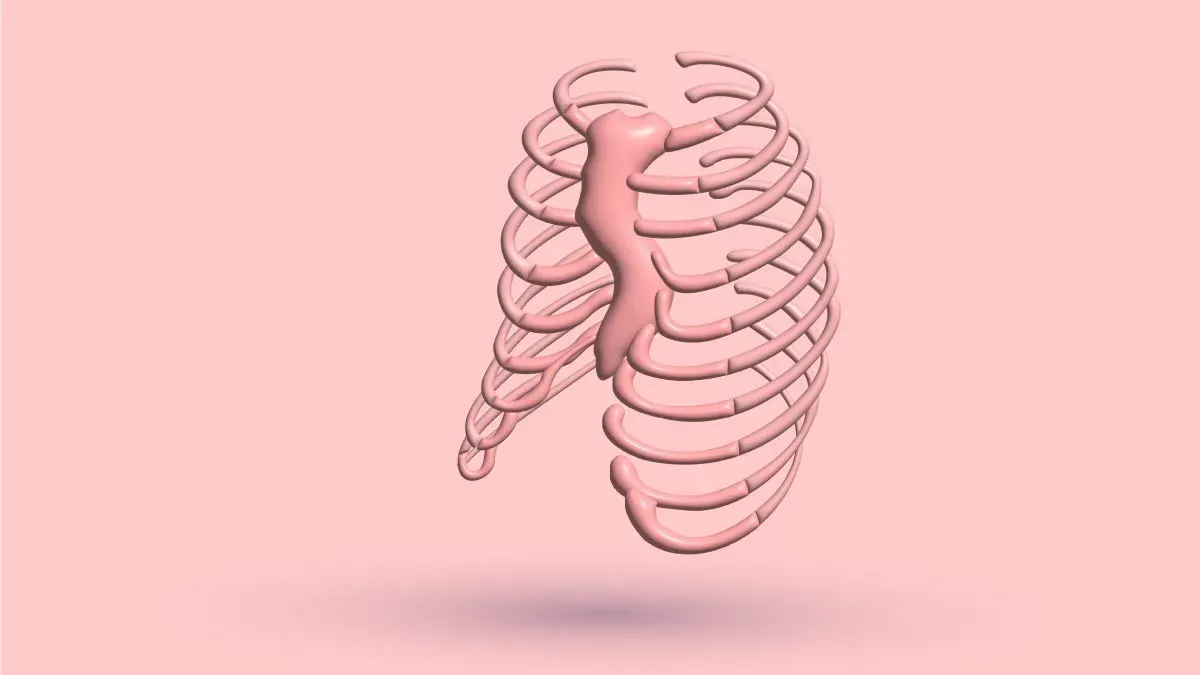
Your sternum, or breastbone, runs down the middle of your chest. Your ribs join it through costal cartilage, the flexible strips at the front of the ribcage. In pectus excavatum, the breastbone and that cartilage grow inward instead of lying flat. Cleveland Clinic describes the dent as involving four or five ribs on each side.
The dip can sit right in the middle or lean more to one side. Some people also have lower ribs that stick out at the bottom of the ribcage, which is called rib flare. The opposite condition, where the breastbone pushes outward, is pectus carinatum, or pigeon chest.
It’s a structural condition of the chest wall, not an infection. You can’t catch it from someone or give it to anyone.
How common it is
It’s the most common chest wall condition people are born with. Cleveland Clinic puts it at about 1 to 8 people per 1,000, and it happens more often in boys. Surgical reviews put the ratio at roughly four to five boys for every girl. Estimates vary between sources, so treat any single figure as a rough guide.
What causes it
Nobody knows exactly. The problem lies in the costal cartilage, but why it grows this way is still unknown. I go through each theory, and how strong the evidence is for it, in what causes pectus excavatum.
It often runs in families. Cleveland Clinic says 40% to 53% of people with pectus excavatum have a relative with it, and a 2022 German study of 78 patients found a family history in 54%. No single gene has been identified.
It can also come with connective tissue conditions such as Marfan syndrome and Ehlers-Danlos syndrome. Mayo Clinic also lists osteogenesis imperfecta, Noonan syndrome and Turner syndrome as risk factors. In one US series of 1,215 people who had the Nuss procedure, 2.8% had confirmed Marfan syndrome. Those were chests severe enough for an operation, so the figure doesn’t tell you the rate in milder cases. If you or a doctor suspect Marfan or Ehlers-Danlos, it’s one of the red flags further down.
It isn’t caused by anything you did, and that includes bad posture. Posture does change how it looks, though. Rounded shoulders and a slumped upper back can make the dip look deeper than it is. That’s appearance, not the breastbone moving.
When it shows up, and whether it gets worse
Mayo Clinic says a sunken breastbone can often be seen shortly after birth. It’s also often missed early. At one large US center, only 22% of patients had it noticed in their first decade. The same surgeons describe it progressing slowly through childhood, then often deepening quickly at puberty. That’s why so many people first notice it as teenagers, during the growth spurt.
After growth finishes, it varies. Mayo Clinic notes that in some people the dip keeps getting deeper into adulthood, and Cleveland Clinic says symptoms may increase with age.
Don’t expect it to go away on its own. None of the studies or clinical guides behind this page describe an established sunken chest flattening out without treatment.
If you’re a parent, your child’s age changes what makes sense, from watching and measuring to the timing of any treatment. I’ve put that in a separate guide to sunken chest in babies and children.
How severe is yours?
A doctor confirms pectus excavatum with a physical exam. To see how much it affects you, they may order some of these:
- a CT, X-ray or MRI scan of the chest, to measure the dip
- an ECG (a heart rhythm tracing) and an echocardiogram (an ultrasound of the heart)
- lung function tests
- an exercise test, to see how your heart and lungs cope under effort
The Haller index
The standard severity number is the Haller index, also called the pectus index. On a CT scan, the widest inside width of the chest is divided by the shortest distance between the back of the breastbone and the front of the spine, as Haller and colleagues defined it in 1987. A deeper dip shrinks that second distance, so the index goes up.
What the numbers mean:
- About 2.5 is average for a chest without pectus excavatum.
- 3.25 or more is usually called severe.
- Mild and moderate have no agreed cut-offs. The guidelines and studies cited here define severe, not the bands below it, so treat exact mild and moderate ranges you see quoted as rough labels, not a standard.
What the number doesn’t tell you:
- It shifts with breathing. The 2024 guidelines note it can read up to 30% higher at the end of a breath out than at the end of a breath in.
- It describes shape, not symptoms. It says nothing about how you feel or how your heart and lungs are working.
- It doesn’t always need CT. In one small study of 32 children, a plain two-view chest X-ray gave a number close to the CT result.
- It doesn’t decide surgery on its own. In the guidelines, the clearest case for surgery is an index above 3.25 together with tests showing the heart is being compressed. In the 1,215-patient series above, people offered surgery needed symptoms, a severe chest and at least two objective findings, such as an index over 3.25, heart or lung compression, a heart valve problem or an abnormal heart rhythm.
There’s more on how the Haller index is calculated and used if you have a scan in front of you.
You can’t calculate a Haller index at home, because it needs a scan. What you can do is measure the depth of your dip the same way each time and take photos, so you can see whether it’s changing. I explain how in measuring pectus excavatum at home.
Is it dangerous?
For most people, no. The 2024 guidelines describe the majority of cases as mild and well tolerated. A small number of people have a chest that limits them physically, and symptoms at rest are rare.
Heart and lungs
In more severe cases, the breastbone takes up room the heart and lungs would otherwise use. The heart can be pushed to the left, and the right side of the heart can be squeezed. People in this group can get:
- shortness of breath during exercise, and less stamina than others their age
- chest pain
- palpitations, meaning a racing, pounding or irregular heartbeat
Mitral valve prolapse is a heart valve whose flaps bulge back when they close, which can let a little blood leak the wrong way. In the same 1,215-patient surgical series, 18% had it and 16% had an abnormal heart rhythm. The same caveat applies: these were chests severe enough for an operation. The numbers show these problems travel together in severe chests. They don’t show the dip caused them. I go through heart problems with pectus excavatum in a separate guide.
Whether repair improves heart and lung function is a question where the research genuinely disagrees:
- An 11-center study of 327 patients found lung volumes improved modestly after repair, and exercise capacity improved in the 20 patients who had exercise tests before and after.
- A meta-analysis of 12 studies with 313 patients, meaning a study that pools earlier studies, found no significant change in lung function measured at rest.
- A review of five studies covering 118 patients found no reliable evidence that heart function improved.
The 2024 guidelines cite their largest cohort as showing improvement. So if someone tells you surgery will definitely fix your breathing, or definitely won’t, they’re ahead of the evidence.
Will it shorten your life? There’s no clear evidence it does. Cleveland Clinic says there’s no evidence it limits life expectancy. An older autopsy series from Johns Hopkins found mixed survival results, but many of those people had other syndromes and nobody knows how severe their chests were, so it can’t settle the question.
The mental side
Don’t skip this part because it isn’t physical. The guidelines note that some people develop low self-esteem or depression because of how their chest looks, and start avoiding swimming, dating or the beach. That’s a real effect of the condition, not vanity. The guidelines even list it as a reason surgery can help: they say there’s good evidence that people affected psychologically benefit from repair.
Hiding it under clothes is a fine short-term choice, and there are practical ways to hide pectus excavatum while you work on it. It shouldn’t be the whole plan if it’s keeping you out of the pool or out of relationships. I’ve written more about how pectus excavatum affects mental health.
When to see a doctor first
See a doctor before you start any device, brace or exercise program if any of these apply to you:
- chest pain
- fainting or nearly fainting
- breathlessness at rest or with light effort
- palpitations or an irregular heartbeat
- a diagnosed heart or lung condition
- Marfan syndrome or Ehlers-Danlos syndrome, or a doctor has raised either
- previous chest surgery
- a Haller index above 3.25 together with symptoms
- symptoms that nobody has checked yet
None of these means you’ll need surgery. They mean someone should look at your heart and lungs before you go further. The doctors who treat pectus excavatum are pediatric surgeons and thoracic (chest) surgeons who work with chest wall conditions, so that’s the referral to ask for.
Your options
What makes sense depends on four things: how deep the dip is, whether you have symptoms, how old you are, and how flexible your chest is.
Watching it and training around it
For a mild chest with no symptoms, leaving it medically alone is a legitimate choice. The surgeons behind the 22% figure above recommend deep breathing, posture work and aerobic exercise for mild to moderate cases.
Training builds the chest, shoulders and back around the dip, and a fuller frame makes the dip less noticeable. Breathing and posture work change how your chest sits and how it looks. If you want to start, these pectus excavatum exercises are a good place.
None of it moves the breastbone by itself. If someone sells you a workout as a complete correction, be skeptical.
Vacuum bell
A vacuum bell is a cup that seals over the dip and connects to a pump. Pumping the air out creates suction, and CT scans show it lifts the breastbone while it’s on. The aim of long, regular use is for the chest to hold more of that position on its own.
The 2024 guidelines call it a safe conservative treatment, with a moderate-strength recommendation, and advise professional supervision and an early assessment by a specialist.
What it achieves is less dramatic than most sales pages suggest. Here’s what the published studies found:
| Study | Patients | What happened | Limits |
|---|---|---|---|
| Obermeyer 2018, Norfolk, Virginia | 115 | 20% reached an excellent correction (a dip of about 0.5 cm or less) | Retrospective, one center |
| Aughtman 2025, same Virginia center | 278 analyzed out of 431 | 11% reached an excellent correction. 15.5% later had surgery, none of them from the excellent group | Retrospective, 153 lost to follow-up, 89% male |
| Toselli 2022, Argentina | 186 | 17% complete correction, 35% good or excellent | Retrospective, 34% stopped treatment |
| Koo 2025, Boston | 57 | Those who wore it about 28 hours a week corrected 28% of the dip’s depth, against 16% for those who wore it less | Small, retrospective |
| Gao 2020, China | 82 | 29.3% excellent (a dip of 3 mm or less on a 3D scan) by 12 months | Retrospective, patients wore it over 2 hours a day |
Each study defines “excellent” its own way, so don’t compare the percentages too closely. A near-flat result happened in a minority of patients, and a lot depended on who was wearing the bell.
The people who did best tended to be younger, started with a shallower dip (about 1.5 to 1.8 cm or less), had a flexible chest, used the bell for more than 12 months, and wore it more hours each week. In the Boston study, weekly hours mattered more than age once wear time was counted.
All five are retrospective, meaning the researchers looked back at patient records instead of running a planned trial, and most of the patients were children. A 2025 scoping review of 27 studies and 2,271 patients found the bell safe and effective for younger patients with mild to moderate pectus, while noting that high-quality randomized trials are missing. No randomized trial has compared the bell with surgery.
Reported side effects include bruising, tiny red spots on the skin (petechiae), chest pain and tightness. Healthline lists heart problems, bleeding disorders and musculoskeletal disorders as conditions that rule it out, so ask a doctor first if any of those apply.
The bell is the route I took, alongside structured training. My result fits the picture above: visible and measurable after about three years, not complete. That’s one person, not a study. For more on the evidence, see vacuum bell therapy.
Bracing
Braces press on the chest from the outside. The 2024 guidelines recommend bracing for pectus carinatum, where the breastbone sticks out, not for sunken chests.
Dr. Sydney Haje’s group in Brazil has published bracing results that include sunken chests. Over 32 years they saw 4,012 patients with pectus carinatum and excavatum. Of the 1,717 they re-evaluated, 60.6% of children and teenagers had good results, against 27% of adults. Both chest types are counted together in those figures, so they don’t give you the rate for sunken chests alone.
Surgery: Nuss and Ravitch
For a severe chest, surgery is a well-established option with strong published results, and choosing it is not a failure. It’s usually done in the teenage years, though adults have it too. There are two main operations.
| Nuss procedure | Ravitch procedure | |
|---|---|---|
| Type | Minimally invasive | Open repair |
| How it’s done | Small cuts on each side of the chest. Guided by a camera, the surgeon places one or more curved steel bars under the breastbone to push it forward | A cut on the front of the chest. The surgeon removes the overgrown cartilage, brings the breastbone forward and holds it with a plate and screws or a small bar |
| When the hardware comes out | After about 2 to 3 years. The guidelines say bars shouldn’t stay in long-term beyond about three years | After 6 to 12 months |
| Usually used for | Most symmetric chests, and usually the first choice | Asymmetric or more complex chests |
The guidelines rate the two as having similar surgical risks and effectiveness. The Nuss procedure has its own guide. So does the Ravitch procedure.
Recovery. Some centers now use cryoablation, which freezes the nerves between the ribs so the chest stays numb for months while it heals (6 to 12, according to Cleveland Clinic). With it, Cleveland Clinic says most people can go home the day after surgery, and students are usually back at school in two to three weeks. Exercise is restricted for about six weeks after Nuss, with normal activity after about 12.
Results. In the 1,215-patient Nuss series, 95.8% had a good or excellent result when the bar came out, and 1.4% needed another operation because the dip came back.
Risks. The most common complication is a pneumothorax, air trapped around the lung, in up to 20% of patients according to the guidelines. The bar moves out of place in about 1%, and the risk of death is about 0.03%, or roughly 3 in 10,000. Serious bleeding when the bar is taken out is rare. Both operations leave scars.
Cost and insurance are in my guide to pectus surgery cost.
Sunken chest in adults
If you’re past your growth spurt, my view is that being an adult changes how hard and how slow correction is, not whether any change is possible.
Surgery still works for adults. In an Egyptian series of 86 people aged 15 to 46 who had open repair, 77.9% rated their cosmetic satisfaction as excellent a year later, and pain, breathlessness on exertion and exercise tolerance improved too. The 1,215-patient Nuss series included 253 adults aged 18 to 31. There is a trade-off. Pooled data from 13 studies found adults had more complications with Nuss than with Ravitch. The guidelines add that open repair in adults should wait until the bones have fully matured.
Non-surgical evidence for adults is thin. An adult chest is stiffer, and the vacuum bell studies above are mostly in children. The Boston study found weekly hours mattered more than age, while the others found younger patients did better. In Haje’s bracing series, 27% of adults had good results, with both chest types counted together.
My read of that, which is opinion rather than a study finding:
- Posture, breathing and muscle will probably make up a bigger share of the visible change than they would for a teenager, because the structural part is less predictable.
- Expect months to years, not weeks, and judge progress with measurements and photos, not the mirror on a bad day.
- A partial structural improvement plus better posture and more muscle is a good outcome, and worth working for.
- If your chest is severe, symptomatic and rigid, an honest assessment may point you toward surgery. That’s information, not failure.
It’s not only a young person’s condition, either. A Dutch study of older adults whose chest X-rays showed pectus excavatum concluded that doctors shouldn’t dismiss it as a possible cause of breathlessness, tiredness or palpitations later in life.
What to do next
Pick the line that sounds like you.
- A mild dip and no symptoms. You’re in the biggest group. Measure it the same way each time, take photos, and keep an eye on it, especially through the growth spurt. For a sense of how significant yours is and which route fits, take my free 1-minute quiz.
- Any red flag from the list above. See a doctor first, before any device or program.
- A severe chest with symptoms. Ask for an assessment with a surgeon who treats chest wall conditions. You can still choose what to do after that.
- You want to try without surgery. Every non-surgical route, from free to hands-on, is laid out on the pectus excavatum treatment without surgery page.
- You’re a parent. Start with the children’s guide linked above, because age changes the options.
If you go the non-surgical way, give it honest time. Structural change is measured in months and years.
Sources
- Dunning J, et al. Pectus Care Guidelines. Eur J Cardiothorac Surg. 2024;66(1):ezae166. Read it
- Pectus Excavatum. Cleveland Clinic. [cited 2026 Oct 19]. Read it
- Kloth K, et al. Eur J Pediatr Surg. 2022;32(4):316-20. Read it
- Kelly RE, et al. Ann Surg. 2010;252(6):1072-81. Read it
- Nuss D, Obermeyer RJ, Kelly RE. Ann Cardiothorac Surg. 2016;5(5):493-500. Read it
- Haller JA Jr, et al. J Pediatr Surg. 1987;22(10):904-6. Read it
- Kelly RE Jr, et al. J Am Coll Surg. 2013;217(6):1080-9. Read it
- Malek MH, et al. Eur J Cardiothorac Surg. 2006;30(4):637-43. Read it
- Guntheroth WG, Spiers PS. Am J Cardiol. 2007;99(12):1762-4. Read it
- Obermeyer RJ, et al. J Pediatr Surg. 2018;53(6):1221-5. Read it
- Aughtman S, et al. J Pediatr Surg. 2025;60(3):162020. Read it
- Toselli L, et al. J Pediatr Surg. 2022;57(11):550-4. Read it
- Koo DC, et al. J Surg Res. 2025;308:112-21. Read it
- Gao Y, et al. Pediatr Surg Int. 2020;36(10):1205-11. Read it
- Sesia SB, et al. J Thorac Dis. 2025;17(10):9161-77. Read it
- Pectus Excavatum: Symptoms, Treatments, and Complications. Healthline. [cited 2026 Oct 19]. Read it
- Haje SA, Haje DP. Rev Bras Ortop. 2009;44(3):191-8. Read it
- Shaalan AM, et al. J Cardiothorac Surg. 2017;12:72. Read it
- Kanagaratnam A, et al. Ann Cardiothorac Surg. 2016;5(5):409-21. Read it
- Winkens RA, et al. ISRN Fam Med. 2013:373059. Read it
Reading about the condition is one thing. Knowing which one you have, how severe it is and what to do first takes about a minute.
- Your condition named, not guessed
- A severity read you can act on
- The exact next step for your case

This article is for educational purposes only and does not constitute medical advice. Always consult a qualified healthcare professional before starting any treatment plan. View full disclaimer →