Contents · 10 sections
Things are going well with someone, and part of your head is already working on a moment that hasn’t happened yet: the first long hug, the first time your shirt comes off, the first time they rest their head on your chest.
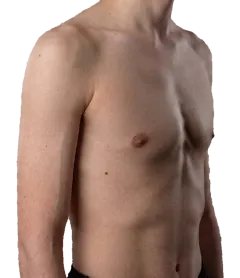
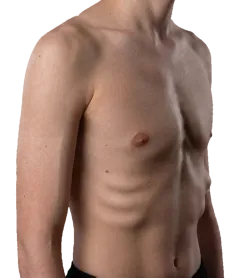
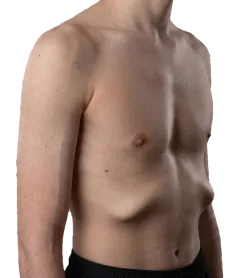
Here’s the honest answer to the question underneath all that. No study I found has asked partners how they react to pectus excavatum (PE), and none has measured dating, intimacy or telling a partner in people who have it. What researchers have measured is how people with PE feel about their own chest, and that’s where this guide starts.
I had pectus excavatum. I was diagnosed at 15 and corrected it without surgery over about three years, and the result was visible and measurable, but not complete. I’m not a doctor, and I’m a man, so I can’t speak for women’s experience or for what any partner thinks. Below is the research, then my advice on telling someone, hugs and intimacy, and when worry needs more than an article.
What research can and can’t tell you about dating with pectus
A PubMed search in October 2026 for studies of pectus and dating, partners, attraction or intimacy turned up nothing. That’s a gap, not a finding. It doesn’t mean pectus has no effect on dating, or a big one.
The closest thing is the UK-led pectus care guideline published in 2024. It says most pectus is mild and well tolerated, but that some young people pull back from things that might expose their chest, naming dating alongside sleepovers and the beach.
| Study | Who was studied | What it found |
|---|---|---|
| Steinmann 2011, Germany | 90 people seeking chest surgery (71 with PE, 19 with pectus carinatum, where the chest sticks out) and 82 people without | Body image was much worse than in the comparison group, and that distress went with lower self-esteem and lower mental quality of life. Rates of mental disorders were not higher. |
| Sutyak 2025, Houston | 57 under-18s seen for PE at one hospital | 42% were uncomfortable taking their shirt off in public, and 42% screened positive for social anxiety. Parents and children often disagreed about how the child was doing. |
| Matsuda 2024, Tokyo | 129 people scheduled for surgery | 43% scored in the social anxiety disorder range, yet their mental quality-of-life scores were better than the general population’s. |
| Alaca & Yüksel 2021, Istanbul | 180 teenagers aged 10 to 18 (90 with PE, 90 with pectus carinatum) and 90 without | How teens saw their own chest went with how they were doing physically and socially. How deep it measured didn’t. |
Prof. Mustafa Yüksel, who reviews medical content on this site, co-authored the Istanbul study.
Look at who was studied. The German, Houston and Tokyo groups had all gone to a hospital about their chest, and people who seek treatment are likely to be among the most bothered by it. Read these numbers as “this feeling is real”, not “this is your future”. And keep both halves of the German result together: the distress about appearance was real, and the patients weren’t more likely to have a mental disorder.
How you see your chest versus how others see it
The Istanbul result is the one I’d hold on to: a teenager’s own view of their chest tracked how they were doing, and the measured depth didn’t. A Dutch study of 215 patients did find that deeper and longer dents were linked to distress, but only weakly. Put together, how much pectus bothers people follows how they see their chest more than how deep it measures.
A small Innsbruck study puts the two views side by side. Eighteen women (mean age 20), surveyed after their repair was finished, rated how their chest had looked before surgery, and a panel of 24 medical professionals and students rated their before-surgery photos. The women rated their chests as more severe than the panel did. The panel weren’t partners, and 18 is a small group.
In the original spotlight effect experiments, Cornell students wore an embarrassing T-shirt into a room and then guessed how many people had noticed. They guessed too high. That was a T-shirt, not pectus and a partner, so take it as a rule about attention. It doesn’t prove that nobody notices.
Telling a partner: whether, when and how
I found no study of how partners react to pectus or of telling them, so this section is my advice, plus research on other visible differences such as scars and skin conditions, not pectus. In a UK interview study of 22 adults with various visible differences, people described feeling unattractive and anxious about telling partners. They also said a partner’s support and acceptance could help the relationship.
Whether you tell anyone at all is your call. You don’t owe a date an explanation of your body, though in my view carrying a secret into every hug can be more tiring than one conversation. Changing Faces, a UK charity for people with visible differences, talks about opening up gradually, since trust can take time, and gives no rule on timing. I don’t think there’s one right moment. Three that make sense to me:
- Early and casual. Mention it in passing, before it turns into a big reveal.
- Just before the first time your shirt comes off. One sentence beforehand means the moment isn’t a surprise for either of you.
- Later, once you trust them. Nothing says it has to be early.
If you want words ready, here are two:
- “I’ve got something called pectus excavatum. My breastbone grew inward, so there’s a dip in the middle of my chest. I’m a bit self-conscious about it.”
- “Heads up before we go swimming, my chest has a dent in the middle. It’s just how it grew.”
Questions are a normal reaction. Changing Faces points out that most people who notice a difference are simply curious, and that the worst-case thoughts in your head aren’t facts. If someone mocks you, that tells you about them and whether this relationship is good for you, not that your chest is the problem.
The first time a partner sees your chest
It will probably feel bigger to you than to them. You’ve studied your chest in mirrors for years. They’re seeing it with the rest of you in the room.
Pick the place and the timing that feel comfortable. And if it helps, say it: “I get a bit nervous about my chest” is a perfectly good sentence to say to someone who likes you.
If you use a vacuum bell, plan sessions around the date. KidsHealth says the bell can leave a little redness or bruising where it sits, and that it usually goes away on its own after a few hours, so finish a session well ahead of time. Skin care is in how to use a vacuum bell, and the beach and what to wear are in how to hide pectus excavatum.
Hugging, cuddling and intimacy
Feeling exposed the first few times someone holds you close is common. In the UK interviews above, adults with other visible differences said their appearance affected physical intimacy, and that a partner’s acceptance could help.
I’d talk before, not in the moment. Tell your partner what feels fine and what doesn’t, whether that’s a hand on your chest, a long hug, or their head resting on it, and ask them the same question back.
I haven’t found any study or hospital guidance on hugging or cuddling with a chest that hasn’t had surgery, so I won’t make promises either way. What I will say is that pain isn’t something to work around. If a hug or pressure on your chest hurts, get it checked by a doctor rather than putting up with it.
After a Nuss procedure, where curved metal bars are placed under the breastbone to push it forward, the rules change. KidsHealth’s guidance is to avoid strenuous activity for about six weeks, skip sports that could injure the chest until your surgeon says it’s OK, and expect a return to all activities to take six months or more. It doesn’t mention hugs, and rules vary by hospital. So ask your surgeon directly:
- Are tight hugs, or hugs that press or twist my chest, okay yet?
- Can someone lie with their head or weight on my chest?
- When is sex okay, and is anything off limits while the bars are in?
I’ve covered timing in sex after the Nuss procedure.
If you’re a woman with pectus
Don’t assume pectus bothers women less. In a Serbian study of 58 patients aged 10 to 30, female patients reported a worse experience of their chest than male patients. It’s a small sample, so it isn’t the last word.
Breasts change how pectus looks, which I’ve covered in pectus excavatum in women and girls. For bras, see bras for a sunken chest. The rest of this guide applies whoever you’re dating.
For teenagers, and for parents
The Houston patients had a median age of 14, so these worries can start early. In a Chinese study of 337 children aged 6 to 16, parents reported more withdrawn, anxious and social problems than parents of children without pectus did, and being teased about the chest was one of the things linked to those problems. In an online study of 40 teenagers with various visible differences, not pectus specifically, worries about how they looked got in the way of romantic relationships.
If you’re a teenager: if you’re being teased, or worry about your chest is stopping you from going out, tell a parent or another adult you trust. You don’t have to sort it out alone.
If you’re a parent: ask your teen directly how they feel about their chest. In the Houston study, parents and children often disagreed on how the child was doing, so don’t assume you know. University of Utah Health advises parents to be a good listener and validate their child’s feelings, and to find a qualified mental-health specialist if the distress is significant. My own advice: don’t push them to tell a partner or to start treatment. Let them set the pace.
When worry turns into something more
Nerves before a date are normal. Worry that runs your life is different. The NHS lists signs of body dysmorphic disorder (BDD), where worry about how you look takes over: worrying a lot about one part of your body, spending a lot of time comparing your looks with other people’s, checking mirrors a lot or avoiding them completely, and going to great lengths to hide what you see as a flaw. The NHS says BDD can affect relationships and lead to depression. Having some of these signs doesn’t mean you have it. If you’ve stopped dating altogether because of your chest, that’s the withdrawal the guideline describes, and it’s worth taking seriously. If any of this sounds like you, see a professional.
A GP or family doctor is a good start, and in England you can refer yourself to NHS talking therapies.
For adults who want something to work through alongside that, Loving ACTion is a free seven-episode podcast on appearance and romantic relationships for adults with visible differences, made by researchers at the University of the West of England. In their evaluation with 71 adults, which had no comparison group, people reported less shame and worry about their appearance. It isn’t pectus-specific, and its makers say it isn’t meant for anyone in severe distress, feeling suicidal or self-harming.
If you’re thinking about hurting yourself, or you don’t feel safe, get help now. In the US, call, text or chat 988 any time, or text HOME to 741741. In the UK, call Samaritans free on 116 123, 24 hours a day. Anywhere else, findahelpline.com lists free helplines by country. If you’re in immediate danger, call your local emergency number.
Do you need to fix your chest before you date?
No. Nothing I found in the research says you have to correct your chest before you date. Treatment is a choice, and leaving your chest alone is one option.
Treatment can change how people feel about their chest. In a study of 264 patients aged 8 to 21 at 11 North American children’s hospitals, body image and social self-consciousness improved a year after surgery. A 2023 meta-analysis pooling 7 studies of 478 patients up to age 60 found self-esteem rose after the Nuss procedure, though the authors note there’s little high-quality evidence behind it. Neither measured dating. Options and recovery are in my pectus excavatum surgery guide.
On the non-surgical side, a 12-week randomised study of 26 boys aged 11 to 18 in Istanbul found their view of their own chest improved with a vacuum bell, with or without added physiotherapy. Prof. Yüksel co-authored it. I found no study of how the bell affects adults’ self-image or dating. More in vacuum bell therapy.
Non-surgical correction is slow. Mine took about three years, and the result was visible and measurable, but not complete. Structural change takes months and years, so don’t put your love life on hold for it. If the worry is what you want to work on now, there’s my Confidence Program, a self-guided program based on cognitive behavioural therapy (CBT), with a chapter that covers dating and intimacy. It’s my own product, and it doesn’t change your chest.
Before you try anything physical: if you have chest pain, get short of breath, have a known heart or lung condition, have had chest surgery before, have Marfan or Ehlers-Danlos syndrome, or have symptoms nobody has checked, see a doctor first. I’ve listed the symptoms worth getting checked.
If you want to know where your chest stands and whether non-surgical correction is realistic for you, take my free 1-minute quiz.
Sources
- Dunning J, Burdett C, Child A, et al. The pectus care guidelines: best practice consensus guidelines from the joint specialist societies SCTS/MF/CWIG/BOA/BAPS for the treatment of patients with pectus abnormalities. Eur J Cardiothorac Surg. 2024;66(1):ezae166. Read it
- Steinmann C, Krille S, Mueller A, et al. Pectus excavatum and pectus carinatum patients suffer from lower quality of life and impaired body image: a control group comparison of psychological characteristics prior to surgical correction. Eur J Cardiothorac Surg. 2011;40(5):1138-45. Read it
- Sutyak KM, Hebballi NB, Bidart Y, et al. Is it time to expand the surgical criteria? The psychosocial impact of pectus excavatum in pediatrics. Surgery. 2025;185:109546. Read it
- Matsuda K, Fujisawa D, Masai K, et al. Quality of life, psychological states, and personality traits in patients with pectus excavatum. JTCVS Open. 2024;19:355-369. Read it
- Alaca N, Yüksel M. Comparison of physical functions and psychosocial conditions between adolescents with pectus excavatum, pectus carinatum and healthy controls. Pediatr Surg Int. 2021;37(6):765-775. Read it
- Janssen N, Daemen JHT, van Hulst LD, et al. Beyond the chest wall: examining the relationship between morphological features and psychosocial distress in pectus excavatum patients. Eur J Pediatr Surg. 2025;35(3):247-254. Read it
- Wachter T, Del Frari B, Edlinger M, et al. Aesthetic outcomes after surgical repair of pectus excavatum in females: differences between patients and professional evaluators. Arch Plast Surg. 2020;47(2):126-134. Read it
- Gilovich T, Medvec VH, Savitsky K. The spotlight effect in social judgment: an egocentric bias in estimates of the salience of one’s own actions and appearance. J Pers Soc Psychol. 2000;78(2):211-22. Read it
- Sharratt ND, Jenkinson E, Moss T, et al. Understandings and experiences of visible difference and romantic relationships: a qualitative exploration. Body Image. 2018;27:32-42. Read it
- Overcoming the challenges of dating and relationships with a visible difference. Changing Faces. [cited 2026 Oct 20]. Read it
- Vacuum bell device. KidsHealth (Nemours). Reviewed 2022 Oct. Read it
- Nuss procedure. KidsHealth (Nemours). Reviewed 2023 May. Read it
- Kostic M, Sretenović A, Radulović D, et al. Influence of psychosocial characteristics of patients and opinions of their relatives on indication for surgical treatment of pectus excavatum. ANZ J Surg. 2023;93(12):2974-2980. Read it
- Ji Y, Liu W, Chen S, et al. Assessment of psychosocial functioning and its risk factors in children with pectus excavatum. Health Qual Life Outcomes. 2011;9:28. Read it
- Griffiths C, Williamson H, Rumsey N. The romantic experiences of adolescents with a visible difference: exploring concerns, protective factors and support needs. J Health Psychol. 2012;17(7):1053-64. Read it
- Living with mild pectus excavatum. University of Utah Health. 2024 Mar 25. Read it
- Body dysmorphic disorder (BDD). NHS. Page last reviewed 2023 Oct 18. [cited 2026 Oct 20]. Read it
- Loving ACTion: appearance and romantic relationships programme. Visible Difference Support Hub, University of the West of England. [cited 2026 Oct 20]. Read it
- 988 Suicide & Crisis Lifeline. [cited 2026 Oct 20]. Read it
- Crisis Text Line. [cited 2026 Oct 20]. Read it
- Contact a Samaritan. Samaritans. [cited 2026 Oct 20]. Read it
- Find A Helpline. [cited 2026 Oct 20]. Read it
- Kelly RE Jr, Cash TF, Shamberger RC, et al. Surgical repair of pectus excavatum markedly improves body image and perceived ability for physical activity: multicenter study. Pediatrics. 2008;122(6):1218-22. Read it
- Mohamed JS, Tan JW, Tam JKC. Quality of life with minimally invasive repair of pectus excavatum: a systematic review and meta-analysis. Ann Transl Med. 2023;11(12):407. Read it
- Alaca N, Alaca I, Yüksel M. Physiotherapy in addition to vacuum bell therapy in patients with pectus excavatum. Interact Cardiovasc Thorac Surg. 2020;31(5):650-656. Read it
Correcting the chest takes months. Not letting it run your social life in the meantime is its own piece of work, and it is trainable.
- Body image work that is evidence-based
- Scripts for the conversations you dread
- Shirt off in public, worked up to properly

This article is for educational purposes only and does not constitute medical advice. Always consult a qualified healthcare professional before starting any treatment plan. View full disclaimer →