Contents · 8 sections
A bone on the front of your chest sticks out, maybe for years, maybe seemingly overnight, and you want to know if it’s bad.
The usual explanations are a chest shape you grew into (pectus carinatum), a normal landmark or variant of the breastbone, or a benign change in a rib cartilage or joint. The NHS says most lumps are harmless. The ones to get checked are new in an adult, growing, hard and fixed, painful at night, or red and hot, or they come with fever, night sweats or weight loss you can’t explain.
Worried right now? Skip to when to see a doctor.
I had pectus excavatum, the sunken kind, not carinatum. I’m not a doctor, so the medical points here come from studies and hospital pages.
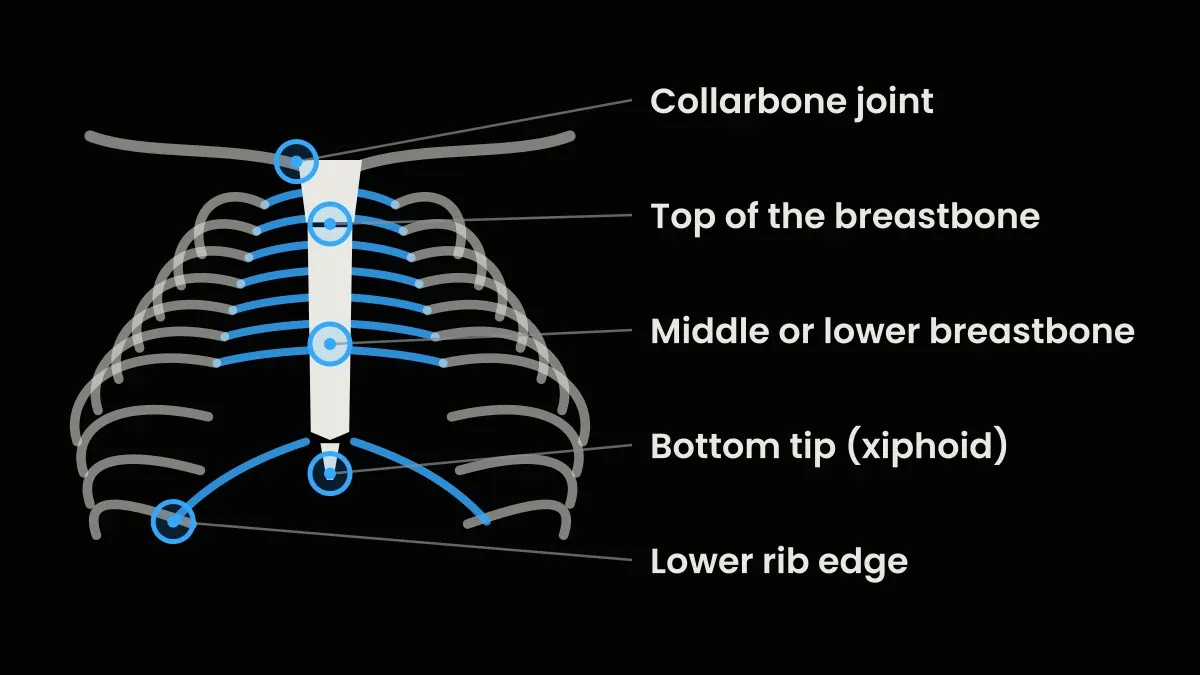
Where is your bump? A map of your chest
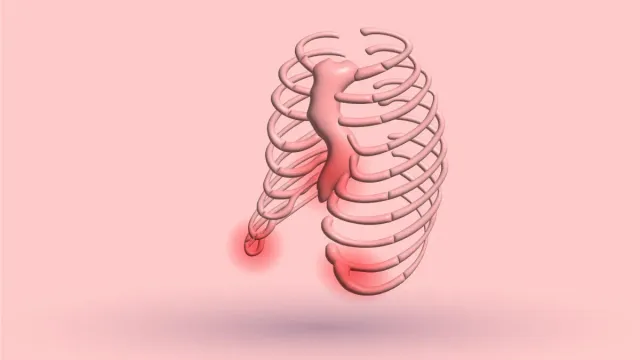
Your breastbone (sternum) has three parts: the manubrium at the top, the long body in the middle and a small tip at the bottom, the xiphoid. Where the manubrium meets the body there’s a ridge called the sternal angle. Your ribs join the breastbone through costal cartilage, short bars of tough, slightly bendy tissue. Each collarbone meets the breastbone at the sternoclavicular (SC) joint, just below the base of your neck. A “normal variant” is a shape that differs from the textbook drawing but turns up in plenty of healthy people and needs nothing.
| Where it sticks out | Often feels like | Usual explanations | Next step |
|---|---|---|---|
| Middle or lower breastbone | Hard, broad, painless. May give when pressed | Pectus carinatum, tilted sternum, a forward-curving cartilage | Press test. Doctor if changing fast or painful |
| Top of the breastbone or a collarbone end | A ridge across the bone, or a lump at the base of the neck | Sternal angle, SC joint lump, Tietze, upper-type carinatum, pectus arcuatum | Doctor for a new, red, hot or growing lump |
| Bottom tip | A small hard point, sometimes forked | Forward-angled or forked xiphoid, rarely a painful one | Nothing if painless. Doctor if tender with chest or belly pain |
| Beside the breastbone or one side | A firm, tender swelling, or one side higher | Tietze, uneven cartilage, one-sided carinatum | Doctor if swollen and tender |
| Lower rib edge | The bottom of the ribcage juts out | Rib flare, or a lean but normal rib margin | Resting check at full exhale |
The middle or lower breastbone
A breastbone that pushes forward through the middle or lower chest, often with the cartilage beside it, is the classic shape of pectus carinatum. Cleveland Clinic calls this lower type the more common one. An upper type is rarer, and a third pattern affects one side, sometimes with a dip on the other.
Cleveland Clinic puts pectus carinatum at about 1 in 1,000 people, with some estimates as high as 1 in 300, and more common in males. It’s present from birth but often noticed in the teens. It’s usually painless and isn’t dangerous. Types, causes and the home check are in my pectus carinatum guide.
The bottom tip: the xiphoid
The small point at the bottom of your breastbone is the xiphoid, and its shape varies a lot between healthy people. On CT scans, it angled forward in 65.4% of 500 Turkish adults scanned for heart checks, but in 23.0% of 902 Korean patients. The studies disagree, so the honest range is roughly a quarter to two-thirds of adults. A forked tip showed up in 27.2% of 1,000 CT scans in Istanbul and 36.9% of 1,150 CT scans in Greece, whose authors say these variants are frequent, cause no symptoms and can be mistaken for disease.
A tender tip is different. Xiphodynia, pain from the xiphoid itself, is rare, and it can mimic a heart problem. So if a tender lump at the tip comes with chest or upper-belly pain, see a doctor, who can rule out heart and stomach causes.
Beside the breastbone, or one side only
A firm, tender swelling over one rib cartilage beside the upper breastbone, usually the second or third, is the picture of Tietze syndrome. NORD describes it as rare and inflammatory, mostly under 40, in men and women equally. It can be red and warm, and the swelling can outlast the pain. Costochondritis is pain in the rib cartilages, generally without swelling, so it usually doesn’t make anything stick out. Pain and popping are in my guide to sternum popping and pain.
A painless bump on one side can be a cartilage curving forward more than its partner, or one-sided carinatum. In 430 UK children with carinatum, bump-only chests more often stood out on the right. The spine can be involved too: in a clinic study co-authored by Prof. Yüksel, the site’s medical reviewer, 23 of 117 carinatum patients had a spinal deformity. Have your back checked as well. If you can’t tell muscle from ribcage, see my uneven chest guide.
The lower rib edge
If the bottom edge of your ribcage sticks out, that’s the rib margin, not the breastbone. When it angles forward and outward it’s called rib flare. Being lean makes a normal margin visible, and people mistake visibility for flare. The resting check in my flared ribs guide sorts the two.
If yours doesn’t fit a row
In a CT study of 200 US children with no suspected chest wall problem, 33% had at least one front-of-chest variant, most often a tilted sternum or a forward-curving rib or cartilage, which the radiologists called normal. And when 27 healthy children with a painless lump and a normal X-ray had CT or MRI, a cause was found in 26, and none needed treatment. Those are children only. I couldn’t find a matching study in adults.
My interpretation, not a measured finding: with little fat and muscle over the breastbone, landmarks like the sternal angle, collarbone ends and xiphoid show more, and weight loss can make them newly obvious. I couldn’t find a study measuring this.
Why is my sternum sticking out all of a sudden?
The answer splits by age.
You’re a teenager, or the parent of one. A breastbone pushing forward over months during a growth spurt fits pectus carinatum. In the UK series of 430 children, girls developed it earlier than boys (median age 10 vs 14) and more often came in with pain (44% vs 26%). If it’s getting worse quickly, or it hurts, show a doctor.
You’re an adult and it’s new. I couldn’t find a study of pectus carinatum appearing for the first time in adulthood. In the studies I found, it was typically picked up between about 10 and 15. So a first-time bump in an adult is less typical and worth getting looked at. It may have been there all along and only become visible, but let a doctor confirm that.
The NHS rule for any new lump: see a GP if it’s still there after 2 weeks, or sooner if it’s growing or hurts (full list below).
It appeared after a knock. A new step, bump or tender spot on the breastbone after a blow, a fall or a crash should be checked. Doctors also look for other injuries alongside a breastbone fracture.
Upper chest bone sticking out (women, and men too)
If the bone is high on your chest, below the base of your neck, these are the usual explanations. I couldn’t find a study that ranks them, in women or anyone else, so they’re in no particular order.
- The sternal angle. A horizontal ridge below the notch at the base of your neck, level with your second ribs. Kenhub describes it as a forward projection where the manubrium meets the body, and the textbook Essential Clinical Anatomy notes it’s often visible in young people. It’s normal anatomy.
- A lump at the inner end of a collarbone. That’s the SC joint. In a 1979 UK series of 22 patients whose collarbone end had slipped forward without injury, most were middle-aged women with a lump at the root of the neck and little or no discomfort. It isn’t only women: a 2019 series of 23 young people was split almost evenly by sex, and with wait-and-see the slipping eased in 19 of 23. A red, hot, painful joint with a fever can be an infection and needs prompt care.
- Tietze swelling of the second or third rib cartilage, described above.
- The upper type of pectus carinatum. The top of the breastbone pushes forward, just below the collarbones.
- Pectus arcuatum. A short breastbone whose segments fused early, giving a high, stiff bump. It’s often mistaken for carinatum and confirmed with a side chest X-ray or CT. In that French series of 34 patients, bracing was tried in 3 and worked in none.
The upper type of carinatum has responded partly to bracing in one small series of 11 patients. Still, show a high, rigid bump to a specialist first.
For carinatum in girls and women, see pectus carinatum in women.
Sticking out after surgery
After a Nuss repair for a sunken chest. A bar end you can newly feel or see, or a change in your chest’s shape, can mean the bar has shifted. Texas Children’s says to go to the emergency department for a sudden change in how the chest looks, severe unexplained chest pain, fever or shortness of breath. Anything in between, call your surgeon. Tell them, too, if the breastbone starts to stand out. I couldn’t find a study giving a reliable rate for that kind of overcorrection. More in what to expect around bar removal.
After childhood heart surgery. Operations through the breastbone can leave it sticking out. In one series of 51 infants and toddlers braced for this, 58.8% responded well. The authors declared that they receive royalties from the brace.
After heart surgery as an adult. Follow your surgeon’s discharge sheet. Baylor College of Medicine’s sternotomy guide says to call the surgical team for a fever of 101°F or higher, incision drainage or pain your medication doesn’t help.
Check your own chest (this isn’t a diagnosis)
These help you describe it to a doctor. They won’t tell you what it is.
- Where is it? Use the map above.
- Hard or soft? A new hard lump that doesn’t move is a reason to see a GP.
- Does it change when you move your arm or shoulder? That helps a doctor tell a joint from a fixed lump.
- Is it tender, swollen, red or hot? Tender swelling over one cartilage fits Tietze. Red and hot, especially with a fever, needs a doctor promptly.
- One side or both?
- Is it changing? Take a side photo monthly in the same light. Growth in an adult is a red flag.
If it’s the breastbone, the press test in the carinatum guide shows whether it gives under gentle pressure, which suggests a flexible chest. If it’s the lower rib edge, ribs that settle flat at full exhale aren’t a structural flare.
If those checks point to carinatum, rib flare or a mix with a sunken chest, my free 1-minute quiz helps you work out which one fits. It covers chest shapes, not lumps, joints or the xiphoid.
When a scan is used
A doctor examines you first and decides whether you need a scan. You don’t need a CT to know you have a carinatum bump. Collarbone joint problems often need CT or MRI. For a lump, a GP may refer you for an ultrasound or a biopsy. The Haller index you may read about is a CT measurement designed for sunken chests, not bumps.
What helps, by cause
- Flexible pectus carinatum. Bracing, which works best during the growing years while the chest is still flexible. Exercise can’t push the bone back. Hours, timing and results are in my pectus carinatum brace guide.
- A rigid bump, the upper type or arcuatum. A specialist assessment first.
- A forward-angled or forked xiphoid, or a visible sternal angle. Usually nothing. They’re normal.
- A collarbone joint that slipped forward. Reassurance and simple painkillers. Long-term series found it does well without surgery.
- Tietze. Your doctor manages the pain, which usually settles over weeks to months. The swelling may stay.
- Rib flare. Breathing and training, in the flared ribs guide above.
When to see a doctor
The NHS advice on lumps says to see a GP (family doctor) if your lump or bump:
- is new and still there after 2 weeks
- is getting bigger
- hurts, or is red or hot
- is hard and doesn’t move
- grows back after being removed
Those rules are for a new lump, not a breastbone that slowly pushed forward in the teens.
Also see a GP for bone pain or tenderness that’s worse at night, a fever or night sweats that keep coming back, or unexplained weight loss, as the NHS pages on bone cancer symptoms and cancer signs advise.
Tumours of the breastbone are rare: one Polish centre treated 30 in 10 years. Chondrosarcoma, the most common malignant tumour that starts in the chest wall, tends to be a hard, fixed lump that grows slowly, which is why those words are on the list.
Call 911 (999 in the UK) or your local emergency number now if you have any of these. Don’t drive yourself.
- palpitations that won’t stop
- palpitations with chest pain, shortness of breath, feeling faint or fainting
- sudden chest pain or pressure that doesn’t go away
- chest pain that spreads to your arm, neck, jaw or back
- chest pain with sweating, feeling sick, light-headedness or breathlessness
That list follows the NHS advice on chest pain and palpitations, as in my heart problems guide.
Who to see. Start with your family doctor. If they find a chest wall shape like carinatum or arcuatum, or your bump is rigid, ask for a referral to a pediatric or thoracic (chest) surgeon who works with chest wall conditions. My notes on how to vet a chest wall surgeon cover the questions to ask.
Sources
- Pectus Carinatum. Cleveland Clinic. [cited 2026 Oct 20]. Read it
- Akin K, et al. Skeletal Radiol. 2011;40(4):447-52. Read it
- Xie YZ, et al. Surg Radiol Anat. 2014;36(3):209-17. Read it
- Yekeler E, et al. AJR Am J Roentgenol. 2006;186(4):956-60. Read it
- Vatzia K, et al. Eur J Radiol. 2021;142:109828. Read it
- Noor N, et al. Orthop Rev (Pavia). 2022;14(3):37070. Read it
- Tietze Syndrome. National Organization for Rare Disorders (NORD). [cited 2026 Oct 20]. Read it
- Bough GM, et al. Pediatr Surg Int. 2025;42(1):56. Read it
- Şirazi S, Heydar AM, Bezer M, Yüksel M. Spine Deform. 2024;12(6):1615-22. Co-authored by Prof. Yüksel. Read it
- Donnelly LF, et al. Radiology. 1999;212(3):837-40. Read it
- Donnelly LF, et al. Radiology. 1997;202(3):829-31. Read it
- Khoriati AA, et al. J Emerg Trauma Shock. 2013;6(2):113-6. Read it
- Thoracic cage. Kenhub. [cited 2026 Oct 20]. Read it
- Sadr B, Swann M. Acta Orthop Scand. 1979;50(3):269-74. Read it
- Moreels R, De Wilde L, Van Tongel A. J Shoulder Elbow Surg. 2019;28(12):2350-5. Read it
- Rockwood CA Jr, Odor JM. J Bone Joint Surg Am. 1989;71(9):1280-8. Read it
- Higginbotham TO, Kuhn JE. J Am Acad Orthop Surg. 2005;13(2):138-45. Read it
- Abdellaoui S, et al. J Pediatr Surg. 2023;58(9):1679-85. Read it
- Cruz-Centeno N, et al. Am Surg. 2026;92(6):1853-7. Read it
- Konishi H, et al. Gen Thorac Cardiovasc Surg. 2024;72(11):718-25. Read it
- Sternotomy recovery. Baylor College of Medicine. [cited 2026 Oct 20]. Read it
- Lumps. NHS. [cited 2026 Oct 20]. Read it
- Bone cancer: symptoms. NHS. [cited 2026 Oct 20]. Read it
- Cancer signs and symptoms. NHS. [cited 2026 Oct 20]. Read it
- Kozak K, et al. Kardiochir Torakochirurgia Pol. 2016;13(3):213-6. Read it
- Somers J, Faber LP. Semin Thorac Cardiovasc Surg. 1999;11(3):270-7. Read it
- Chest pain. NHS. [cited 2026 Oct 20]. Read it
Reading about the condition is one thing. Knowing which one you have, how severe it is and what to do first takes about a minute.
- Your condition named, not guessed
- A severity read you can act on
- The exact next step for your case

This article is for educational purposes only and does not constitute medical advice. Always consult a qualified healthcare professional before starting any treatment plan. View full disclaimer →