Contents · 11 sections
Your breastbone cracks like a knuckle when you stretch, pops when you pull your shoulders back, or aches in a spot you can press on. The first worry is usually the heart.
A painless pop with nothing else going on is usually a joint, and the sound alone isn’t a sign that something is wrong. Pain, swelling, a recent hit to the chest, recent chest surgery, breathlessness or a click that keeps time with your heartbeat change that answer.
Worried right now? Go straight to the emergency checklist.
I was diagnosed with pectus excavatum at 15 and corrected it without surgery over about three years. The change was visible and measurable, but not complete. I’m not a doctor, so every medical point here comes from a study, a hospital or a health service, listed at the end.
Is it an emergency? Check this first
This is the emergency list from my guide to pectus excavatum symptoms. It applies to any chest.
Call 911 (999 in the UK) or your local emergency number now if you have any of these. Don’t drive yourself.
- palpitations that won’t stop
- palpitations with chest pain, shortness of breath, feeling faint or fainting
- sudden chest pain or pressure that doesn’t go away
- chest pain that spreads to your arm, neck, jaw or back
- chest pain with sweating, feeling sick, light-headedness or breathlessness
That list follows the NHS advice on chest pain and palpitations, as in my heart problems guide.
Two more patterns are urgent:
- Sudden chest pain on one side with breathlessness. It can be a collapsed lung, and Cleveland Clinic says to go to the nearest emergency department right away.
- A crunching or clicking in time with your heartbeat, with chest pain or breathlessness. That isn’t a joint. Get urgent care.
See a doctor if you have:
- chest pain that comes and goes
- a tender spot on the breastbone or ribs that isn’t settling
- swelling over a rib joint, or where your collarbone meets the breastbone
- popping with pain or swelling
- pain or popping after a hit, a fall or a car accident
- new chest pain after a change in training
- new painful clicking after chest surgery (Nuss signs are further down)
- any chest pain if you’re over 35 or have heart risk factors
A sore spot doesn’t clear your heart. A 2021 review in American Family Physician cites an emergency department study in which 12% of patients with chest pain and a tender chest wall were also having a heart attack.
Nothing needed if the pop doesn’t hurt and comes with no swelling, injury, recent surgery or other symptoms. A 2026 review of sternal cracking in active people says that without pain, swelling, instability or other symptoms, joint sounds alone shouldn’t be treated as a problem.
What makes your sternum pop or crack
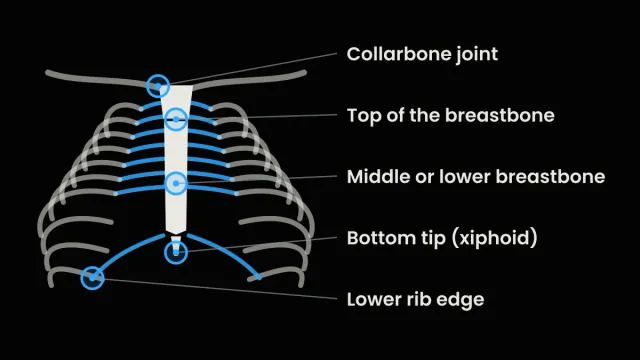
Your breastbone (sternum) connects to your collarbones and rib cartilages, and not all of those joints move. Where each rib meets its own cartilage (the costochondral joint), bone and cartilage are joined solidly and normally don’t move. The joints that can glide a little sit where the cartilages of ribs 2 to 7 meet the breastbone, between the lower rib cartilages, and at the sternoclavicular (SC) joint, where your collarbone meets the breastbone. These are synovial joints, with fluid between two surfaces, the same type as your knuckles.
In 2015, researchers filmed knuckles cracking inside an MRI scanner as the finger joints were pulled apart. The sound came the moment a gas cavity formed in the joint fluid, not when a bubble burst.
I couldn’t find anyone who has imaged a breastbone pop. My interpretation, since the chest’s gliding joints are the same type: the same event is the most likely explanation for a painless one, though nobody has proved it. The sound tells you little. What comes with it tells you more.
Chest-wall causes of sternum pain and popping
The 2026 review names the SC joint, the rib-breastbone joints and slipping rib syndrome as the usual sources of chest cracking in active people, plus overload or stress injury. Most of the conditions below cause pain, not noise.
| What you notice | What it may be | What to do |
|---|---|---|
| A painless pop when you stretch or twist | Most likely one of the gliding joints | Nothing |
| Pain where ribs meet the breastbone, worse when pressed, no swelling | Costochondritis | See a doctor |
| A firm, visible, painful swelling over one upper rib joint | Tietze syndrome | See a doctor |
| Clicking or catching at the lower rib edge, with pain | Slipping rib syndrome | See a doctor |
| Swelling, clicking or pain where collarbone meets breastbone | SC joint problem or arthritis | See a doctor |
| Pain after a hit, a fall or a new training load | Strain, fracture or stress injury | See a doctor |
| Pain at the bottom tip of the breastbone | Xiphodynia | See a doctor |
Costochondritis
Costochondritis is pain and tenderness where rib cartilages join the breastbone. Its tell: pressing on the spot brings the pain back. The NHS describes a sharp pain at the front or side of the chest, worse when you move your upper body, lie down, breathe deeply or press on your ribs. It links it to chest injury, repetitive lifting, heavy coughing and infections.
The AAFP review says it usually affects ribs 2 to 5, often at several spots on one or both sides, usually without swelling, and most often in adults aged 40 to 50. Popping isn’t a listed feature: the pain is the sign. The NHS says it usually clears on its own within a few weeks to several months.
Tietze syndrome
Tietze syndrome looks like costochondritis with one visible difference, a firm swelling over the painful cartilage. NORD describes it as rare, usually at one rib, most often the second or third, sometimes red and warm, and worse with sneezing, coughing or hard effort. It mostly starts before 40 and affects men and women equally. The pain usually settles over weeks to months, but the swelling can stay.
Slipping rib syndrome
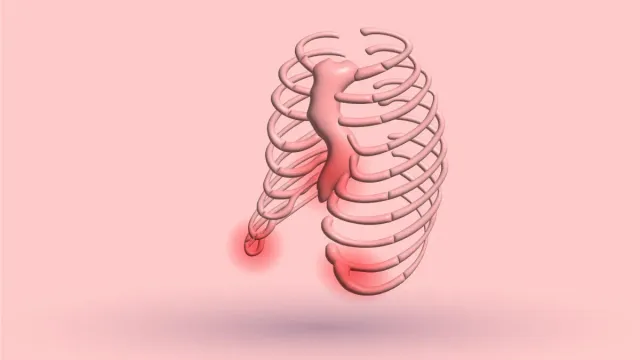
Slipping rib syndrome is the one chest-wall condition where clicking is part of the description. The 8th to 10th ribs move too much, so a rib tip slips under or catches on the rib above. A 2023 review notes that some patients feel a clicking or popping, and that there are no accurate figures on how common it is.
The pain sits at the lower front edge of the rib cage, where the rib presses on a nerve, and flares when you use your arms, cough, laugh or lean over. A 2018 review calls it under-diagnosed: people often go months to years with pain and tests before anyone finds it. Doctors diagnose it by examination, and an ultrasound taken while you move can help.
If your lower ribs also stick out, my flared ribs guide lists clicking or catching at the rib tips as a reason to see a doctor before any exercises.
The collarbone joint and arthritis
The SC joint is synovial, and it can click or shift. When it goes wrong without an injury (arthritis, infection or a partial dislocation), a 2005 orthopaedic review says it mostly shows up as swelling, with or without pain, and is mostly managed without surgery. The AAFP review adds that arthritis there, or where the top piece of the breastbone meets its middle part, shows as tenderness over the joint.
Strain, fracture and training overload
The NHS describes a chest strain as pain that starts after a chest injury or chest exercise, may get worse when you breathe in, and eases when you rest the muscle.
A broken breastbone is a different matter. Sternal fractures come mostly from blunt trauma and sudden deceleration, and doctors check for other injuries alongside them. Pain or popping after a hit means getting checked.
Training can do it too. In one case report, an elite sprinter who started bouncing the barbell off her chest on the bench press developed a rib stress fracture within weeks. It settled after 4 weeks off bench. One case can’t tell you how common this is, but new pain after a training change deserves a check, not more reps.
Pain at the bottom tip (xiphoid)
The xiphoid is the small tip at the bottom of the breastbone, and pain there is called xiphodynia. A 2022 review describes it as rare and able to mimic heart disease, which can delay the right treatment. Care ranges from simple measures and injections to removing the tip. I couldn’t find evidence that the xiphoid itself pops.
Sternum pain when you breathe
Pain that sharpens when you breathe in fits costochondritis and strains, but it doesn’t rule out the lungs. The one to know is a collapsed lung (pneumothorax), where air leaks into the space around a lung. Cleveland Clinic lists one-sided chest pain, especially when breathing in, with shortness of breath, fast breathing or a fast heart rate. The risk is higher with a tall, thin build, especially in men, with Marfan syndrome and with a family history.
I couldn’t find a source showing pectus itself raises the risk. Sudden one-sided pain with breathlessness means the emergency department, whatever your chest shape.
What a doctor needs to rule out
Chest pain can also come from the heart, the lungs, the stomach or acid reflux, and sorting those out is a doctor’s job. A 2009 article in American Family Physician notes that coronary artery disease is present in 3 to 6% of adults with chest pain and a chest wall that’s tender to touch. It recommends an ECG, and possibly a chest X-ray, for anyone over 35, with heart risk factors, or with any heart or lung symptoms.
Two sounds are easy to mistake for a joint:
- A click in time with your heartbeat. This crunching or clicking is called Hamman sign. It usually means air in the middle of the chest, less often a collapsed lung, and a 2026 case report says it needs a chest X-ray or CT.
- The mitral valve prolapse click. A doctor hears this one through a stethoscope. It isn’t a pop you feel. More in my guide to pectus and heart problems.
And anxiety? I couldn’t find a study showing anxiety makes the sternum pop. The NHS does list chest pain triggered by worry or stress. If worry is part of it for you, tell your doctor that too.
Does pectus make it more likely?
I couldn’t find a study comparing how often the sternum pops or hurts in people with and without pectus. So I can’t tell you it’s more common with pectus, and I can’t tell you it isn’t.
Two connections are real. At Phoenix Children’s, 98 patients had surgery for slipping rib syndrome between 2018 and 2022, and 8 of them had a Nuss repair for pectus excavatum in the same operation. That’s the two together at one centre, not a rate.
Loose connective tissue is the other. Pectus excavatum is linked with Marfan and Ehlers-Danlos syndromes, and the 2023 slipping rib review names hypermobility, with or without those conditions, as a risk factor. If that’s you, a rib that catches and clicks is worth having checked. My Marfan syndrome guide covers the pectus side.
If your chest aches more than it pops, my guide to pectus excavatum pain goes further. And if you think you have pectus but don’t know where you stand, my free 1-minute quiz is a place to start. It isn’t a diagnosis.
Popping with a vacuum bell or brace
With a vacuum bell, the Basel team reports that most of their patients felt moderate pain in the sternum, and uncomfortable pressure, during their first five sessions. Eckart Klobe’s instructions for his original bell say to stop increasing the pressure as soon as it hurts, and the University of Rochester’s children’s hospital says never to pump to the point of discomfort or pain.
I couldn’t find a bell study that reports popping as a side effect. So this is my rule, not a study’s: if your chest pops during a session and the pain is sharp or doesn’t fade, let the air in, stop, and get it checked before the next session. Technique is in my guide to using a vacuum bell.
For pectus carinatum braces, a 2018 review of 8 studies covering 1,185 patients (median age 14, 87% male) found chest discomfort in about 12% and skin problems in about 5%. I couldn’t find popping reported in brace studies either. My rule is the same: a painful pop under a brace means loosening or removing it and asking whoever fitted it. More in my pectus carinatum brace guide.
Popping after the Nuss procedure or Ravitch
The Nuss procedure slides a curved steel bar behind the breastbone through small cuts at the sides, without cutting the breastbone, so after a Nuss the question is the bar, not the bone.
Not every sensation is trouble. Children’s Mercy’s post-operative sheet calls popping or clicking as the bar and stabilizers move normal. Texas Children’s tells families to go to the emergency department for a sudden change in how the chest looks, severe unexplained chest pain, fever or shortness of breath. Anything in between, like a bar end you can suddenly feel, is a reason to call your surgeon, not to wait for removal day. More in bar movement after the Nuss procedure.
When to call. CHOP’s list: fever above 101.5 °F (38.6 °C), more redness or swelling at the cuts, any drainage, trouble breathing, a change in how the chest looks, new or worse chest pain, or any injury to the chest.
Each hospital writes its own rules (Children’s Mercy’s sheet is one example), so follow the one your surgical team gave you.
The Ravitch is different: the surgeon removes the deformed cartilage and usually cuts the breastbone to reset it, as my guide to the Ravitch procedure explains. In a Dutch series of 44 patients who had a modified Ravitch for pectus excavatum, the breastbone failed to heal, causing pain or instability, in 3 of 18 fixed with mesh and wires and none of 26 fixed with plates. In a group that small, the difference wasn’t statistically significant.
Rib cartilage instability is rare after a Ravitch, mostly after a repeat operation. In a 2020 report of three cases, one teenager’s 7th rib moved along the breastbone with pain and clicking six months after surgery for pectus carinatum. New clicking with pain after a Ravitch means seeing your surgeon.
Should you crack your sternum on purpose?
Maybe your chest feels like it needs to crack. I couldn’t find a study that tests any technique for cracking your sternum, or whether doing it is safe. The evidence supports something narrower: a painless pop that happens on its own during normal stretching is usually nothing to worry about. In knuckles, habitual cracking wasn’t linked to hand arthritis in a study of 215 people aged 50 to 89. I couldn’t find the same question studied in the breastbone.
My view, and it’s only mine: you don’t need to force it, and pressing hard on a joint that already hurts doesn’t fix it. Get it checked. If you want your chest and upper back to move better, my guide to stretches for pectus covers what stretching can and can’t do.
What helps
If it pops and doesn’t hurt, there’s nothing to treat.
If it hurts, see a doctor first. Once a doctor has called it a chest-wall problem, here’s what the evidence says:
- Costochondritis. The AAFP review says no high-quality studies have tested any treatment. First-line options are heat, anti-inflammatory painkillers by mouth or on the skin (ask a pharmacist or doctor which suits you) and a break from whatever sets it off. In one observational study, 91% of people had recovered after 3 weeks of rest and anti-inflammatories.
- Long-lasting costochondritis. In a small retrospective study of 51 outpatients, those given stretching exercises had less pain over time than matched controls. The AAFP review calls the benefit small, for people with symptoms for over a year, working with a physical therapist.
- Tietze syndrome. NORD lists rest, heat and anti-inflammatories, with injections for stubborn cases.
- Slipping rib syndrome. A 2021 clinical review starts with reassurance, anti-inflammatories, physical therapy and nerve injections, and keeps surgery for pain that doesn’t respond.
- A strain. Rest the muscle. The NHS says it should feel better when you do.
So go back to where you landed at the top. A painless pop with nothing else: carry on. Anything more: book the doctor first, then come back to this list.
Sources
- Chest pain. NHS. [cited 2026 Oct 20]. Read it
- Collapsed lung (pneumothorax). Cleveland Clinic. [cited 2026 Oct 20]. Read it
- Mott T, Jones G, Roman K. Costochondritis: rapid evidence review. Am Fam Physician. 2021;104(1):73-8. Read it
- Joint and sternal cracking in physically active individuals: clinical significance and current evidence. J Educ Health Sport. 2026. Read it
- Aghoghovwia B. Thoracic cage. Kenhub. [cited 2026 Oct 20]. Read it
- Kawchuk GN, Fryer J, Jaremko JL, et al. Real-time visualization of joint cavitation. PLoS One. 2015;10(4):e0119470. Read it
- Costochondritis. NHS. [cited 2026 Oct 20]. Read it
- Tietze syndrome. National Organization for Rare Disorders (NORD). [cited 2026 Oct 20]. Read it
- Madeka I, Alaparthi S, Moreta M, et al. A review of slipping rib syndrome: diagnostic and treatment updates to a rare and challenging problem. J Clin Med. 2023;12(24):7671. Read it
- McMahon LE. Slipping rib syndrome: a review of evaluation, diagnosis and treatment. Semin Pediatr Surg. 2018;27(3):183-8. Read it
- Higginbotham TO, Kuhn JE. Atraumatic disorders of the sternoclavicular joint. J Am Acad Orthop Surg. 2005;13(2):138-45. Read it
- Khoriati AA, Rajakulasingam R, Shah R. Sternal fractures and their management. J Emerg Trauma Shock. 2013;6(2):113-6. Read it
- Fukuda Y, Kato K, Otoshi K, et al. Rib stress fracture in a female athlete caused by bouncing the barbell in bench press exercise: a case report. SAGE Open Med Case Rep. 2024;12. Read it
- Noor N, Amgalan A, Vij N, et al. Treatment and management of xiphoidalgia. Orthop Rev (Pavia). 2022;14(3):37070. Read it
- Proulx AM, Zryd TW. Costochondritis: diagnosis and treatment. Am Fam Physician. 2009;80(6):617-20. Read it
- Good A, Walker Z, Gregg J. An unusual case of chest pain in a 16-year-old male. Adv Emerg Nurs J. 2026;48(3):166-8. Read it
- Lai K, Eldredge RS, Nguyen M, et al. Initial outcomes using cryoablation in surgical management of slipping rib syndrome. J Pediatr Surg. 2023;58(8):1430-4. Read it
- Haecker FM, Sesia S. Vacuum bell therapy. Ann Cardiothorac Surg. 2016;5(5):440-9. Read it
- Vacuum bell. University of Rochester Medical Center, Golisano Children’s Hospital. [cited 2026 Oct 20]. Read it
- de Beer SA, Blom YE, Lopez M, et al. Measured dynamic compression for pectus carinatum: a systematic review. Semin Pediatr Surg. 2018;27(3):175-82. Read it
- Pectus Excavatum Post-Operative Recommendations. Children’s Mercy Kansas City. [cited 2026 Oct 20]. Read it
- Nuss procedure. Children’s Hospital of Philadelphia. [cited 2026 Oct 20]. Read it
- de Loos ER, Hulsewé KWE, van Loo ERJ, et al. Does the use of locking plates or mesh and wires influence the risk of symptomatic non-union of the sternal osteotomy after modified Ravitch? J Thorac Dis. 2020;12(7):3631-9. Read it
- de Beer SA, van Heurn ELW. Sternocostal instability after Ravitch repair in adolescents: 3 case reports and a review of surgical techniques in the literature. Plast Reconstr Surg Glob Open. 2020;8(3):e2720. Read it
- deWeber K, Olszewski M, Ortolano R. Knuckle cracking and hand osteoarthritis. J Am Board Fam Med. 2011;24(2):169-74. Read it
- Rovetta G, Sessarego P, Monteforte P. Stretching exercises for costochondritis pain. G Ital Med Lav Ergon. 2009;31(2):169-71. Read it
- Foley Davelaar CM. A clinical review of slipping rib syndrome. Curr Sports Med Rep. 2021;20(3):164-8. Read it
Reading about the condition is one thing. Knowing which one you have, how severe it is and what to do first takes about a minute.
- Your condition named, not guessed
- A severity read you can act on
- The exact next step for your case

This article is for educational purposes only and does not constitute medical advice. Always consult a qualified healthcare professional before starting any treatment plan. View full disclaimer →