Contents · 10 sections
Maybe a doctor found both on the same X-rays. Maybe one shoulder sits higher than the other, next to a sunken or pigeon chest, and you’re wondering whether one is making the other worse.
Scoliosis turns up with pectus far more often than chance: in roughly 1 in 10 to 1 in 4 people in hospital pectus series, against 2 to 4 in 100 teenagers in general. Nobody has shown that one causes the other. Most of these curves are mild and only need watching. What to treat first depends on the curve’s size, how much growing is left and how deep the chest is, and your chest and spine teams decide it together. Skip to what to treat first.
I was diagnosed with pectus excavatum at 15 and corrected it without surgery over about three years, visibly and measurably but not completely. I’m not a doctor, so every medical point below comes from a study or guideline. For the wider picture, see my guide to chest wall deformities.
How common is scoliosis with pectus?
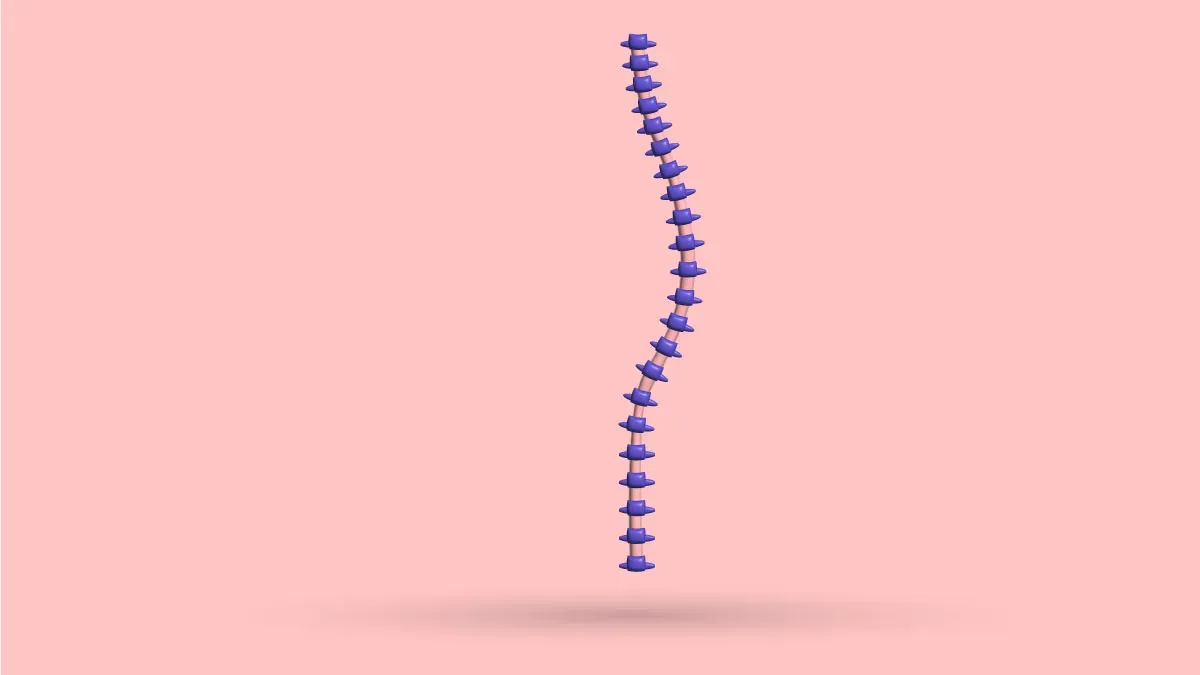
More common than in teenagers generally, but how much more depends on who was counted. Scoliosis is a sideways curve of the spine, usually with some twist. On an X-ray it’s measured as a Cobb angle, the degrees the spine bends to the side, and 10° or more counts as scoliosis.
| Who was studied | How | Scoliosis |
|---|---|---|
| Adolescents in general (clinical review) | Review | 2% to 4% |
| 5,140 matched people without a chest deformity, Wenzhou, China | Records and X-rays | 4.67% |
| 1,315 with excavatum or carinatum, same Wenzhou study | Records and X-rays | 9.86% |
| 779 bar repairs, Seoul | X-ray | 8% |
| 418 excavatum and 117 carinatum, Istanbul clinic | Exam and X-ray | 13% and 19% (any spinal deformity) |
| Review of 48 studies | Combined, mostly surgical patients | 13.1% |
| Meta-analysis, under-18s with excavatum | Pooled, 34 studies | 16% |
| 596 patients repaired in Boston | Exam and X-ray | 21%, mostly mild |
| 248 with excavatum, Korea | Spine X-ray and CT | 22.6% |
| 1,215 Nuss patients, Norfolk, Virginia | Noted in records | 28% |
Wenzhou is the only study with a matched comparison group, and it found about double the rate. Every other pectus row is a hospital series: people seen by a surgeon or specialist clinic, who skew toward severe chests and are more likely to get a spine X-ray at all.
Prof. Mustafa Yüksel, who reviews medical content on this site, co-authored the Istanbul study.
Most curves only need watching. In Boston, 18% of the excavatum and 14% of the carinatum patients with scoliosis needed a brace, spinal fusion or both. A 2000 review estimated that only about 4% to 5% of people with severe chest wall deformities have a curve needing a spine specialist.
Who gets it. It usually shows up in the teens, often after the chest. In 142 people with excavatum in Hebei, China, 6.06% of under-11s had scoliosis against 21.79% of teenagers. Studies disagree on whether boys or girls with pectus get it more, but in teenage scoliosis generally, girls are up to 10 times likelier to have a curve that progresses. In several pectus series most curves sat in the mid-back and bent to the right, though not in all.
Does pectus cause scoliosis?
Nobody has shown that one causes the other. There are three main explanations for why they travel together, none proven for most people.
- Shared genes. In one large family, teenage scoliosis and pectus excavatum were inherited together, tied to a region of chromosome 18, though no single gene was identified.
- Connective tissue disorders. The 2000 review says the link is clearest in Marfan syndrome, where curves are at high risk of getting worse. In the Norfolk group, 2.8% had confirmed Marfan and 17.8% suggestive features.
- Mechanical forces. Some researchers propose that the chest, or the heart pressing to one side, pushes the spine sideways. The Hebei team wrote that this “needs further proof”.
About 8 in 10 cases of scoliosis are idiopathic, meaning no known cause. It isn’t thought to be linked to bad posture (NHS) or heavy backpacks (OrthoInfo). Kyphosis, a rounded upper back, was also common in the Istanbul group: see why people with pectus often look hunched.
Does a deeper chest mean a worse curve?
Not reliably. Most studies found no link, and a few did. Depth is usually measured with the Haller index, a ratio from a chest scan where about 2.5 is average and higher means deeper.
No link turned up in 37 people with both (the curve tracked age instead), 54 children in Poland or 70 people with both in Japan. The Hebei team did find one, and in Wenzhou a Haller index above 3.25 raised the risk of a new curve. The 48-study review called the evidence conflicting. My takeaway: a mild chest isn’t a reason to skip a spine check, and a deep one doesn’t mean a bad curve.
How scoliosis is checked and graded
NHS signs include a visibly curved spine, leaning to one side, uneven shoulders, one hip or shoulder sticking out, and ribs sticking out on one side. A doctor will usually do the Adams forward bend test, looking for one side of your back sitting higher as you bend, then an X-ray measures the Cobb angle.
OrthoInfo, the US orthopaedic surgeons’ patient site, sets next steps by curve and growth:
- Under 25°, or nearly grown: usually watched, with a check every 6 to 12 months.
- 25° to 45° while growing: a brace. It won’t straighten the curve, but often stops it worsening enough to need surgery.
- Above 45° to 50°: surgery is discussed, usually spinal fusion, which joins vertebrae so they heal into one straighter section.
Curves can worsen fast in growth spurts. Once you’re fully grown, fast worsening is rare.
The 2000 review advised examining people with pectus for scoliosis, with X-rays if needed, and referring children with a spinal deformity before age 5 to a spine specialist. The twist of a curve can also push the ribs out on one side: see flare from scoliosis.
What pectus surgery does to the spine
On average, a few degrees either way. Small curves usually stay the same or ease a little. Larger curves can get a bit worse, and rarely a new one appears.
The Nuss procedure
The Nuss procedure places a curved bar behind the breastbone to push it forward. Three recent studies:
- 177 patients in Korea (Na 2025): about 1° up while the bar was in, and no significant change from before surgery to after removal. Curves of 10° or more fell about 3.6°.
- 186 adults in Taiwan (Htut 2026), most without scoliosis: changes of about 1° or less.
- 581 patients in Turkey (Aydemir 2026), 148 of them carinatum repairs: no significant change in the main curve overall, though the upper curve rose in about 80%, which can show as mild shoulder imbalance.
Curve size matters. In the 779 Seoul repairs, curves under 15° shrank by 2.88° on average and curves over 15° grew by 3.86°. Studies disagree on age: in 468 other Seoul patients, curves eased only in those operated on before age 10, but the 48-study review found later surgery wasn’t linked to bigger curves. In Wenzhou, the Nuss was linked to more worsening of existing curves (hazard ratio 5.94, a measure of how much more often something happens over time). The abstract doesn’t say compared with whom, so the size of the effect is unclear. A trend toward fewer new curves wasn’t statistically significant.
A new curve after the Nuss is rarely reported, a 2020 review found, and it recommends evaluating the spine before and after surgery. In one case, a 14-year-old had a 54° curve four weeks after surgery. The bar came out (41°), and with a brace 12 hours a day the curve was gone three months later. In two patients with braced moderate curves, the curves worsened after the Nuss until they needed fusion. Both said post-surgery discomfort cut their brace wear.
Carinatum repair and the reverse Nuss
The reverse Nuss puts the bar in front of the breastbone to press a pigeon chest down. In Wenzhou, it was linked to much more new scoliosis (hazard ratio 9.087), against a comparison group the abstract doesn’t define. That’s one retrospective study, and bracing remains the main carinatum route: see pectus carinatum brace therapy. I couldn’t find data on what the Ravitch, the open repair, does to the spine.
What spine surgery does to a sunken chest
Straightening the spine can make a sunken chest deeper, and in rare severe cases squeeze the heart. That’s behind the one firm guideline rule.
In 20 people in Nagoya, Japan with excavatum who had scoliosis surgery, average age 13, curves went from 72° to 19° on average and the Haller index worsened in 11 of the 20. Nine had pectus surgery first. Case reports describe the heart or a main vein being compressed around spinal fusion, mostly with severe excavatum, Marfan syndrome or syndromic curves.
The 2024 Pectus Care Guidelines come from UK and international societies, including the Chest Wall International Group, which Prof. Yüksel founded. He isn’t a named author. For severe excavatum needing scoliosis surgery, they recommend assessment by an experienced spinal surgeon and an anaesthetist, and pectus surgery first if the spine operation may leave too little space for the heart. That’s Class I, the strongest grade, at Level C: expert consensus rather than trials.
A scoliosis brace or cast presses on the chest too, and the team behind the 70-patient Japanese study proposed this may affect heart function in a deep chest. That’s a proposal, not a measured result, but reason enough to tell your spine team how deep your chest is.
Vacuum bell, chest brace and exercise with scoliosis
Little is known about either device with scoliosis, and there’s no good evidence exercise straightens a curve.
In about 450 bell patients in Basel, scoliosis and kyphosis were among the factors influencing results, though the abstract doesn’t say which way (more in vacuum bell therapy). In 2,453 people treated with compression braces and exercise in Brasília, those with 20° to 52° curves also wore a bending brace for the spine, and no curve got worse. That’s one centre using its own method.
I couldn’t find a study measuring what a vacuum bell or chest brace does to a scoliosis curve, or testing one worn alongside a scoliosis brace. My rule: don’t start a chest device until your spine team knows, and if you wear a scoliosis brace, ask how the two fit together.
Exercise. General exercise is good, says the NHS. For scoliosis-specific exercise, a 2024 Cochrane review of 13 trials in 583 teenagers found it very uncertain whether it reduces the curve compared with no treatment. Bracing has stronger evidence: in the BrAIST trial of 242 teenagers with high-risk curves, 72% of those told to wear a brace at least 18 hours a day finished growing without the curve reaching 50°, against 48% of those only watched. My reading: exercise isn’t a substitute for a brace your spine team recommends.
Yoga. In a 64-patient trial, the side plank made no significant difference to the curve after 6 months, and the doctor who first promoted it has written that it can exaggerate mid-back curves, the kind several pectus series found most often.
What to treat first
There’s no single order for everyone, and your chest and spine teams decide it together. This table is my interpretation, not a protocol. Only the spinal fusion row is backed by a guideline.
| Your situation | What usually happens | Ask the chest team | Ask the spine team |
|---|---|---|---|
| Small curve (under about 25°) or nearly grown | Spine watched, checked every 6 to 12 months | Does my curve change your plan? | Is it OK to start a bell or brace? |
| Brace-range curve (about 25° to 45°), still growing | Spine brace, worn many hours a day | Can chest treatment wait or fit around it? | Can I use a bell or chest brace alongside it? |
| Pectus surgery planned, curve over about 15° | Curve may grow a few degrees after the Nuss (one large series) | Will you X-ray my spine before and after? | Should the curve be followed more closely? |
| Spinal fusion planned, severe sunken chest | Guideline: assessment by a spinal surgeon and anaesthetist; pectus surgery first if fusion may compress the heart | Is my chest severe enough to matter? | Will a spinal surgeon and anaesthetist assess my chest? |
| Carinatum with scoliosis | Little data; reverse Nuss linked to more new curves in one cohort | Is bracing an option before surgery? | Should my spine be followed after surgery? |
What to tell each team:
- Chest team: your curve in degrees, brace hours and any planned spine surgery.
- Spine team: your Haller index, any planned bell, chest brace or pectus surgery, and any heart findings.
- Both: signs of Marfan or Ehlers-Danlos syndrome, and whether you’re still growing.
When to see a doctor
See a doctor before you start any device, brace or exercise program if any of these apply to you:
- chest pain
- fainting or nearly fainting
- breathlessness at rest or with light effort
- palpitations or an irregular heartbeat
- a diagnosed heart or lung condition
- Marfan syndrome or Ehlers-Danlos syndrome, or a doctor has raised either
- previous chest surgery
- a Haller index above 3.25 together with symptoms
- symptoms that nobody has checked yet
None of these means you’ll need surgery. They mean someone should look at your heart and lungs before you go further. An index above 3.25 is a common referral threshold, not an emergency.
For signs that need urgent care, see pectus excavatum and heart problems.
Who to see for the spine. Start with your family doctor, who can check your back and arrange an X-ray. If there’s a curve, ask for a referral to a spine specialist.
What to do next
- You have both and you’re still growing. Ask both teams how chest treatment fits around the spine plan.
- Surgery is planned for either. Make sure each team knows about the other condition.
- Your spine is checked and you’re wondering about your chest. For a sense of how significant yours is and which route fits, take my free 1-minute quiz.
Whatever your situation, give it honest time. Structural change to the chest without surgery is measured in months and years.
Sources
- Horne JP, et al. Am Fam Physician. 2014;89(3):193-8. Read it
- Zhang S, et al. Eur Spine J. 2025;34(11):5296-307. Read it
- Chung JH, et al. Eur J Cardiothorac Surg. 2017;52(1):76-82. Read it
- Şirazi S, Heydar AM, Bezer M, Yüksel M. Spine Deform. 2024;12(6):1615-22. Read it Co-authored by Prof. Mustafa Yüksel.
- van Es LJM, et al. N Am Spine Soc J. 2022;11:100140. Read it
- Pu Y, et al. Arch Med Sci. 2025;21(4):1421-31. Read it
- Waters P, et al. J Pediatr Orthop. 1989;9(5):551-6. Read it
- Hong JY, et al. J Pediatr Orthop. 2011;31(8):870-4. Read it
- Kelly RE Jr, et al. Ann Surg. 2010;252(6):1072-81. Read it
- Frick SL. Chest Surg Clin N Am. 2000;10(2):427-36. Read it
- Wang Y, et al. J Cardiothorac Surg. 2012;7:118. Read it
- Gurnett CA, et al. Spine. 2009;34(2):E94-100. Read it
- Scoliosis. NHS. Reviewed 2023 Apr 12 [cited 2026 Oct 21]. Read it
- Idiopathic Scoliosis in Children and Adolescents. American Academy of Orthopaedic Surgeons (OrthoInfo). [cited 2026 Oct 21]. Read it
- Zhong W, et al. J Healthc Eng. 2017;2017:5048625. Read it
- Tomaszewski R, et al. Acta Orthop Traumatol Turc. 2017;51(4):284-9. Read it
- Tauchi R, et al. Spine Surg Relat Res. 2018;2(1):37-41. Read it
- Na HR, et al. J Thorac Dis. 2025;17(7):4633-43. Read it
- Htut N, et al. J Cardiothorac Surg. 2026;21(1):647. Read it
- Aydemir S, et al. Interdiscip Cardiovasc Thorac Surg. 2026;41(1):ivaf310. Read it
- Park HJ, et al. J Thorac Dis. 2017;9(10):3810-6. Read it
- Meng Y, et al. Medicine (Baltimore). 2019;98(1):e13855. Read it
- Floccari LV, et al. Spine Deform. 2019;7(6):1003-9. Read it
- Beltsios ET, et al. Gen Thorac Cardiovasc Surg. 2020;68(11):1225-33. Read it
- Tauchi R, et al. Eur Spine J. 2018;27(2):381-7. Read it
- Dunning J, et al. Pectus Care Guidelines. Eur J Cardiothorac Surg. 2024;66(1):ezae166. Read it The Chest Wall International Group, founded by Prof. Mustafa Yüksel, is one of the author societies.
- Haecker FM, Sesia S. Vacuum bell therapy. Ann Cardiothorac Surg. 2016;5(5):440-9. Read it
- Haje SA, de Podestá Haje D. Rev Bras Ortop. 2009;44(3):191-8. Read it
- Romano M, et al. Cochrane Database Syst Rev. 2024;2:CD007837. Read it
- Weinstein SL, et al. N Engl J Med. 2013;369(16):1512-21. Read it
- Sarkisova N, et al. Glob Adv Health Med. 2019;8:2164956119887720. Read it
- Fishman LM. Glob Adv Health Med. 2021;10:21649561211019372. Read it
Reading about the condition is one thing. Knowing which one you have, how severe it is and what to do first takes about a minute.
- Your condition named, not guessed
- A severity read you can act on
- The exact next step for your case

This article is for educational purposes only and does not constitute medical advice. Always consult a qualified healthcare professional before starting any treatment plan. View full disclaimer →