Contents · 10 sections
You’ve spotted a dip in the middle of your baby’s or child’s chest, maybe at bath time, maybe in a photo. One distinction decides what you do today.
A dip that’s there all the time, even when your child is calm, is often pectus excavatum. Most cases are mild, and on its own the shape is rarely urgent. A chest that pulls in every time your child breathes is different. That’s a breathing sign, not a chest shape, and it can need help now. So that check comes first.
I had pectus excavatum myself and was diagnosed at 15. I’m not a doctor, so every medical point below comes with its source. After the breathing check, this guide runs from birth to the end of growth, including where hospitals disagree.
First, check how your child is breathing
Watch your child while they’re calm or asleep. Two different things can look like a sunken chest.
- A dip that stays. The middle of the chest sits lower than the ribs around it, whether your child is breathing in or out. That’s a shape, and the rest of this guide is about it.
- Pulling in with each breath. The chest, the skin between or under the ribs, or the tummy sucks in with every breath. Doctors call these retractions. MedlinePlus, the US National Library of Medicine’s health encyclopedia, says they’re most often a sign of a breathing problem and describes them as a medical emergency.
Call 911 (999 in the UK) or go to the emergency room now if your child:
- is struggling to breathe, or can barely cry or speak
- makes grunting noises or sucks in their tummy with each breath
- has skin, lips or tongue that look blue, grey, pale or blotchy
- is floppy or hard to wake
- has stopped breathing or passed out
These come from the NHS urgent signs for under-5s and Seattle Children’s.
Call your child’s doctor now if your child is breathing much faster than normal or has any milder trouble breathing. Seattle Children’s adds that if the ribs start pulling in with each breath while you wait for a call back, go to the emergency room.
One overlap matters. KidsHealth, the Nemours children’s health site, says that in newborns, infants and toddlers with pectus excavatum, the chest may suck in when they breathe, laugh or cry. So in a very young child the two can look alike, and a web page can’t tell them apart. Show it to your child’s doctor, and treat it as urgent if any sign from the lists above comes with it. If you’re not sure what you’re seeing, call.
What a sunken chest in a child usually is
Pectus excavatum is the medical name for a sunken chest. You’ll also see funnel chest, concave chest and concave sternum. “Sunken chest syndrome” is a common search phrase, not a separate diagnosis.
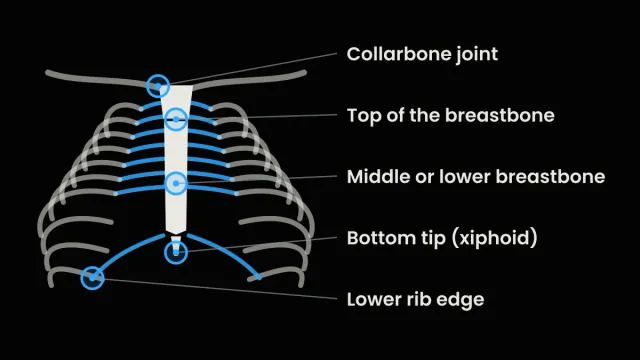
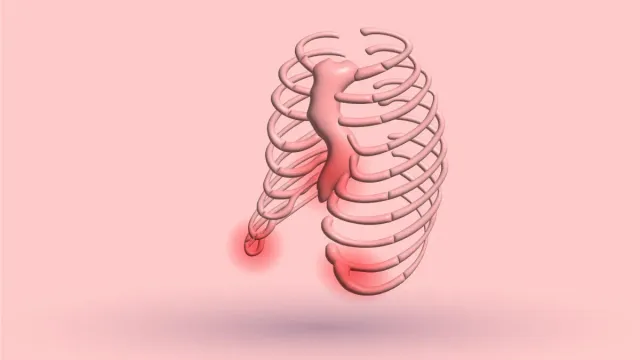
The sternum, or breastbone, runs down the middle of the chest. The ribs join it through costal cartilage, the flexible strips at the front of the ribcage. In pectus excavatum, the breastbone and that cartilage grow inward, so the middle of the chest dips. It ranges from a shallow dent to a deep hollow.
Cleveland Clinic puts it at about 1 to 8 per 1,000 people, and it’s more common in boys. Doctors don’t know exactly what causes it. It can run in families. It isn’t something you caused.
If the breastbone sticks out instead, that’s pectus carinatum, or pigeon chest. For all ages, my main guide to pectus excavatum goes deeper.
What to expect at each age
KidsHealth says some children are born with it, while others show no sign until puberty. Mayo Clinic says a sunken breastbone can often be seen shortly after birth. It’s also easy to miss: at one large US center, only 22% of patients had it noticed in their first decade. The same surgeons describe it progressing slowly through childhood, then often deepening quickly at puberty.
| Age | What you may notice | What usually makes sense |
|---|---|---|
| Newborn and baby | A dip that may be broad and shallow, deep and narrow, or irregular (Boston Children’s). | The breathing check above, then your pediatrician. Nationwide Children’s notes the chest wall becomes less flexible after infancy. |
| Toddler and preschool | Often nothing beyond the dip. Some have rib flare, or one side deeper than the other. | A pediatrician visit if nobody has looked yet. Monthly measuring and photos. Active play. |
| School age | A small dent may first be spotted now (Seattle Children’s). Change is usually slow. | A referral to a pediatric surgeon or chest wall clinic, ideally by 10 to 12 (Nationwide Children’s). |
| Puberty and growth spurts | Often deepens fastest, around 12 to 14 (Seattle Children’s). | A specialist review if you haven’t had one. Most hospitals time surgery, if needed, in this range. |
| After growth ends | It usually stops changing (KidsHealth, Cincinnati Children’s). In some people it keeps deepening into adulthood (Mayo Clinic). | The bell and surgery are still options, but the chest is stiffer. |
I couldn’t find a study that followed dips seen in babies, so I can’t tell you how many deepen, stay the same or fade. Does it go away on its own? For most children, no: KidsHealth says it doesn’t get better without treatment. The only exceptions I found are a few case reports tied to a blocked airway, covered under symptoms. More on whether pectus excavatum gets worse with age.
Symptoms of a concave sternum in a child
Many children with pectus excavatum have no symptoms, especially before their teens, say KidsHealth and Seattle Children’s. When symptoms appear, they depend on age.
Babies and young children usually have few beyond the dip itself. You may see lower ribs that flare out and give a potbelly look (more on flared ribs), a dip that’s deeper on one side, or a chest that sucks in when they breathe, laugh or cry. For that last one, the breathing check above still applies.
Older children and teens may have:
- trouble keeping up with friends, or breathlessness with exercise
- chest pain that comes and goes
- tiredness
- a fast or pounding heartbeat, or palpitations (a heartbeat that feels irregular)
- dizziness when standing up
- trouble playing brass or woodwind instruments
- worries about how their chest looks
On the heart and lungs, Boston Children’s says even severe pectus excavatum usually affects heart and lung function only during extreme exercise, and not usually in a major way. Seattle Children’s says many children have normal, active childhoods and full, healthy lives without treatment. That’s reassuring, but it isn’t a reason to skip a check-up. More on pectus excavatum and the heart.
Tell the doctor about noisy breathing or snoring. In one ENT clinic’s records, 9 of 137 children with laryngomalacia, a floppy voice box that makes breathing noisy, also had pectus excavatum, more often than children without laryngomalacia. A few old case reports describe the dip easing after a blocked airway was treated, in two children by removing enlarged tonsils and adenoids. Small numbers, and an association rather than proof, but worth the doctor knowing.
What I couldn’t find. Some pages say a sunken chest causes repeated chest infections in babies, or makes a baby cry when the chest is touched. I couldn’t find research linking pectus excavatum to either, which isn’t proof there’s no link. If your child has those problems, tell the doctor rather than assuming the chest explains them.
There’s more on pectus excavatum symptoms in teens and adults.
Scoliosis, Marfan and genetics: what doctors look for
Boston Children’s calls the link with connective tissue disorders such as Marfan syndrome rare. Doctors still check, because a few conditions travel with a sunken chest and can change the plan.
- Scoliosis, a sideways curve of the spine. Hospital series put it at roughly 1 in 7 to 1 in 4 children with pectus excavatum. More on scoliosis and pectus excavatum.
- Marfan syndrome and other connective tissue conditions, such as Ehlers-Danlos. The 2024 Pectus Care Guidelines, a consensus from surgical and Marfan societies, say about 5% of people who first come in with what looks like pectus alone are later found to have Marfan. The first assessment covers the eyes, heart, muscles and skeleton, and family history. There’s more on Marfan syndrome and pectus excavatum.
- A genetics referral. The same guidelines say any patient thought to be at risk of an inherited connective tissue disorder must be referred to a genetics service.
If the dip showed up early, ask the doctor whether genetic counseling makes sense. In a small Dutch clinic series, two clinical geneticists examined 18 children seen for pectus excavatum before age 11. Eight had a genetic variant, including Noonan syndrome, chromosomal changes and one connective tissue disorder, Loeys-Dietz syndrome. It was a referral clinic, so that rate won’t apply to every child, but the authors suggest considering genetic counseling when it starts early.
When to see a doctor, and what they may check
Don’t wait for symptoms. UNC Health’s pediatric surgeon points out that children who aren’t exercising hard may not notice them, and his team always screens for connective tissue disorders such as Marfan syndrome. KidsHealth says all children with pectus excavatum should be seen by a chest wall surgeon.
Start with your pediatrician and ask for a referral to a pediatric surgeon or chest wall clinic, a team that treats chest shape problems. Nationwide Children’s puts the best referral age at 10 to 12, earlier if parents or the pediatrician have questions.
KidsHealth’s care sheet for families says to call your child’s doctor if your child:
- tires more easily than you’d expect
- gets short of breath during normal activities
- feels their heart beating irregularly
or if you or your child are worried about how the chest looks. It says to call 911 or go to the emergency room for severe chest pain or trouble breathing.
What they may check. Diagnosis starts with a physical exam. Tests vary by hospital and may include:
- a 3D surface scan to track the shape over time (Boston Children’s uses a white-light 3D camera)
- a chest X-ray
- a CT or MRI scan to measure the dip (Cincinnati Children’s prefers MRI because it uses no radiation)
- an ECG, a heart rhythm tracing, and an echocardiogram, an ultrasound of the heart (Seattle Children’s says it needs an echo only rarely)
- lung function tests and an exercise test
A CT or MRI lets the doctor calculate the Haller index, the chest’s width divided by the distance from the back of the breastbone to the spine. A reading of 3.25 is a common threshold for surgical referral, not an emergency. More in the Haller index explained.
Treatment for an indent in a child’s chest
What fits depends on age, how deep the dip is, how flexible the chest is, whether there are symptoms, and whether your child is bothered by how it looks. KidsHealth counts that last one as a reason for treatment in its own right. For most patients, though, the 2024 guidelines say supportive care is enough.
Watching it and measuring every month
Boston Children’s says that in many cases it recommends close observation first. Children’s Health in Dallas says the evidence doesn’t support observation as a treatment, because the shape doesn’t change without intervention. So watching isn’t a treatment. It’s how you and the doctor time a decision.
At home, measure once a month. Your child lies flat and breathes normally. Rest a ruler across the dip without pressing, and measure straight down to the deepest point in millimeters. Take the same photos each time. The number tracks change, not severity, and it isn’t a Haller index. Full method: how to measure pectus excavatum at home.
Staying active, and what exercise can’t do
Keep your child moving. UNC’s surgeon encourages activity before puberty, with breaks as needed, and KidsHealth says physical therapy can strengthen the chest muscles and improve posture. What exercise hasn’t shown is a smaller dip. In a 12-week supervised program for 14 children, breathing tests and walking distance improved, but chest depth wasn’t measured. Seattle Children’s says no exercise has ever been shown to improve pectus excavatum itself. Braces are mainly a treatment for pectus carinatum, the chest that sticks out, which is where the 2024 guidelines recommend them. More in pectus excavatum exercises.
The vacuum bell, and why hospitals disagree
A vacuum bell is a cup that seals over the dip, connected to a pump that draws the air out. The suction pulls the chest forward while it’s on, and months of use aim to make the chest hold more of that position. Children’s hospitals disagree about it.
- For it, in the right child. Boston Children’s, Cincinnati Children’s, KidsHealth and the 2024 guidelines offer it, mainly for younger children with milder, flexible chests. The guidelines call it safe, with the best results in milder dips and younger patients. They advise starting early, because the chest stiffens with age, and want children closely supported throughout.
- Against relying on it. Seattle Children’s says that at this time “surgery is the only option that works.” UNC’s surgeon says the bell can temporarily reduce the depth but doesn’t correct the problem, and the breastbone often goes back when you stop.
What the studies, mostly in children, show:
- Age matters. Starting at 11 or younger went with better results in a study of 115 patients in Norfolk, Virginia. A 2026 review of 27 studies of patients aged 3 to 20 named age under 10 as a predictor.
- A near-flat chest is a minority result. In that review, excellent results ranged from 11% to 52.5%, each study defining “excellent” its own way. In 139 preschool children averaging 4.6 years, 30.9% reached a depth under 3 mm over a short follow-up.
- Part of the visible change can be fat. In 47 children with a median age of 7, the dip at the skin improved by 4.0 mm in a year, the dip in the bone by 1.4 mm, and chest fat increased in 95.7%.
- High-quality randomized trials are still missing, as a 2025 scoping review notes.
In children under 10, a parent or caregiver should supervise the sessions, says the Basel team. They check the heart with an ECG and echocardiogram before starting, and write that the best age to start is still undefined. Boston aims for four hours of wear a day in total, usually for at least two years. Talk to your child’s doctor before you buy one.
Full disclosure: I used a bell myself and I sell a custom-built one, which is why this section sticks to what hospitals and studies say. Routines, school and sport are covered in vacuum bell therapy for kids, and the full study table is in my vacuum bell therapy guide.
Surgery, and the age question
For a severe chest, surgery is a well-established option, and choosing it is not a failure. In the most common operation, the Nuss procedure, a surgeon places curved metal bars under the breastbone through small cuts at the sides of the chest and removes them a few years later.
When to operate is where hospitals differ:
| Hospital or source | Usual timing |
|---|---|
| Cleveland Clinic | Best age 10 to 14 |
| Children’s Hospital of The King’s Daughters, Norfolk | About 12 to 14 |
| Cincinnati Children’s | Not usually under 12 |
| Children’s Health, Dallas | Most often after 13 |
| Boston Children’s | The teen years |
| Nationwide Children’s | Usually early adolescence, with evaluation at any age |
| UNC Health | 13 to 15 for girls, 14 to 16 for boys |
| 2024 Pectus Care Guidelines | The best age is not yet settled |
Cincinnati Children’s says infants and very young children are usually not considered unless the chest is very severe or another illness requires it. Waiting into adulthood has a cost too. A review of 15 studies covering 5,978 Nuss patients found adults, 18 to 20 and older, had more complications, which the authors say supports repair before late adolescence.
If a connective tissue disorder is suspected, the 2024 guidelines say surgery should wait for a geneticist’s assessment. In Marfan syndrome, an older Johns Hopkins study linked recurrence to operating young and advised waiting until growth is nearly complete.
How it can affect your child’s confidence
For some children, the harder part is how they feel. Boston Children’s says that in most cases the biggest benefits of treatment are psychological. The 2024 guidelines note that the harm can come at a crucial time in a child’s physical and social development, and UNC’s surgeon calls social withdrawal and depression documented consequences.
In a study across 11 North American children’s hospitals with 264 patients and 291 parents, how much the chest affected a child socially and emotionally before surgery wasn’t related to how deep it was on CT. After repair, body image and self-consciousness improved by both the child’s and the parent’s report, and 97% said the chest looked better. That was a surgical group, so it shows how much the chest can matter to some children, not what every child feels.
The guidelines also note that some people with a sunken chest avoid swimming or the beach. If your child starts doing that, tell the doctor, and don’t let anyone wave it off as vanity. I’ve written more about how pectus excavatum affects mental health.
What to do next
If your child is under 13
- Breathing comes first. Pulling in with each breath, or any urgent sign above, means getting help now.
- Book a routine visit with your pediatrician and ask about a chest wall specialist. Mention noisy breathing or snoring, any family history of a sunken chest or Marfan syndrome, and how early you noticed the dip.
- Measure once a month and take photos, so the doctor sees a trend.
- Keep your child active.
If your child is 13 or older
This is the age I know firsthand. After my diagnosis at 15, I declined surgery and corrected my chest over about three years of daily vacuum bell use and structured training. The change was visible and measurable, but not complete. That’s one person, not a study.
The same rules apply to a teen: see a doctor first if there are symptoms or any red flag above. If you’d like a sense of how significant their chest is and which routes might fit, your teen can take my free 1-minute quiz with you. It’s built for ages 13 and up.
Sources
- Dunning J, et al. Pectus Care Guidelines. Eur J Cardiothorac Surg. 2024;66(1):ezae166. Read it
- Intercostal retractions. MedlinePlus, US National Library of Medicine. [cited 2026 Oct 20]. Read it
- When to get urgent medical help for babies and children under 5. NHS. Reviewed 2026 Aug 6. [cited 2026 Oct 20]. Read it
- Breathing Trouble. Seattle Children’s. Reviewed 2025 May 6. [cited 2026 Oct 20]. Read it
- Chest Wall Disorder: Pectus Excavatum (for Parents). Nemours KidsHealth. Reviewed 2024 Mar. [cited 2026 Oct 20]. Read it
- Pectus Excavatum: How to Care for Your Child. Nemours KidsHealth. [cited 2026 Oct 20]. Read it
- Pectus Excavatum. Cleveland Clinic. [cited 2026 Oct 20]. Read it
- Pectus excavatum: Symptoms and causes. Mayo Clinic. [cited 2026 Oct 20]. Read it
- Nuss D, Obermeyer RJ, Kelly RE. Ann Cardiothorac Surg. 2016;5(5):493-500. Read it
- Pectus excavatum. Boston Children’s Hospital. [cited 2026 Oct 20]. Read it
- Pectus Excavatum. Seattle Children’s. [cited 2026 Oct 20]. Read it
- Pectus Excavatum. Cincinnati Children’s. [cited 2026 Oct 20]. Read it
- Why Does My Child Have a Dent in Their Chest? UNC Health Talk. 2026 Jan 28. Read it
- Pectus Excavatum. Nationwide Children’s Hospital. [cited 2026 Oct 20]. Read it
- Pectus excavatum. Children’s Health. [cited 2026 Oct 20]. Read it
- Schaerer D, et al. Int J Pediatr Otorhinolaryngol. 2013;77(10):1721-3. Read it
- Fan L, Murphy S. Am J Dis Child. 1981;135(6):550-2. Read it
- Billar R, et al. Eur J Pediatr Surg. 2024;34(4):325-32. Read it
- Amăricăi E, et al. Wien Klin Wochenschr. 2019;131(5-6):126-131. Read it
- Obermeyer RJ, et al. J Pediatr Surg. 2018;53(6):1221-5. Read it
- Kumar B, Jain V, Dhua AK. Efficacy and safety of vacuum bell therapy in pectus excavatum: a systematic review of clinical outcomes. J Indian Assoc Pediatr Surg. 2026;31(1):4-19. Read it
- Luo D, et al. Front Pediatr. 2022;10:1008437. Read it
- Zhang, et al. J Pediatr Surg. 2026;61(7):163131. Read it
- Sesia SB, Sesia N, Haecker FM. J Thorac Dis. 2025;17(10):9161-77. Read it
- Haecker FM, Sesia S. Non-surgical treatment of pectus excavatum. J Vis Surg. 2016;2:63. Read it
- Coughlin AC, et al. Pediatr Surg Int. 2022;38(3):365-75. Read it
- Arn PH, et al. J Pediatr. 1989;115(6):954-8. Read it
- Kelly RE Jr, et al. Pediatrics. 2008;122(6):1218-22. Read it
Reading about the condition is one thing. Knowing which one you have, how severe it is and what to do first takes about a minute.
- Your condition named, not guessed
- A severity read you can act on
- The exact next step for your case

This article is for educational purposes only and does not constitute medical advice. Always consult a qualified healthcare professional before starting any treatment plan. View full disclaimer →