Contents · 18 sections
Put a vacuum bell on a sunken chest, squeeze the pump, and the dip lifts right away. What matters is how much of that lift is still there after months of wearing it, once the bell comes off.
The published answer is less tidy than most sales pages suggest. In the studies on this page, mostly of children and teenagers, the share of patients counted as a “success” or an “excellent” result ran from about 11% to 52%. Much of that spread comes from how each study defined success, and who it counted. Most patients improved to some degree. The odds were best for younger patients with shallower, more flexible chests who wore the bell many hours a week for a year or more. And there are still no randomized trials, the kind of study where chance decides who gets which treatment.
I was diagnosed with pectus excavatum at 15, declined surgery, and corrected it over about three years of daily vacuum bell use and structured training. The change was visible and measurable, but not complete. I’m not a doctor, so every clinical point here comes with the study or hospital guide behind it.
Below: what the studies found, who it suits and who shouldn’t use it, adults, how to judge a before-and-after photo, then hours, pain, side effects and surgery.
How a vacuum bell works
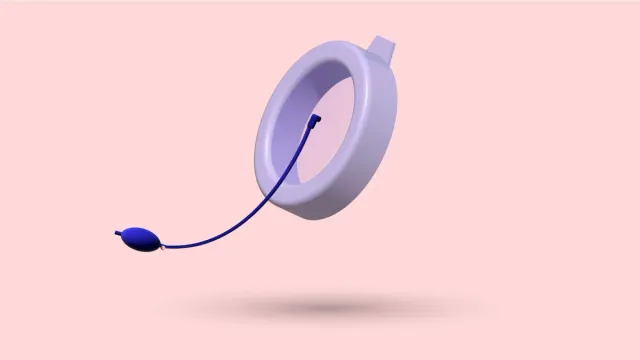
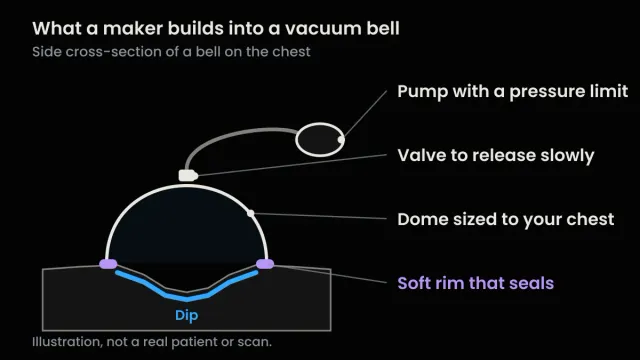
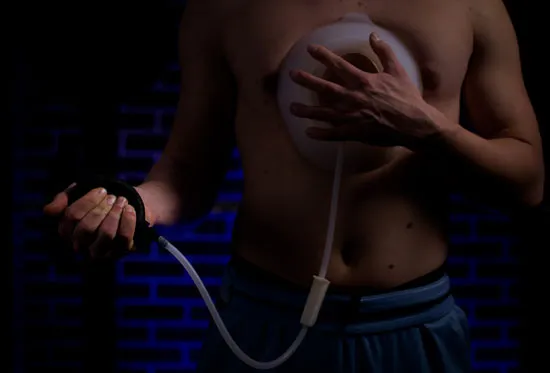
A vacuum bell is a cup that seals over the dip in your chest, connected by a tube to a hand pump. Squeezing the pump draws air out of the bell, and the lower pressure inside pulls the front of the chest outward. In Haecker and Mayr’s 2006 Basel study, the pump took the pressure inside down to as much as 15% below the air around you.
A 2016 review by Haecker and Sesia cites a 2005 pilot study in which CT scans showed the breastbone (sternum) and ribs lifting at once when the bell went on. Eckart Klobe, the engineer behind the modern bell, writes that it also stretches the inner muscles that pull the funnel back in, including the diaphragm.
The long-term target is the costal cartilage, the flexible strips that join your ribs to the breastbone. In pectus excavatum, that cartilage and the sternum have grown inward. Lifting them again and again, for months, is meant to reshape the cartilage so the chest holds more of the lifted position on its own. The bell doesn’t bend bone.
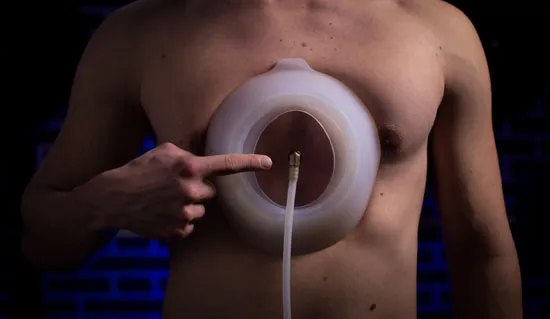
Then the lift partly sinks back. In his own 2019 article, Klobe says this may last “a few minutes or hours”, and children’s chests sank back faster than adults’ in the 2006 study. So a few weeks of wear isn’t enough: each session gives a temporary lift, and any lasting change builds over months.
To put it on, center the bell over the deepest point, spread the rim so it seals evenly, pump gradually, and at the end let air back in slowly. The full routine is in my guide on how to use a vacuum bell, and choosing a size has its own page on vacuum bell sizing.
Does vacuum bell therapy work?
These studies measured whether the lift lasts, each in its own way, so read the “what counted” column first. Most are retrospective: the researchers went back through patient records instead of running a planned trial. Nuss is the usual operation, in which a surgeon places a curved metal bar behind the breastbone to push it forward.
| Study | Who was counted | What counted as success | Result |
|---|---|---|---|
| Haecker and Mayr 2006, Basel | 34 patients aged 6 to 52 | Sternum lifted more than 1.5 cm at 3 months; at a normal level at 12 months | 79% lifted more than 1.5 cm; 14.7% (5) at a normal level |
| Haecker and Sesia 2016, Basel | 140 patients aged 3 to 61, averaging 107.9 minutes a day | Sternum lifted to a normal level | 61 of 140 (about 44%), after an average of 21.8 months. 25 stopped; 15 of them had Nuss |
| Obermeyer 2018, Norfolk, Virginia | 115 analyzed of 180 enrolled | “Excellent”: a dip of 0.51 cm or less | 20% |
| Aughtman 2025, same center | 278 analyzed of 431 | Excellent correction | 11%. 15.5% later had surgery, none from the excellent group |
| Toselli 2022, Buenos Aires | 186 patients | Complete correction; good or excellent | 17% complete, 35% good or excellent. 34% withdrew |
| van Braak 2025, Amsterdam | 165 under-18s who completed treatment, of 259 | Patient, parents and surgeon all judged it aesthetically pleasing | 52.1% |
| AlShammari 2026, London | 240 children, enrolled only if the chest lifted at the first fitting | Clinical improvement; dip depth | 67.5% improved. Average depth from 21.1 mm to 7.7 mm |
| Koo 2025, Boston | 57 patients | Share of the dip’s depth corrected | 28% with at least 28 hours a week, 16% with less |
The definition drives the number. Amsterdam’s 52.1% counts a chest that looked good to patient, parents and surgeon, while Obermeyer’s 20% needed the dip down to about half a centimeter. The groups also shrink: Aughtman analyzed 278 of 431, a third of Toselli’s patients withdrew, and AlShammari only enrolled early responders, so their 67.5% won’t carry over to everyone. AlShammari’s patients did rate their breathing difficulty lower afterwards, from 3.58 to 2.0 out of 10, while chest pain didn’t change.
The reviews agree. A 2026 systematic review of 27 studies and 2,644 patients aged 3 to 20 found excellent correction in 11% to 52.5%, with definitions varying, and some improvement in 60% to 80%. A 2025 scoping review of 27 studies called the bell safe, effective and cost-efficient, especially for younger patients with mild to moderate chests, and found no high-quality randomized trials.
The 2024 UK Pectus Care Guidelines call the bell “a safe conservative treatment”, with a recommendation one step below their strongest grade, best in younger patients and milder dips, and much less successful overall than bracing is for pectus carinatum (a chest that sticks out).
The one comparison with surgery I found is small. A 2021 study of 57 patients looked at outcomes one year after Nuss bar removal or at least a year of bell use. The Haller index, a CT measure of the chest’s width against the distance from breastbone to spine, didn’t differ significantly, but the Nuss group had changed more. Haecker, in a 2024 review and survey of chest wall surgeons, calls its statistics debatable.
Does it last? Basel saw no regression over 27.6 months of follow-up. In Amsterdam, 2 of the 86 successes (2.3%) relapsed, with a median follow-up of 64 months. Follow-up running into decades is still missing.

Who it suits best
The same factors kept coming up. None decides your case on its own.
- Age. Starting at 11 or younger went with better results in Obermeyer’s study, and the same center’s 2025 series found the best odds at ages 8 to 12.9. Haecker recommends starting before 10 where treatment is needed.
- Depth. A dip of about 1.5 cm or less (Obermeyer, Aughtman) or 1.8 cm or less (Toselli).
- Flexibility. In Obermeyer’s study, a chest wall that gives when pressed was the strongest predictor of an excellent result. Amsterdam found lower success in flexible chests, so this one isn’t settled.
- Symmetry. Haecker puts severe, asymmetric, stiff chests in the group most at risk of failure. More on uneven chests and asymmetric pectus.
- Time and hours. More than 12 months in a row went with better results (Obermeyer, Toselli). In Koo’s study, weekly hours mattered more than age or depth, though most other series found age mattered too.
- Spine and posture. Haecker notes that scoliosis or a rounded upper back may affect results, and Klobe recommends posture exercises alongside the bell. See pectus posture.
The first fitting tells you something. AlShammari only took children whose chest lifted when the bell first went on, and a 2021 study found a CT scan taken with the bell applied predicted who would respond. Basel supervises every first application, and it’s worth asking for the same.
Girls. Female models of the bell exist, and girls were treated in the Basel and Amsterdam series. In Amsterdam, 11 of 28 girls stopped as their breasts grew. For parents, age changes the plan most; I cover that in vacuum bell therapy for kids.
Who shouldn’t use a vacuum bell
A contraindication is a condition that makes a treatment unsafe. Between them, Haecker’s papers, Klobe’s article and Pectus Clinic London rule out:
- Bone conditions that weaken the skeleton, such as osteogenesis imperfecta (brittle bone disease) and osteoporosis.
- Blood vessel conditions, including Marfan syndrome, a widened aorta and aneurysms.
- Bleeding disorders, such as hemophilia.
- Heart conditions. See heart problems with pectus excavatum.
Surgeons don’t all exclude the same things. In Haecker’s 2024 survey, 72.5% of respondents cited bleeding disorders, 60% major heart malformations and 30% previous heart surgery.
See a doctor first. In Basel, patients have an ECG (a tracing of the heart’s rhythm) and an echocardiogram (a heart ultrasound) before starting. Klobe writes that his bell is only dispensed when a physician is in charge, and the UK guidelines call for early specialist assessment and regular professional support.
When not to wear it. A wear-and-care sheet from Braceworks, a Canadian orthotics clinic whose instructions appear to follow Klobe’s, adds: on flights or high-altitude railways, after scuba diving, with silicone or fat implants in the chest, or with Poland syndrome (an underdeveloped chest muscle on one side) unless the bony chest is complete. That’s one clinic’s list, so check it with your doctor.
If none of this applies and you want a sense of where your chest sits, my free 1-minute quiz asks how severe it is and points you to the route that fits.
Vacuum bell therapy for adults
Adults can improve with the bell. The change is slower, a complete correction is less likely, and the evidence is thinner than for children. Of 434 patients who started in Basel over 13 years, 113 were over 18.
- Adults lift less but hold it longer. In the 2006 study the lift was more obvious in children, while in adults it lasted 30 to 60 minutes after removal, and adults improved slowly but continuously.
- It takes longer. Haecker expects 24 to 36 months for moderate, less flexible chests deeper than 3 cm, a group running from adolescents to adults.
- It can fit a working day. Some adult patients in Basel wore it up to 8 hours a day during office hours.
- One case at 61. Klobe describes a 61-year-old man with a 4.0 cm dip who wore a 26 cm bell 3 to 4 hours a day, and concludes that at least a fair to good result is possible in middle age. One case, reported by the manufacturer.
Against that, Pectus Clinic London doesn’t routinely recommend the bell for adults, and I found no outcome series of adults alone.
My opinion: with a mild to moderate, reasonably flexible chest and the hours to wear it, the bell is worth discussing with a specialist. Expect years, and a partial change rather than a flat chest.
Results and before-and-after photos: what to expect
Structural change is measured in months and years. Clinics typically check depth and take photos every 3 to 6 months.
Part of the visible change can be fat
Imaging studies found the skin surface improving more than the bone underneath, with the fat under the skin thickening where the bell pulls. That changes how you read any before-and-after photo.
- In a 2020 study of 15 children and teens, the dip’s depth improved by 8.7 mm on average while the Haller index barely changed. Fat under the skin thickened in 11.
- In a 2026 CT study of 47 children (median age 7), after a year the surface dip had improved by 4.0 mm and the bony dip by 1.4 mm, and chest fat had increased in 95.7%.
- In a 2026 MRI study of 19 boys and young men (median age 14.8) after at least a year, the Haller index didn’t change, fat over the dip grew by 6.5 mm, and the authors attribute the visible improvement mainly to that.
Haecker has disputed the first study, and the CT study’s authors describe bone and fat changes working together. So “it’s all fat” is wrong, but a skin-surface measurement can’t tell the two apart.
How to judge a before-and-after photo
- When was the “after” taken? Pectus Clinic London photographs patients with the bell typically not worn since the previous day. A photo soon after a session shows that session’s lift.
- Same angle, light and breath? Each can change how deep a dip looks.
- How long, how many hours, what age? Without those, it says little about your odds.
The photos below show the angles to use. They’re from one session, not a before and after.


Tracking your own
Measure once a month, before your first bell session of the day. Lie flat on your back and rest the ruler across the dip without pressing, then take front and side photos the same day. The method, and why your number isn’t a Haller index, is in my guide to measuring pectus excavatum at home.
When to rethink
A 2025 systematic review of 20 studies in children suggests considering surgery if no visible results are seen after 6 to 12 months. Treat that as the point to sit down with a specialist and your log, not an automatic switch.
How many hours a day, for how long, and overnight
There’s no single schedule:
- Boston Children’s Hospital: start at 30 minutes twice a day, add 15 minutes a week, aim for 2 hours twice a day. KidsHealth gives a similar 4- to 6-week build-up.
- NHS Scotland’s Chest Wall Service: building up to 2 hours a day, for at least 12 months.
- Klobe: typically 1 to 3 hours a day over 1 to 3 years.
- Basel: at least 30 minutes twice a day; some teenagers wore it 7 to 8 hours a night.
More hours went with more correction. In AlShammari’s study, each extra hour of average daily wear meant about 1.7 mm more depth reduction. A 2023 study of 50 children aged 10 to 14 found correction rose with daily hours and suggested 6 hours a day, though only 5 of its 25 completers had a good repair.
Overall length: more than half of the surgeons in Haecker’s survey recommend 12 to 24 months, and Basel expects 12 to 15 months for mild, symmetric, flexible chests under 3 cm deep and 24 to 36 months for moderate ones.
Your skin sets the limit, so build up gradually. My paid vacuum bell guide has a plan for building up wear time and pressure.
Overnight. In Amsterdam, overnight use went with higher success in under-18s, but overnight wearers also treated for longer, so it’s an association. The authors advise against starting overnight wear in the first 2 to 3 months, while the skin adapts, and the UK guidelines note many patients can’t sleep with it. I used to sleep with my vacuum bell. I don’t anymore. The setup for nights is in my guide to the best sleeping position for pectus excavatum.
Does the vacuum bell hurt?
At first, often yes. Haecker reports that most patients had moderate pain in the sternum and uncomfortable pressure during the first five applications, without needing painkillers. Boston Children’s describes it to families as pressure rather than pain, and asks them to get in touch if it does hurt.
Two rules from the sources:
- Pain means stop pumping. Klobe: as soon as it starts to hurt, don’t increase the pumping. The Braceworks sheet says to squeeze until you feel suction, not pain.
- Back pain or burning, prickly arms mean take it off. KidsHealth says to remove it and retry later at lower pressure, and Haecker found these settled with lower pressure.
Pain that lasts after the bell is off is a different matter: see pectus excavatum pain.
Side effects and what to do about them
In Basel’s 140 patients, skin irritation was reported in 13.6%, localized pain in 12.1% and hematoma (bruising from blood collecting under the skin) in 7.1%. In Amsterdam, 22.8% had complications, all minor and mainly skin. The table gathers what the sources report, not everything that could happen.
| Side effect | What the sources advise |
|---|---|
| Bruising (hematoma) | Less pressure, shorter sessions. Moderate bruises cleared within hours in Basel. Dark or black bruising: see a doctor |
| Petechiae (pinpoint red spots from tiny bleeds) | Usually fade within weeks after treatment ends |
| Redness or a ring from the rim | Fades within hours |
| Thick, swollen skin from fluid (the most common side effect, per Klobe) | Usually too much pressure or time early on: shorten and lower |
| Flabby or loose skin | Shorter sessions, less pressure |
| Chafed skin, watery blisters | Pause until healed |
| Blood droplets on the skin | Lower the pressure |
| Skin darkening after repeated bruising (rare, per Pectus Clinic London) | Ease off; see a doctor if bruising turns dark |
| Acne in the suction zone | Keep skin and bell clean |
| Irritated nipples | Offset the bell so one nipple is fully inside the rim and the other fully outside |
| Enlarged nipples in males | See a doctor. Only the Braceworks sheet lists it; Amsterdam recorded a thickened gland in 3 of 259 |
| Sore chest muscles, back pain | Lower pressure, shorter sessions, a few days off |
| Tingling arms | Take it off, retry later at lower pressure |
| Dizziness | Sit or lie down when you put it on and take it off |
| Febrile bronchitis (listed on one sheet) | See a doctor |
Most of these come back to the same two adjustments: shorter sessions and less pressure.
Is the vacuum bell safe?
For suitable patients, the published record is reassuring: Haecker’s 2024 review found no complications in the literature that were permanent or classified as severe, and the 2026 systematic review saw no severe complications in any cohort.
That isn’t the same as “nothing ever goes wrong”. Haecker’s 2006 paper lists rib fractures in rare cases, though the Basel team writes they never saw one in their own patients. Children under 10 need a parent or caregiver supervising, say both Basel and KidsHealth.
Can it collapse a lung? I found no published case of a vacuum bell causing a collapsed lung (pneumothorax), in the reviews or a PubMed search in October 2026. That’s an absence of reports, not proof it can’t happen.
Using the bell before or during the Nuss procedure
- While waiting. In Amsterdam, 4 of 15 patients waiting for Nuss no longer needed it after using the bell.
- If the bell fails. A 2021 study of 127 Nuss patients, 27 of whom had tried the bell without success, found the failed attempt didn’t change the operation’s outcome.
- During the operation. In a 2012 Basel report, surgeons used a gas-sterilized bell (off-label) to lift the sternum during Nuss in 50 patients aged 9 to 28, with no heart or vessel injuries.
- The heart while it’s on. In a 2019 cardiac MRI study of 20 young adults awaiting surgery, the heart pumped about 10% more blood per beat (adjusted for body size) while the bell was on. An immediate effect, not a lasting one.
My guide to the Nuss procedure covers the operation itself.
Bell or surgery: the short version
Surgery has a legitimate place, especially for severe chests and when the bell hasn’t worked. Choosing it isn’t a failure.
| In the bell’s favor | Against it |
|---|---|
| No operation, anesthetic or scar | Hours a day for one to three years |
| You control the pressure and the time | Many stop: 34% withdrew in Toselli’s study; only 38.6% in Koo’s reached 28 hours a week |
| Published side effects were temporary | Lower odds of a full correction; Klobe writes it doesn’t always reach the cosmetic result of an operation |
| You can stop at any time | In the one small comparison, the Nuss group changed more |
| The 2025 scoping review called it cost-efficient | A 2019 best-evidence review found success “largely dependent on patient compliance and motivation” |
For the full comparison, including the one study that put them side by side and how the two can be combined, see vacuum bell vs surgery. If you’re weighing an operation, my guide to pectus excavatum surgery covers it.
A short history of the vacuum bell
The idea is over a century old: the pediatricians Spitzy and Lange used a glass bell to lift the sternum, described by Lange in 1910, until inadequate material and side effects ended its routine use.
The modern bell dates from 1992, when Eckart Klobe, an engineer with pectus excavatum, developed a new device and corrected his own chest with it over about two and a half years. It was registered as a medical device in 2002. In 2012 his bell was registered with the US FDA as a Class I device, and CHKD in Norfolk, Virginia, started using it. Its surgeon Dr. Robert Obermeyer, who had toured Klobe’s factory, said in CHKD’s announcement: “I believe this could eliminate the need for surgery in some pectus excavatum patients.”
In Haecker’s 2024 survey, 72.4% of responding members of the Chest Wall International Group, a society of chest wall surgeons, used it.
How to clean a vacuum bell
Follow your own bell’s manual first. Two sources agree on the basics and differ on alcohol:
- Braceworks’ Klobe-based sheet: a soft cloth moistened with soap and water, or with ethyl, propyl or isopropyl alcohol. No disinfectants.
- Pectus Clinic London: mild soap and warm water after each session, dry it, and check the valves for leaks.
Mild soap, water and drying it fully is the common ground. Use alcohol only if your manual allows it.
My experience with the vacuum bell
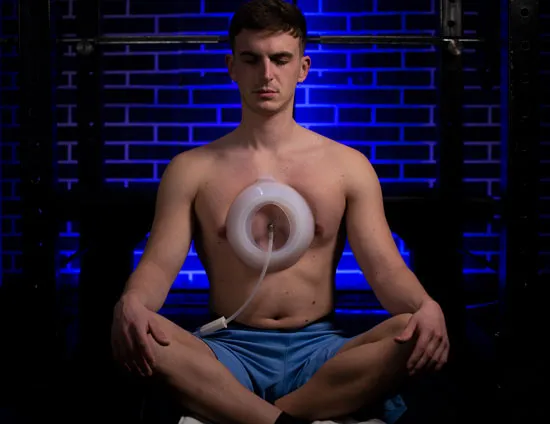
I was diagnosed in 2012 and turned down surgery. Because the bell and the training ran together, my result can’t tell you what the bell does alone, and my correction isn’t complete. I won’t pretend it is.
I started with a Pectus Healing bell and later moved to my own mrpectus design, the custom bell I now sell, so weigh what I say with that in mind. It’s on my vacuum bell page. The results on this page come from published studies, and no published study has used my bell.
Where to start
- A contraindication or red flag (a bleeding disorder, a heart or blood vessel condition, Marfan syndrome, fragile bones, chest pain, breathlessness): see a doctor first and ask for a chest wall specialist.
- Measure before you buy anything, so you have a starting point, and ask for a supervised first fitting.
- Comparing bells: where to buy a vacuum bell lists sellers, prices and terms. Thinking of building one? Read my page on homemade vacuum bells first.
- A deep, stiff or asymmetric chest, or no visible change after 6 to 12 months: ask a surgeon whether surgery fits.
Frequently asked questions
Can a vacuum bell bend bone?
No. It works on the costal cartilage and surrounding muscles. The bone itself isn’t reshaped.
Does it work for a deep chest?
It can help, but the odds drop. The best odds went with dips of about 1.5 to 1.8 cm or less, and Basel expects 24 to 36 months for moderate chests deeper than 3 cm.
Sources
- Haecker FM, Sesia S. Vacuum bell therapy. Ann Cardiothorac Surg. 2016;5(5):440-9. Read it
- Haecker FM, Mayr J. The vacuum bell for treatment of pectus excavatum: an alternative to surgical correction? Eur J Cardiothorac Surg. 2006;29(4):557-61. Read it
- Klobe E. Trichterbrustversorgung mit der Saugglocke nach Eckart Klobe (the inventor’s own article). Orthopädie Technik. 2019;(1), English special edition. Read it
- Obermeyer RJ, et al. J Pediatr Surg. 2018;53(6):1221-5. Read it
- Aughtman S, et al. J Pediatr Surg. 2025;60(3):162020. Read it
- Toselli L, et al. J Pediatr Surg. 2022;57(11):550-4. Read it
- van Braak H, et al. J Pediatr Surg. 2025;60(2):161891. Read it
- AlShammari, et al. J Thorac Cardiovasc Surg. 2026;171(3):732-741.e3. Read it
- Koo DC, et al. J Surg Res. 2025;308:112-21. Read it
- Kumar B, Jain V, Dhua AK. Efficacy and safety of vacuum bell therapy in pectus excavatum: a systematic review of clinical outcomes. J Indian Assoc Pediatr Surg. 2026;31(1):4-19. Read it
- Sesia SB, Sesia N, Haecker FM. J Thorac Dis. 2025;17(10):9161-77. Read it
- Dunning J, et al. Pectus Care Guidelines. Eur J Cardiothorac Surg. 2024;66(1):ezae166. Read it
- Jung Y, et al. J Chest Surg. 2021;54(6):473-9. Read it
- Haecker FM. 20 years clinical application of the vacuum bell for conservative treatment of pectus excavatum: past, present, future. J Thorac Dis. 2024;16(8):5285-98. Read it
- Yi, et al. Sci Rep. 2021;11:22787. Read it
- Vacuum Bell Therapy (VBT). Pectus Clinic London. [cited 2026 Oct 19]. Read it
- Vacuum bell wear and care instructions. Braceworks. 2022. [cited 2026 Oct 19]. Read it
- Furuta, et al. Pediatr Surg Int. 2020;36(12):1465-9. Read it
- Zhang, et al. J Pediatr Surg. 2026;61(7):163131. Read it
- Feng, et al. JPRAS Open. 2026;48:404-14. Read it
- Khalifa, et al. Pediatr Surg Int. 2025;41:321. Read it
- Vacuum bell therapy: A nonsurgical option for chest wall depression. Boston Children’s Answers. 2021. [cited 2026 Oct 19]. Read it
- Pectus Excavatum: Vacuum Bell Device (for Parents). Nemours KidsHealth. Reviewed 2022 Oct. [cited 2026 Oct 19]. Read it
- Vacuum Bell Device for Pectus Excavatum. National Chest Wall Service, NHS Scotland. [cited 2026 Oct 19]. Read it
- Prada Arias, et al. Cir Pediatr. 2023;36(3):116-21. Read it
- Muff JL, et al. Pediatr Surg Int. 2021;37(10):1429-35. Read it
- Haecker FM, Sesia SB. J Laparoendosc Adv Surg Tech A. 2012;22(9):934-6. Read it
- Monti L, et al. J Thorac Dis. 2019;11(12):5398-406. Read it
- Patel AJ, Hunt I. Interact Cardiovasc Thorac Surg. 2019;29(2):287-90. Read it
- Haecker FM, Sesia S. Non-surgical treatment of pectus excavatum. J Vis Surg. 2016;2:63. Read it
- CHKD surgeons use vacuum bell device to treat pectus excavatum. News-Medical. 2012 Nov 22. Read it
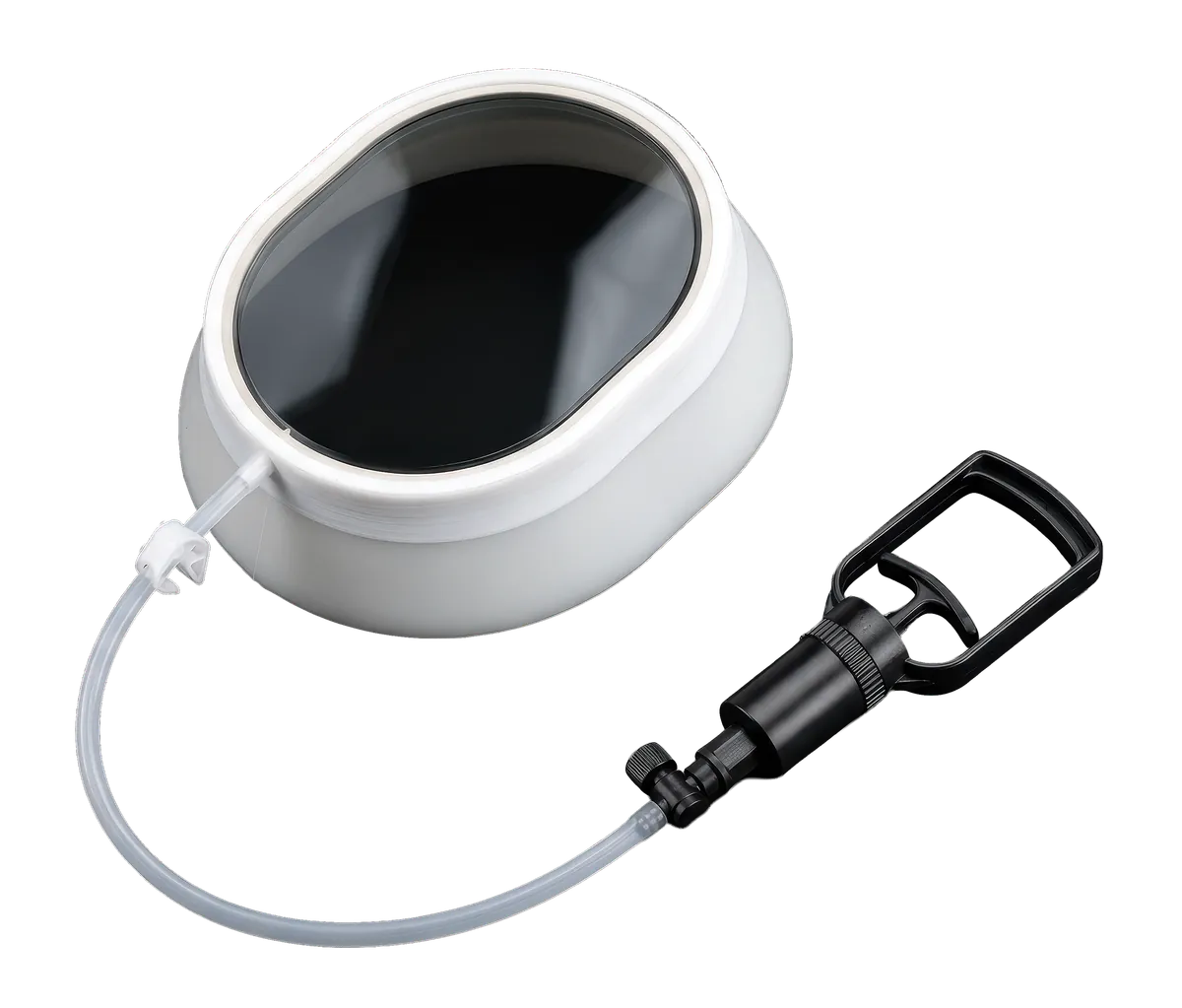
A bell sized to your chest and depth, with the session length and suction progression that decide whether it works.
- Cup sized to your chest, not a size chart
- Session length and pressure progression
- How to tell at 8 weeks if you are responding

This article is for educational purposes only and does not constitute medical advice. Always consult a qualified healthcare professional before starting any treatment plan. View full disclaimer →