Contents · 10 sections
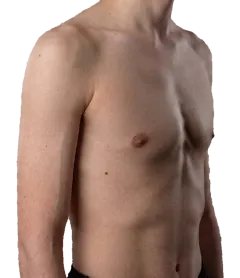
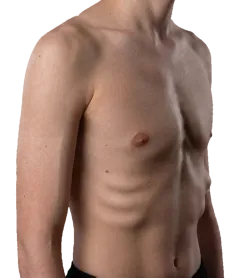
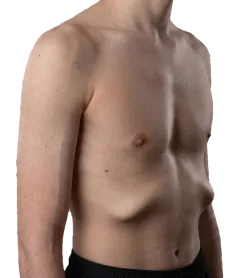
An implant fills the dip of a sunken chest but doesn’t move the breastbone or take pressure off the heart and lungs, so it changes how your chest looks, not how it works. The most studied type is a custom silicone implant shaped from your CT scan and placed under the chest muscles, and its usual problem is a pocket of fluid around it, called a seroma, that often needs draining.
Worried about symptoms right now? Skip to when to see a doctor.
I’m not a doctor and I haven’t had surgery, so every medical point below comes from a named study, guideline or the company’s own page, and where nobody has measured something, I say so.
What an implant changes, and what it doesn’t
Surgeons split pectus operations into two kinds. A Spanish thoracic team puts it simply: structural repair reshapes the rib cage itself, while aesthetic repair fills the defect with a custom implant.
| Option | Moves the breastbone | Changes the look | Helps heart and lung symptoms | Lasts |
|---|---|---|---|---|
| Custom silicone implant | No | Yes, fills the dip | No | Permanent implant |
| Fat grafting | No | Yes, for small dips | No | Changes with your weight |
| Hyaluronic acid filler | No | Yes | No | Temporary |
| Breast implants (women) | No | Softens how the dip looks | No | Permanent implant |
| Nuss procedure or Ravitch procedure | Yes | Yes | Can help, if the chest was the cause | Bone and cartilage reshaped |
If your aim is to change how your chest works, not only how it looks, an implant isn’t the tool. The operations that move bone are compared in my pectus excavatum surgery guide. Pectus Up, which uses a metal plate to pull the breastbone up, is a structural operation too, not a filler; see Pectus Up surgery.
Who an implant may suit, and who should look elsewhere
The 2024 Pectus Care Guidelines, a multi-society consensus, say an implant may be an alternative to bigger operations in carefully selected people with normal exercise tolerance. A plastic surgeon’s review describes implants being used in adults rather than teenagers, for appearance or severe distress about the chest.
An implant may be worth discussing if:
- you’re an adult and your chest has stopped growing
- you have no symptoms, or a doctor has checked them and found no heart or lung cause
- your main concern is how the chest looks
- you’ve already had a Nuss or Ravitch and a dip is left
Look elsewhere first if:
- you have symptoms that nobody has checked (see the list below)
- your chest is severe, with a high Haller index and symptoms
- you’re still growing
- you’re a woman with breast implants and may need a chest repair later (see breast implants below)
How you feel about your chest is a real part of the condition, not vanity. More on that in how pectus excavatum affects mental health.
The 5 types
1. Custom silicone implant
This is the type with the most published experience. According to the guidelines:
- it’s designed from your CT scan
- it’s made of silicone with a firmness similar to cartilage
- it goes in under the chest muscles through a 4 to 5 cm cut in the middle of the chest
- it’s much less painful than bone surgery, because nothing pulls on the ribs
- people go home on day 1 or 2
The main problem is seroma, a pocket of fluid around the implant. The guidelines say it often needs draining with a needle 1 to 5 times. The Toulouse team that developed the implant reported a seroma in every one of 401 implants placed from 1993 to 2015, plus one infection and three collections of blood. Implants designed on a computer from CT scans corrected the dip better (86%) than earlier ones made from plaster moulds (72%), judged on photos by surgeons who didn’t know which was which.
An independent team in Vienna reported 7 adults treated from 2018 to 2024, 5 of whom had already had a Nuss or Ravitch. Among the 5 who answered the questionnaire, average satisfaction was 3.3 out of 5, higher with clothes on (4.0) than without (2.8). One implant had to come out after a seroma led to an infected collection of blood. That’s a very small group, but it’s the only independent series I found.
Anatomik Modeling. You may see this name. According to its own website, checked on 30 October 2026, it’s a company near Toulouse, France, that designs these custom implants. It grew out of about 10 years of work with Toulouse University Hospital’s plastic and thoracic surgery departments, where the first custom implant was placed in 1993.
Older silicone implants were placed in a pocket under the skin over the breastbone. The plastic surgeon’s review lists their late problems, sometimes decades later: wear of the material, late seroma, hard calcium deposits, a bulky look under the skin and pain. It says nobody yet knows whether modern implant blocks form a tight scar capsule over time.
2. Fat grafting
Fat is taken from your belly, thighs or waist by liposuction and injected into the dip. There’s no implant and only tiny scars. The first case report for pectus described a 27-year-old woman with a mild dip.
The plastic surgeon’s review gives its limits:
- only a few case reports exist for the breastbone area
- grafted fat behaves unevenly, depending on how it’s handled and where it goes
- grafted fat grows and shrinks with your weight
- if you’re slim, you may not have enough fat to move, so it suits adults with enough to spare
My reading: it may suit a small dip in someone with fat to spare, not a deep chest.
3. Hyaluronic acid filler
This is a gel injected under the skin, the same family of products used in faces and lips, in much larger amounts. Macrolane was one brand used for this.
The one prospective study I found was funded and designed by the gel’s maker. It treated 23 men aged 18 and over in Sweden and France from 2012 to 2016, with about 150 mL each on average. Self-esteem scores improved, and MRI showed 58% of the gel still there at 2 years. But 26% had another treatment, 35% developed lumps, 30% developed a tight capsule around the gel and in 4 men the gel moved.
The plastic surgeon’s review says the dip returns to its original depth one to two years after injection as the gel is absorbed, and calls the cost of the large volumes prohibitive. I couldn’t confirm whether Macrolane is still sold for this use.
4. Breast implants, for women
Breast implants add volume and can soften how the dip looks. In a private practice in Athens, 28 women with pectus excavatum had breast augmentation from 2017 to 2021, with no complications reported and better quality-of-life scores at 2 years. That’s cosmetic surgery, and it says nothing about the chest wall or breathing.
The bigger issue is a later chest repair. At Mayo Clinic Arizona, among 456 women repaired from 2010 to 2025, infection within a year was 8.8% with breast implants in place at the repair, against 1.8% without. The authors now recommend taking implants out before a pectus repair and putting them back later if wanted. The Toulouse team’s series of 301 women, 234 of them with pectus excavatum, also put the chest first and the breasts second. More in pectus excavatum in women.
5. Experimental options
Two ideas appear in the review, neither established:
- External suction plus fat grafting. A suction device worn on the chest (BRAVA, made for breast surgery) swells the tissue so it may hold more grafted fat. The review calls it a possible future option for the chest.
- Cultured cartilage cells. Your own cartilage cells, grown in a lab and injected. Still in research and trials.
Pectoral implants, the muscle-shaped implants some men get to look more muscular, are a different product. I couldn’t find a study of them in pectus excavatum.
How the results hold up
| Type | What the studies show | Who was studied |
|---|---|---|
| Custom silicone implant | Seroma in all; 86% well corrected with CT-designed implants | 401 implants, Toulouse, 1993 to 2015 (developers) |
| Custom silicone implant | Satisfaction 3.3 out of 5 (5 answered); 1 of 7 implants removed | 7 adults, Vienna, 2018 to 2024 |
| Any implant, adults | Another operation needed in 18.8%, against 5.3% after Nuss and 3.3% after Ravitch | Systematic review of 44 studies, published 2014 |
| Hyaluronic acid filler | 58% of the gel left at 2 years; 26% retreated | 23 men, Sweden and France, 2012 to 2016 (maker-funded) |
| Fat grafting | Case reports only | I couldn’t find a series |
So an implant is a smaller operation, but not a free pass. Seroma is the rule rather than the exception, and the one pooled figure I found puts repeat operations higher than after bone surgery, though the review mixed different implants and eras.
After a Nuss or Ravitch
Implants are sometimes used to smooth a dip that’s left after bone surgery. In the Vienna series, 5 of the 7 adults had already had a Nuss or Ravitch. If that’s you, ask your chest surgeon and a plastic surgeon to look at your scans together.
What it costs
I couldn’t find a verified published price for a custom silicone implant, fat grafting or filler for pectus excavatum. Cosmetic operations are usually self-paid. Ask for a written quote that includes any seroma drainage visits. For what bone surgery costs and when insurers pay, see my pectus surgery cost guide.
When to see a doctor
See a doctor before you start any device, brace or exercise program if any of these apply to you:
- chest pain
- fainting or nearly fainting
- breathlessness at rest or with light effort
- palpitations or an irregular heartbeat
- a diagnosed heart or lung condition
- Marfan syndrome or Ehlers-Danlos syndrome, or a doctor has raised either
- previous chest surgery
- a Haller index above 3.25 together with symptoms
- symptoms that nobody has checked yet
None of these means you’ll need surgery. They mean someone should look at your heart and lungs before you go further. An index above 3.25 is a common referral threshold, not an emergency.
Call 911 (999 in the UK) or your local emergency number now if you have any of these. Don’t drive yourself.
- palpitations that won’t stop
- palpitations with chest pain, shortness of breath, feeling faint or fainting
- sudden chest pain or pressure that doesn’t go away
- chest pain that spreads to your arm, neck, jaw or back
- chest pain with sweating, feeling sick, light-headedness or breathlessness
That list follows the NHS advice on chest pain.
The same applies before an implant: any of those symptoms should be checked first.
Questions to ask a surgeon about an implant
- Have my heart and lungs been checked, and do I need a structural repair instead?
- Is the implant made for me from a CT scan, and does it go under the muscle?
- How many have you placed, and how often do you drain a seroma?
- How often have you had to remove one, and why?
- What happens if I need a Nuss or Ravitch later?
- For women: should breast implants come before, after or not at the same time?
- What’s included in the price?
Where to go from here
- You have red flags or symptoms. See a doctor first, then a thoracic or pediatric surgeon who treats chest wall conditions.
- You mainly want the chest to look different, without surgery. Clothing, posture and muscle can change how a dip shows; see how to hide pectus excavatum. The evidence for reshaping the chest without surgery is in vacuum bell therapy, and my free non-surgical pectus excavatum plan is a place to start. I make and sell my own vacuum bells, so weigh my view on them with that in mind. Every route is on the pectus excavatum treatment without surgery page.
- You’re not sure where your chest stands. Take my free 1-minute quiz for a sense of how severe it is and which route fits.
Sources
- Galbis Caravajal JM, et al. Cir Esp (Engl Ed). 2024;102(5):252-6. Read it
- Dunning J, et al. Pectus Care Guidelines. Eur J Cardiothorac Surg. 2024;66(1):ezae166. Read it
- Schwabegger AH. Ann Cardiothorac Surg. 2016;5(5):501-12. Read it
- Chavoin JP, et al. Plast Reconstr Surg. 2016;137(5):860e-71e. Read it
- Geisler D, et al. JPRAS Open. 2026;52:514-21. Read it
- The society. AnatomikModeling. [cited 2026 Oct 30]. Read it
- Pereira LH, Sterodimas A. Aesthetic Plast Surg. 2008;32(2):393-6. Read it
- Hedén P, Sinna R. Aesthet Surg J. 2019;39(6):NP189-NP201. Read it
- Keramidas E, Rodopoulou S, Gavala MI. Plast Reconstr Surg Glob Open. 2024;12(6):e5926. Read it
- Khedr AE, et al. J Am Coll Surg. 2026;243(1):130-40. Read it
- Chavoin JP, et al. Ann Chir Plast Esthet. 2022;67(5-6):404-13. Read it
- Johnson WR, Fedor D, Singhal S. J Cardiothorac Surg. 2014;9:25. Read it
- Chest pain. NHS. [cited 2026 Oct 30]. Read it
Reading about the condition is one thing. Knowing which one you have, how severe it is and what to do first takes about a minute.
- Your condition named, not guessed
- A severity read you can act on
- The exact next step for your case

This article is for educational purposes only and does not constitute medical advice. Always consult a qualified healthcare professional before starting any treatment plan. View full disclaimer →