Contents · 15 sections
When a vacuum bell first arrives, the temptation is to wear it for hours from day one. I did. In my first week I wore it for more than two hours a day, and my skin paid for it.
The routine that works is slower. See a doctor before your first session. Start with about 15 minutes, lying on your back. Pump until you feel a pull, never pain. Then build up hours over weeks, not pressure.
I was diagnosed with pectus excavatum at 15 and corrected it over about three years of daily vacuum bell use and structured training. The change was visible and measurable, but not complete. I’m a Level 5 Certified Personal Trainer, not a doctor. I started with a Pectus Healing bell and later moved to my own design, which I now sell as my own custom bell, so weigh what I say about bells with that in mind.
Much of the detail comes from the instructions for use that Eckart Klobe, the engineer who developed the modern vacuum bell, wrote for his own bell, so I name him when I use them. Where your bell’s manual and this page disagree, follow your manual. Whether the bell works, and for whom, is on my page about vacuum bell therapy.
Before you start: a doctor’s check, who shouldn’t use one, and what you need
Klobe’s instructions say a doctor should examine you for contraindications (conditions that make a treatment unsafe) before you first use his bell, and that medical staff should supervise the first application. In Basel, patients also have an ECG (a tracing of the heart’s rhythm) and an echocardiogram (a heart ultrasound) before they start, according to Haecker and Sesia’s 2016 review.
The sources list these as reasons not to use a bell:
- Bone conditions that weaken the skeleton, such as osteogenesis imperfecta (brittle bone disease) and osteoporosis.
- Blood vessel conditions, such as Marfan syndrome or an aneurysm.
- Bleeding disorders, such as haemophilia.
- Heart conditions, added by the Basel team. In a 2024 survey of chest wall surgeons, 30% also listed previous heart surgery.
If any of these applies to you, the decision belongs to a specialist.
Klobe’s instructions also say not to use his bell after diving, on planes or on high-mountain railways. For the whole treatment, he says to avoid work or sports that put extreme stress on the ribcage, such as boxing or wrestling, because the ribcage can lose some firmness while it’s being lifted. If you fight, read pectus excavatum and combat sports first.
Children under 10 need a parent or caregiver supervising, say both Basel and KidsHealth. More for parents is in vacuum bell therapy for kids.
What you need
- A bell that fits, with the rim sitting flat around your chest. See choosing a vacuum bell size, and if you don’t own one yet, where to buy a vacuum bell.
- The pump that came with it. Klobe says his bulb’s suction is limited for safety, and to use only the manufacturer’s bulb with his bell.
- A plug for the tube, if your bell uses one. If it’s missing, ask the seller for a spare rather than improvising one.
- A timer, such as your phone, and a ruler for measuring before you start.
- A pressure gauge is optional. In a 2021 survey from Buenos Aires, every patient had one and none of the 54 who answered had skin lesions, but nobody went without a gauge for comparison.
Not assessed yet? My free 1-minute quiz gives you a sense of how severe your chest is. It doesn’t replace the doctor’s check.
Your first session, step by step
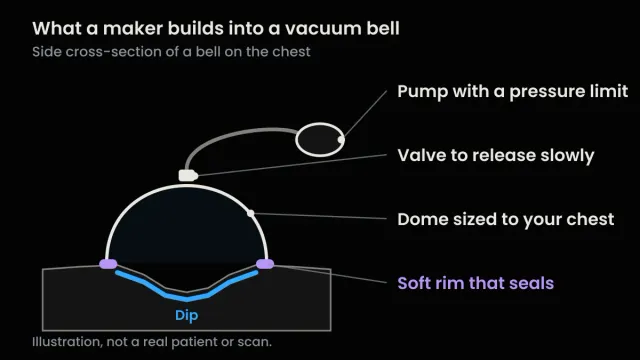
The parts: the rim is the soft edge that seals on your skin, the window is the clear dome you look through, the pump is the hand bulb, the valve lets air in and out, and the plug closes the tube once the pump is off.
Do this first session with the doctor or nurse who checked you if you can. At home, have someone in the room.
-
Lie on your back on a bed or mat, with everything in reach. Klobe says lying down and pumping slowly avoids dizziness.
Done when: you’re flat, relaxed and the timer is set to 15 minutes.
-
Centre the bell over the deepest point of the dip, even if the dip is lopsided. On Klobe’s bell, the hose nozzle usually ends up over the upper part of the breastbone (sternum).
Done when: the deepest point sits in the middle of the window.
-
Spread the rim slightly and press it onto your skin.
Done when: the rim touches skin all the way round, with no hair or gaps under it.
-
Pump slowly until you feel a pull. Klobe’s wording: you may feel the pull, but you shouldn’t feel hurtful discomfort. His bulb usually needs one more squeeze once it has filled out again. Don’t try to pull your chest flat today.
Done when: you feel a firm pull and your chest has started to rise toward the window.
-
Take the pump off and plug the tube, if your bell is designed that way.
Done when: the bell stays on without the pump and the pull doesn’t fade.
-
Wear it for about 15 minutes. Klobe’s instructions say 15 minutes “might be sufficient” for a first session. Once it’s holding, you can stand up carefully and walk around.
If pain rises, your arms tingle or you feel dizzy: lie down and let the air in now.
Done when: the timer goes off.
-
Let the air in slowly, through the valve or as your manual says.
Done when: the bell comes away from your skin with no pull left.
-
Sit for a moment before you stand. The Braceworks wear-and-care sheet, from a Canadian orthotics clinic that bases its instructions on Klobe’s material, says to sit or lie at the start and end of each session to avoid dizziness.
Done when: you can stand without feeling light-headed.
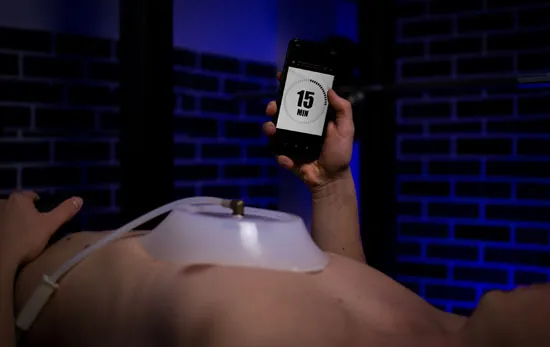
Afterwards, check your skin. KidsHealth says redness or bruising usually fades within hours. If marks last into the next day, go shorter and gentler next time.

Your first weeks: add time slowly
Forget a flat chest for now. The first goal is getting used to the pull.
Klobe’s instructions say taking 2 to 4 weeks before the dip is lifted close to the window “is normally well spent”. Lifting too fast, he explains, can cost the ribcage some of its firmness for a while.
For time, Klobe’s rule of thumb in his 2019 article is at most 1 hour a day in week one and 2 hours in week two, then build toward your own limit. He says that limit ranges from 20 minutes to many hours a day and is found by trial and error. Hospitals often start at 30 minutes twice a day.
Some soreness early on is common. In Basel, most patients felt moderate pain in the sternum during their first five applications and didn’t need painkillers. Pain that grows while you pump is different: stop pumping, and if it keeps growing, let air in.
How hard to pump: a pull, not pain
You may have seen routines that tell you to pump your chest flat from the first session. None of the sources I found say that.
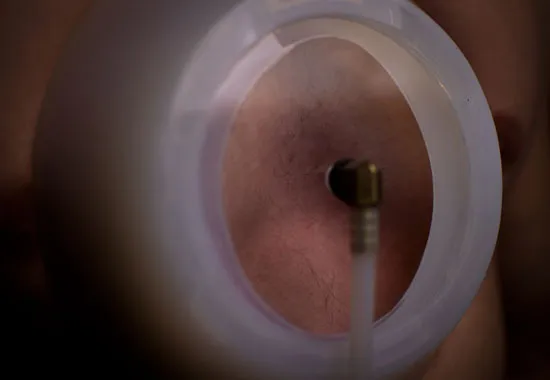
- Start with a partial lift. In Lei and colleagues’ 2024 protocol, from a children’s centre in Changsha, China, week one lifts the dip by a quarter to a half. By about week 5, the pressure is enough to flatten it.
- Stop increasing once it hurts, says Klobe.
- Strong suction pulls skin, not bone. The University of Rochester Medical Center’s page says strong vacuum or big swings in it pull on the skin more than the bones, and never to pump to discomfort or pain. Klobe warns against the same thing.
- Raise the hours, not the suction. Pectus Clinic London, a surgeon-led clinic that sells its own programme, says excessive suction causes skin problems without improving results.
In Haecker and Mayr’s 2006 Basel study, Klobe’s safety-limited pump took the pressure inside the bell down to as much as 15% below the air around you. I don’t know whether other pumps have the same limit, so go by feel and by your manual.
Through the window, the dip should rise a little more over the weeks, not all at once.
Keeping the seal
A bell that slowly loses its pull stops lifting. Check these.
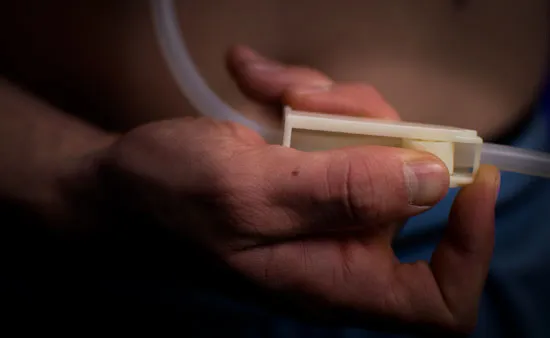
The tube isn’t plugged. If your bell uses a plug, put it in once the pump is off, as in step 5. Pectus Clinic London tells patients to check the valves for leaks, so if the bell still loses pull with the plug in, look at the valve.
Hair under the rim. Klobe’s instructions and URMC both say chest hair can break the seal, so keep it short. I shaved my chest hair so my bell would seal.
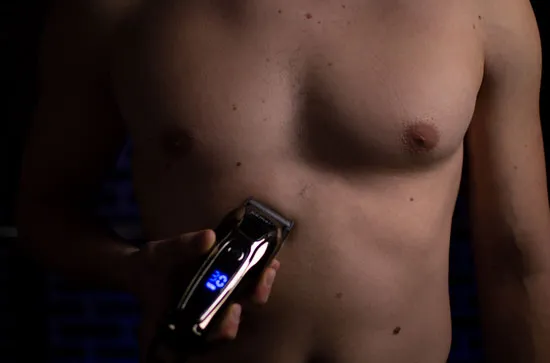
Damp skin. Dry your chest fully first. Pectus Clinic London also links blisters to damp skin, so this helps twice.
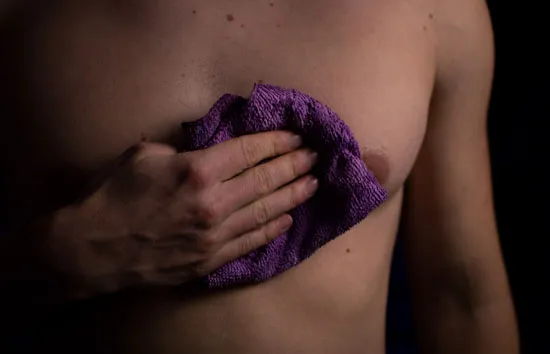
Oil or cream on the skin. Anything greasy under the rim can stop it sealing, so moisturise after a session, not before.
A gap low on the chest. Klobe’s instructions say a full or partly full stomach may help the seal where the rim crosses the upper belly.
How many hours a day, and for how long
There’s no single schedule. These are the published ones I found.
| Source | Start | Build-up | Daily target |
|---|---|---|---|
| Klobe (inventor, for his bell) | At most 1 h a day in week 1 | At most 2 h in week 2, then up to your own limit | 1 to 3 h a day is typical for teens and adults |
| KidsHealth (Nemours, US) | 30 min twice a day | Over 4 to 6 weeks | About 2 h twice a day, for a year or more |
| Braceworks (clinic sheet based on Klobe’s material) | 30 min a day in weeks 1 to 4 | Add 15 min a week | 120 min a day by week 10 |
| Lei 2024, Changsha (children) | 30 min morning and evening | Over about 5 weeks | 2.5 h a day (the authors say adults need double) |
| Scottish Health Technologies Group (national advice, 2024) | Not stated | Not stated | At least 2 h a day, for 12 months or longer |
| URMC, Rochester | Not stated | Not stated | Up to 4 h a day, ideally 2 h morning and 2 h night, for 10 months or more |
| Pectus Clinic London (sells a programme) | 1 h a day | To 4+ h a day over 8 weeks | At least 4 h from month 2, aiming for 8+ |
In Basel, some adults wore the bell up to 8 hours a day during office hours. That’s what some people managed, not a minimum.
Per sitting. The Changsha protocol caps each sitting at 2 hours, with a 10-minute break before the next. That doesn’t fit with the overnight wear other centres allow, so treat it as one centre’s rule.
More hours went with more correction. In a Boston study of 57 patients, those wearing it at least 28 hours a week (4 a day) corrected 28% of the dip’s depth, against 16% for the rest. Your skin decides how fast you can get there.
How long overall. A year or more. More than half the responding surgeons in the 2024 survey recommend 12 to 24 months.
Rest days. The sources don’t schedule days off. They advise rest when your chest is sore or your skin is broken, and KidsHealth says occasional time off for important events is fine.
If you want this turned into a week-by-week plan, that’s what my paid vacuum bell guide does.
What to expect, and when
The Braceworks sheet describes a typical course. Typical, not promised: your chest may move faster or slower.
- Weeks 2 to 4: the dip is lifted close to the window during sessions.
- Week 8: the chest stays lifted for hours after you take the bell off, then partly falls back.
- Week 12: it may stay lifted by about 1 cm between sessions, and your posture and appearance may look better.
- After week 16: continued improvement of about 1 mm a month.
In a 2011 report from Basel, 105 of 133 patients had a lasting lift of more than 1 cm after three months of daily use.
Klobe blames the falling back on muscles inside your chest, including the diaphragm and the transversus thoracis (a thin muscle on the inside of the front chest wall). The bell stretches them, and they pull the dip back in once it’s off. He writes that their adapting often takes longer than any other part of the treatment, so a lift that fades within minutes or hours in the early months is expected.
Skin care: marks, bruises and blisters
Your skin is usually what limits your hours. When I did more than two hours a day in my first week, the skin under my bell turned red, small bubbles came up on the surface, and I had some bruising. It held me back for a while.
Klobe’s default fix for most skin trouble is shorter sessions and less vacuum. His 2019 article names thick, swollen skin, from too much pressure or time early on, as the most common side effect.
Preventing it
Prevention is mostly what’s above: build up slowly, start on dry skin, and save moisturiser for after sessions. For irritation where the rim sits, Pectus Clinic London uses a thin layer of barrier cream around the rim only.
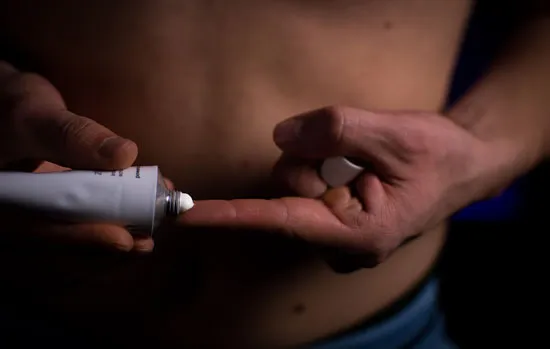
What worked for me: I moisturised once a day after my sessions, with a body milk or almond oil, and my skin problems stopped. That’s my experience, not a tested treatment. I couldn’t find a study showing any cream, oil or supplement prevents vacuum bell marks.
What to do when your skin reacts
| What you see | What to do | Category |
|---|---|---|
| Skin red to violet under the bell | Take it off after about 20 minutes, wait a few minutes, put it back on at lower pressure (Klobe) | Less pressure |
| Bruising (a haematoma, where blood collects under the skin) | Less suction, and don’t put the bell over bruised skin (Pectus Clinic London) | Less pressure |
| Pinpoint red dots (petechiae, tiny bleeds under the skin) or blood droplets | Shorter sessions, less pressure | Less pressure |
| Thick, swollen skin | Shorter sessions, less pressure | Less pressure |
| Scraped or chafed skin | Stop for several days until it heals. Klobe warns it tends to bleed otherwise | Pause |
| Blisters | Stop until healed. Don’t pop them, keep them covered, restart at lower pressure with shorter sessions | Pause |
| One irritated nipple | Position the bell so the rim fully covers one nipple and leaves the other fully outside (Klobe) | Adjust |
| Black bruising | Seek medical attention (Klobe) | Doctor |
| A blister that’s hot, has green or yellow pus, or has spreading redness | Signs of infection: see a doctor | Doctor |
On blisters, the NHS says not to burst them yourself, to cover them with a soft plaster or padded dressing, and that they often heal on their own within a week.
Sleeping with a vacuum bell
Overnight wear is optional. Klobe’s instructions say the best times are before sleeping, “or if tolerable, while sleeping”. The two centres I found disagree on when to start.
- Amsterdam. In a 2025 study of 259 under-18s, overnight use went with more success. But overnight wearers also treated for longer, so that’s an association, not proof. The authors advise against starting overnight wear in the first 2 to 3 months, while the skin adapts.
- London. Pectus Clinic London encourages it and says most patients sleeping on their back or side manage from weeks 4 to 6. If the bell comes off in the night, it says that’s safe: just put it back on.
- The UK guidelines. The 2024 Pectus Care Guidelines note that many patients can only wear it in the evenings and can’t sleep with it.
Ask your doctor which timing fits you. Nights aren’t compulsory.

If you try it, use lower pressure than in the day. My first nights in it were hard because I pumped it as hard as I did in the daytime. Once I lowered the pressure, it stopped bothering me. Lying on your back keeps your weight off the bell (common sense, not a study finding). Some nights it came loose anyway, and I’d put it back on half asleep.
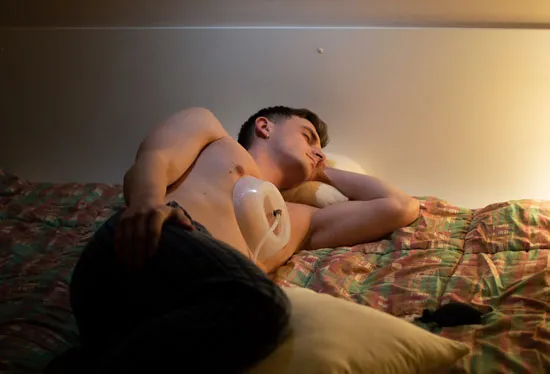
I used to wear my vacuum bell overnight. I don’t anymore. How to set up the bed, pillows and position is in my guide to the best sleeping position for pectus excavatum.
Training with a vacuum bell
I lifted weights and did yoga 3 to 5 times a week during my bell years, and the bell didn’t get in the way of either.
Before, during or after a workout
Klobe’s instructions prefer the bell after sport rather than before, at times when no muscle work follows. That’s how I did it: I trained without the bell, then wore it for the rest of the day.
Klobe lists walking, running, school, office work and some types of sport as possible with it on. But:
- Not heavy exercise, swimming or contact sports. Pectus Clinic London says to avoid all three while it’s on.
- Watch for dizziness. URMC lists light-headedness as a side effect, so sit or lie down when it goes on and comes off.
- Skin chafes more when you move, Klobe warns.
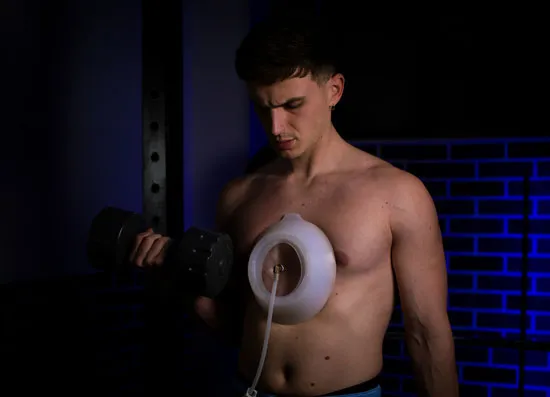
If you lift: chest muscles and fit
Klobe’s instructions warn that pronounced chest muscles can affect the fit and get drawn into the bell, making it less effective. His 19 cm “Small Bodybuilder” model has thinner, softer sides to sit more comfortably over big chest muscles or sensitive nipples. Other makers may not offer one, so check the fit on yours. For lifting around a sunken chest, see exercises for pectus excavatum.
Klobe’s five exercises
Klobe’s view is that the bell can lift the chest, but good posture only comes from your own muscle strength. His 2019 article recommends five exercises alongside the bell. I couldn’t find a study that tested them.
- Standing Superman, about 30 seconds per leg, daily, for the lower back.
- Dumbbell swings, with 3 to 5% of your body weight in each hand, about 5 minutes daily, for the upper back.
- Pullovers lying on your back, with 3 to 5% of your body weight in each hand, pressing the hollow of your lower back flat into the floor, about 1 minute daily. Klobe says this raises the sternum through the chest muscles and flattens flared ribs through the abs.
- Elastic band pulled outward in front of your chest, for the upper back.
- Elastic band pulled wrist over wrist, lying on your back, aimed at a sunken top of the breastbone and collarbone.

Do you need to warm up first?
I couldn’t find a study that tested a warm-up or stretching routine before a vacuum bell session. The manufacturer’s timing rule points the other way: exercise first, bell after.
If stretching helps you relax first, 3 to 5 easy stretches like these are plenty.




Skip headstands and elbow bridges as a warm-up. They put weight through your head and neck, and I found nothing showing they help the bell. That’s my judgment as a trainer, not a study finding. More stretches are on my page about stretching for pectus excavatum.
Measuring your progress
Measure once before your very first session, so you have a starting point. Then measure once a month, lying flat on your back, with a ruler resting across the dip without pressing, before your first bell session of the day. The lift lasts a while after the bell comes off, so a reading after a session tells you about that session, not your chest. The full method is in my guide to measuring pectus excavatum at home.
Cleaning your bell
Follow your own bell’s manual, because materials differ between makers. For his bell, Klobe allows a soft cloth moistened with water, soapy water, ethanol or propanol. He warns that other disinfectants may cloud the window, that the window shouldn’t be steam-sterilised, and that screw threads in the window distorted by heat can’t be repaired. So keep heat away from it, hair dryers included. Pectus Clinic London uses mild soap and warm water after each session, then dries the bell.
When to stop: a session, a few days, or the treatment
End the session now if pain grows while you pump, your arms tingle or prickle (paresthesia), or you feel dizzy. If your skin turns red to violet, take the bell off after about 20 minutes, as in the skin table. For back pain or prickly arms, KidsHealth says to try again a few hours later at lower pressure.
Take a few days off for scraped skin or blisters, until they heal, or for chest soreness like aching muscles, which Klobe says may need a few days’ rest.
See a doctor for black bruising, a blister that looks infected (hot, pus-filled or with spreading redness), or tingling or dizziness that doesn’t settle at lower pressure.
Ending the treatment is a decision for you and your doctor, using your monthly measurements. Pectus Clinic London weans patients off over months 21 to 24, wearing it every other session or night. In Basel, the team saw no regression over 27.6 months of follow-up after patients stopped. If nothing visible has changed after many months, my vacuum bell therapy page covers when to rethink.
Frequently asked questions
Should I warm up before using a vacuum bell?
You don’t have to. I couldn’t find a study on it, and Klobe puts exercise before the bell.
How do I stop my skin getting damaged?
Build up hours slowly, pump to a pull, start on dry skin and moisturise afterwards. When marks appear, go shorter and lower, and stop for broken skin or blisters.
Can I sleep with a vacuum bell on?
Some people can, many can’t. Amsterdam’s authors say not in the first 2 to 3 months, Pectus Clinic London says from weeks 4 to 6. Ask your doctor, and use lower pressure than in the day.
Can I exercise with the vacuum bell on?
Light activity, yes. Not heavy exercise, swimming or contact sports.
Will bodybuilding fix the dent?
I couldn’t find a study showing it does. Training changes your muscles and posture, which can change how your chest looks.
Sources
- Klobe E. The Eckart Klobe Vacuum Bell for Non-Invasive Lifting of Funnel Chest: Instructions for use (the inventor’s instructions for his own bell). 2010 Nov 3. Read it
- Klobe E. Trichterbrustversorgung mit der Saugglocke nach Eckart Klobe (the inventor’s own article). Orthopädie Technik. 2019;(1), English special edition. Read it
- Haecker FM, Sesia S. Vacuum bell therapy. Ann Cardiothorac Surg. 2016;5(5):440-9. Read it
- Haecker FM, Mayr J. The vacuum bell for treatment of pectus excavatum: an alternative to surgical correction? Eur J Cardiothorac Surg. 2006;29(4):557-61. Read it
- Haecker FM. The vacuum bell for conservative treatment of pectus excavatum: the Basle experience. Pediatr Surg Int. 2011;27(6):623-7. Read it
- Haecker FM. 20 years clinical application of the vacuum bell for conservative treatment of pectus excavatum: past, present, future. J Thorac Dis. 2024;16(8):5285-98. Read it
- Pectus Excavatum: Vacuum Bell Device (for Parents). Nemours KidsHealth. Reviewed 2022 Oct. [cited 2026 Oct 19]. Read it
- Toselli L, et al. J Pediatr Surg. 2021;56(12):2235-8. Read it
- Vacuum bell wear and care instructions (a clinic sheet based on Klobe’s material). Braceworks. 2022. [cited 2026 Oct 19]. Read it
- Lei W, et al. BMC Pediatr. 2024;24:173. Read it
- Vacuum Bell. Golisano Children’s Hospital, University of Rochester Medical Center. [cited 2026 Oct 19]. Read it
- Vacuum Bell Therapy (VBT). Pectus Clinic London (a clinic that sells a vacuum bell programme). [cited 2026 Oct 19]. Read it
- Vacuum bell device for people with pectus excavatum: plain language summary. Scottish Health Technologies Group. 2024 Jun. [cited 2026 Oct 19]. Read it
- Koo DC, et al. J Surg Res. 2025;308:112-21. Read it
- van Braak H, et al. J Pediatr Surg. 2025;60(2):161891. Read it
- Dunning J, et al. Pectus Care Guidelines. Eur J Cardiothorac Surg. 2024;66(1):ezae166. Read it
- Blisters. NHS. Reviewed 2023 Nov 22. [cited 2026 Oct 19]. Read it
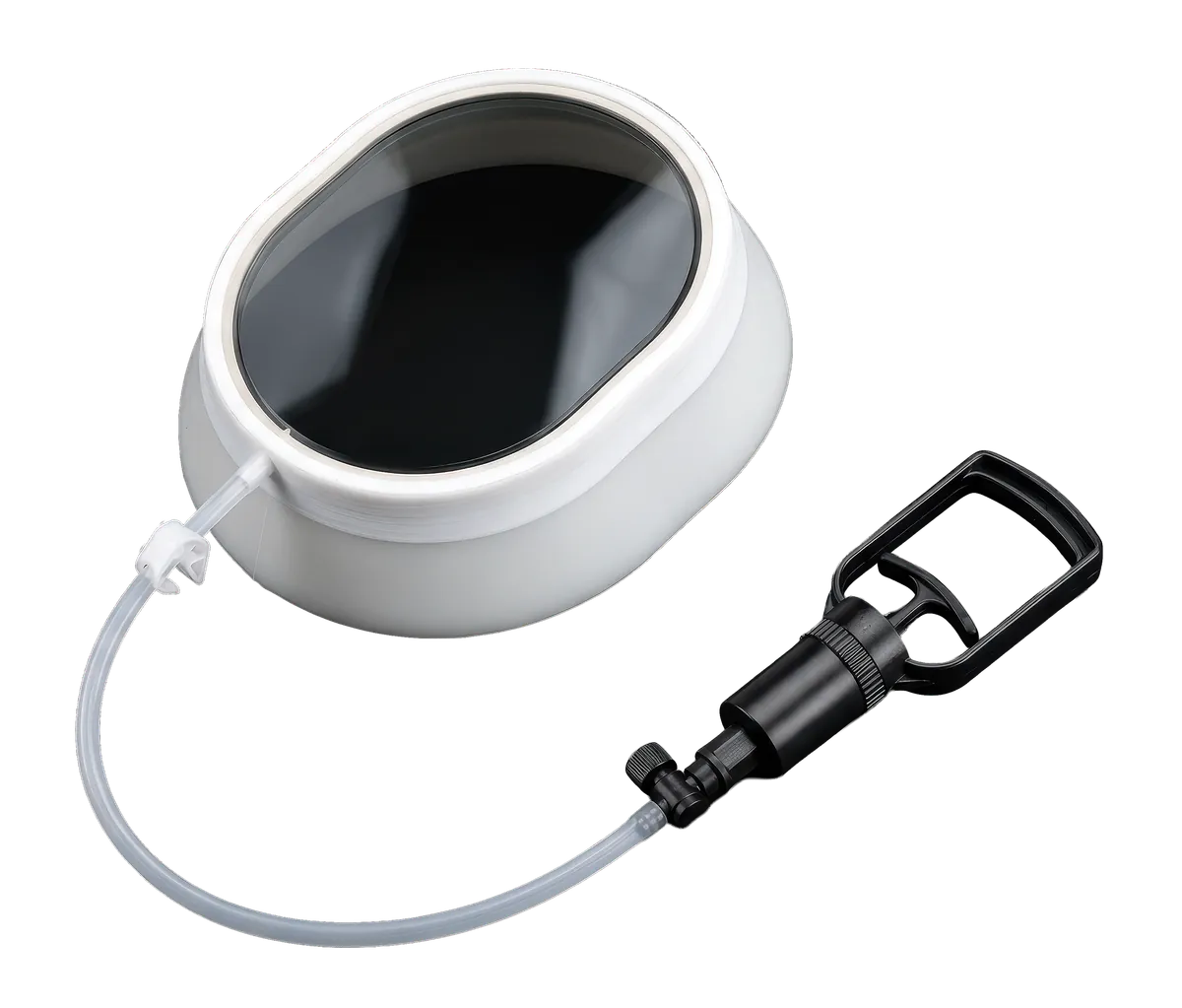
A bell sized to your chest and depth, with the session length and suction progression that decide whether it works.
- Cup sized to your chest, not a size chart
- Session length and pressure progression
- How to tell at 8 weeks if you are responding

This article is for educational purposes only and does not constitute medical advice. Always consult a qualified healthcare professional before starting any treatment plan. View full disclaimer →