Contents · 10 sections
You see yourself side-on in a photo: shoulders rolled forward, upper back rounded, and the dip in your chest looking deeper than it does in the mirror. The obvious worry is that slouching did this.
It didn’t. Posture changes how deep the dip looks, not how deep it is, and that part is yours to work on. Below: what the studies found, a two-minute posture check, a short daily routine built on a children’s hospital handout, and straight answers on sitting, chiropractors, shoulders and shoes.
I had pectus excavatum and was diagnosed at 15. I corrected it without surgery over about three years, and the result was visible and measurable, but not complete. I’m a Level 5 certified personal trainer, not a doctor. My own posture was poor as a teenager, and I’ll come back to that.
Did bad posture cause your pectus excavatum?
No. For many people the cause is unknown, according to Cleveland Clinic, and its page doesn’t list posture among the causes. It affects about 1 to 8 in every 1,000 people and is more common in boys.
What posture changes is the look. A patient handout from McMaster Children’s Hospital in Canada describes a typical “pectus posture”: shoulders sloping forward, a rounded upper back and a belly pushed forward. It says this makes the pectus look worse than it is, so a mild pectus can look severe. Can posture make a mild pectus actually get deeper? The handout calls that uncertain, and I couldn’t find a study that settles it.
When I was diagnosed, my doctor, Dr. Blagoja Gjorgjieski, noticed my poor posture straight away. Posture is worth your attention, just not because it caused the dip.
Why people with pectus often look hunched
Everyone’s upper back curves forward a little; the curve is called thoracic kyphosis. The American Academy of Orthopaedic Surgeons puts a normal curve at 20 to 45 degrees and calls more than 50 abnormal.
In a 2024 study from Turkey, 22 young people aged 10 to 17 with pectus excavatum had more upper-back rounding than 21 healthy peers, about 46 degrees on average against 32, and less spinal mobility. That average sits at the top of the normal range: more rounded than their peers, but not automatically abnormal. And it shows the two go together. It doesn’t show that one caused the other.
In my view, being lean can add to the look. In a Polish study, 19 boys waiting for surgery had an average BMI of 18.7, against 22.2 in 30 healthy boys. It doesn’t back the idea that tight chest muscles pull everyone forward, though: fewer of the pectus boys had a shortened upper chest muscle than the healthy boys. An NHS physiotherapy leaflet simply names rounded shoulders as a common posture linked with pectus.
My version: as a teenager I had a very rounded upper back and my head pushed forward, from gaming and long days at school desks, and my chest muscles were tight. That was my habit. It didn’t cause my pectus, and it won’t be everyone’s story.
What posture changes, and what it doesn’t
In pectus excavatum your sternum, the breastbone down the middle of your chest, sits too far back. Posture moves everything around it.
| Posture changes | Posture doesn’t change |
|---|---|
| Where your shoulders, head and belly sit | Where your sternum sits |
| How deep the dip looks, especially side-on | How deep the dip is |
| Head, shoulder and spine alignment, over months | How severe the deformity is |
| Pectus-specific quality of life, in one trial |
When researchers scanned 21 people with pectus and 35 without standing and lying down, position changed the chest measurements in both groups, but the dent in the pectus group stayed 3.4 cm deep. That’s standing versus lying, not slouching versus standing tall, but it points the same way.
The clearest test is a 2026 controlled trial from Turkey. Thirty-five teenagers used a vacuum bell, a suction cup worn on the chest that draws the sternum forward, and 19 of them also did a Schroth-based posture programme. The groups weren’t assigned at random. The exercise group improved more in head and spine posture angles and in a pectus-specific quality-of-life questionnaire. How severe the deformity was didn’t differ between the groups.
A Romanian study adds a hint: 35 children aged 5 to 17 with milder pectus improved their head and shoulder alignment and swayed less after three months of exercise. It had no control group.
Check your posture in two minutes
Both tests come from the NHS leaflet, written for people preparing for pectus surgery.
The wall test. Stand with the back of your head and your buttocks against a wall, heels 15 cm (six inches) out. Check the gaps behind your lower back and neck with your hand. About 2.5 to 5 cm (one to two inches) at the lower back and 5 cm (two inches) at the neck means you’re close to excellent posture, the leaflet says; if not, it may need professional attention.
The mirror test, front. Check that your shoulders are level, your head is straight, the gaps between your arms and sides look equal, and your hips are level.

The mirror test, side. Use a photo or a friend. Your head should be upright, chin parallel to the floor, shoulders in line with your ears, stomach flat and lower back gently curved.
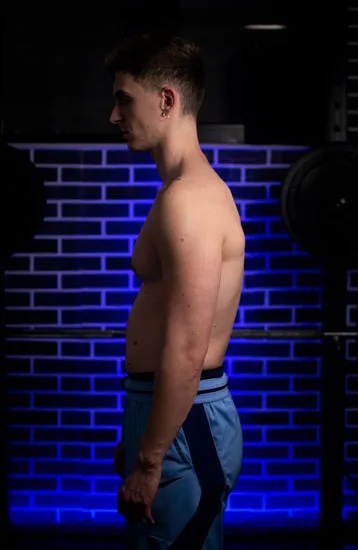
Does the curve straighten when you stand tall? Postural kyphosis, the most common kind, usually does, according to the orthopaedic surgeons’ page; it’s rarely painful and doesn’t get worse. Scheuermann’s kyphosis is different: three or more vertebrae in a row grow wedge-shaped, the curve is stiff, standing tall doesn’t straighten it, and it can sometimes hurt. That one needs a doctor, not a routine from a blog.
Track it monthly. Take a side-on photo in the same light on the day you measure your chest. The photo tracks posture; the ruler tracks the dip.
A short daily posture routine
The core is the McMaster handout’s four exercises: no more than 10 minutes, straight after you get up and again before bed. The hospital is blunt that this won’t fix a severe pectus. It targets posture: a straight upper back and shoulders pulled back.
I add two stretches before and one or two NHS shoulder-blade moves after, a few minutes more. Loosening the front before strengthening the back is my coaching preference; the NHS leaflet also pairs stretching tight muscles with strengthening weak ones.
| Move | Dose | From |
|---|---|---|
| Wall chest stretch | 20 to 30 seconds | Cleveland Clinic (doorway version) |
| Banded lat stretch | About 30 seconds a side | My coaching |
| Sacrospinalis exercise | 25 reps | McMaster |
| Push-ups | 25 reps | McMaster |
| Floor fly | 25 reps | McMaster |
| Chest expansion | 20 reps | McMaster |
| Scapular squeezes | 5 to 6 reps, 5-second hold, building up | NHS |
| Wall angels | 5 to 6 reps, building up | NHS |
| Serratus press | 5 to 6 reps, building up | NHS |
The two stretches
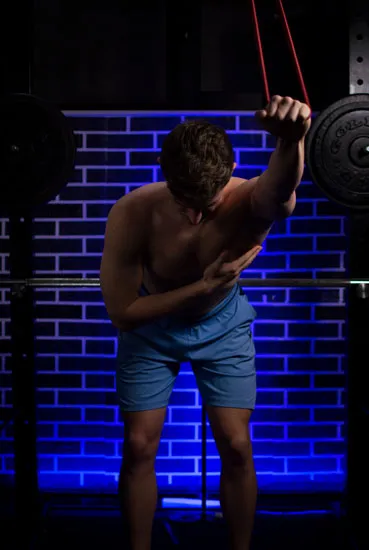
Cleveland Clinic suggests a doorway chest stretch: arms up like a goalpost, palms on the frame, step through until you feel it across your chest. The photo shows a one-arm version against an upright.

For the lats, the large muscles down the sides of your back, loop a resistance band over a bar, hold it with one hand and sit your hips back. The full set is in my stretches for pectus excavatum.
The McMaster four
Sacrospinalis exercise. Lace your fingers behind your head, pull your elbows back as far as you can and keep your neck straight. Hinge forward at the hips until your back is horizontal, hold a second or two, and stand back up, elbows back throughout.

Push-ups. If 25 in a row is too many, split them into sets or put your hands on a bench. That’s my coaching, not the handout’s.

Floor fly. Lie on your back with your arms out at right angles and a small weight in each hand. Keep your arms straight and bring them together over your chest. In my coaching, the floor is the shoulder-friendly start, because it stops your arms dropping too far behind you.

Chest expansion. Stand straight, breathe in as deeply as you can while pulling your shoulders back, and hold it with your chest pushed forward. The handout says to hold as long as possible; my caution is to stop if you feel dizzy or lightheaded. For breathing drills, see breathing exercises for pectus excavatum.

Three NHS moves for the shoulder blades
The leaflet has these twice a day. Start with one or two.
- Scapular squeezes. In front of a mirror, shoulders relaxed, pull your shoulders back so the blades squeeze together. Hold five seconds, relax.
- Wall angels. Back against a wall, arms out along it, elbows bent and hands pointing up. Slide your hands up until your arms are straight, then slowly back down.
- Serratus press. Lie on your back holding a fist-sized ball with straight arms. Push it higher using only your shoulders.
Stop rules
- Stop any move that causes pain.
- Stop the chest expansion hold if you get dizzy or lightheaded.
- The NHS moves are written for people who start them three months after pectus surgery. If you’ve had surgery, follow your own team’s timings.
- Check the red-flag list below first.
Forward head and the neck hump
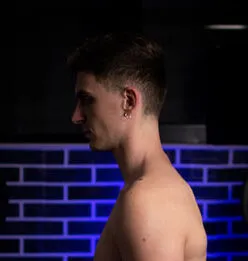
A rounded upper back often comes with a forward head and, over time, a hump at the base of the neck, sometimes called a dowager’s hump. That Cleveland Clinic guide says bad posture is its most common cause, but lists others, such as osteoporosis and Scheuermann’s kyphosis, so see your doctor to rule them out. For the posture kind, it suggests chin tucks: pull your chin straight back, three sets of 10 a day.

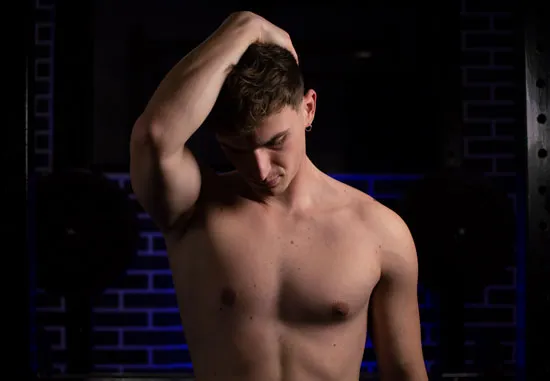
The NHS leaflet adds a neck stretch: tilt your head to one side and use that hand to pull it gently a little further.
What to expect, and how long
Months, not days. Cleveland Clinic says a neck hump can take months to improve, and the Romanian programme ran for three. The dip itself won’t get shallower from this, as the Turkish trial showed.
I’ve coached many clients with rounded shoulders. My expectation as a trainer, not a research finding: you can stand tall the moment you think about it, but making it your default takes months.
Sitting, desks and phones
The NHS leaflet’s sitting guide: sit all the way back so your lower back is supported, keep your head neutral, keep your shoulders slightly down and back and relaxed, and keep your feet flat on the floor.
For screens, Cleveland Clinic says to hold your phone at eye level, raise your computer screen on a stand or riser so you look at the middle of it, and take breaks. My coaching addition: get up and move often, because no position stays good for hours.
When I was diagnosed, my doctor suggested yoga and Pilates, and what they gave me was body awareness: I started noticing when I was hunched over my school desk.
Can a chiropractor fix pectus excavatum?
I found no evidence that one can. I couldn’t find a single published study of chiropractic care for pectus excavatum.
The closest evidence is two single-patient case reports of osteopathy, a different hands-on therapy. In one, a 25-year-old man with pectus who hadn’t had surgery reported less breathlessness, coughing and chest pain after 14 weekly sessions. The other followed open chest surgery. Neither says the dip got shallower.
Chiropractic typically involves spinal manipulation, which the US National Institutes of Health says aims to improve joint motion and function. Most US adults who use it go for pain. Nothing I found shows a manipulation moving a sternum. Cleveland Clinic’s guide says chiropractors and physiotherapists can help posture-related neck humps, so one may help a stiff upper back or neck. My opinion: be wary of anyone who promises to push your chest out.
Manipulation isn’t risk-free either. An overview that pooled 118 reviews couldn’t reach an overall verdict on its safety, but said the serious events reported, such as stroke, show some risk is present.
If you’ve had the Nuss procedure, where a surgeon places a curved metal bar behind the sternum, ask your surgeon before anyone manipulates your chest or back. Your surgical team sets the limits (the NHS leaflet rules out twisting at the waist for three months). See bar movement after the Nuss procedure.
If it’s rib flare you want a chiropractor for, read flared ribs first. If your chest cracks when you pull your shoulders back, see sternum cracking.
Shoulder blades, shoulder pain and uneven shoulders
Shoulder blades that stick out
A winged scapula is a shoulder blade that sticks out instead of lying flat. Cleveland Clinic says it’s rare and most cases are mild. True winging usually comes from injury to the nerves or muscles that hold the blade in place, such as the serratus anterior on the side of your ribcage. A slumped posture and one much weaker shoulder are risk factors for the milder kind.
On a lean frame with rounded shoulders, the blades can simply be more visible. That’s my reading; I couldn’t find a study that measured winging in pectus.
Winging can also follow surgery. In one case report, a man in his early 30s developed it on one side after the Nuss procedure; his surgeons suspected injury to the nerve that controls the serratus anterior. It had almost cleared 28 months later, and the authors call it rare.
Cleveland Clinic says to see a provider if one shoulder blade looks visibly different from the other, or if shoulder pain or stiffness lasts more than a week. I’d add: if it started after surgery, tell your surgical team. Otherwise, the serratus press and wall angels are a sensible start, in my view as a trainer.
Shoulder pain
When I started lifting, I trained mostly chest, skipped back and leg days, and thought stretching was a waste of time. My posture and shoulders got worse, and it took shoulder pain to make me change.
I couldn’t find a study showing shoulder pain or impingement is common with pectus, so I won’t claim it. My rule as a trainer is to do at least as much pulling as pushing; the full week is in pectus excavatum exercises. Pain that keeps coming back needs a physiotherapist, not more stretching. More in pectus excavatum and pain.
Uneven shoulders
One shoulder sitting higher can be a habit, or a sign of scoliosis, a sideways curve of the spine. In a study of 37 people with both pectus excavatum and scoliosis, how severe the scoliosis was didn’t track the depth or asymmetry of the chest. If your shoulders look uneven in the mirror test, get your spine checked; see scoliosis and pectus excavatum.
Pot belly, shoes and pectus carinatum
Pot belly
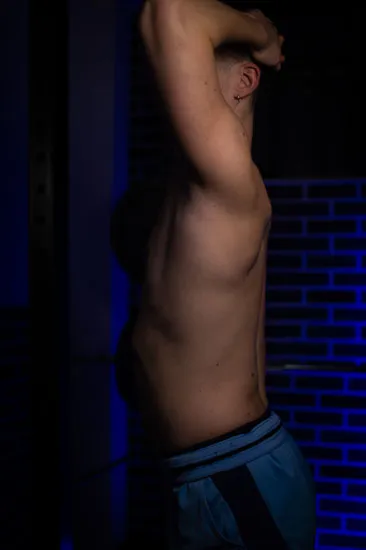
The belly pushed forward is part of the “pectus posture” in the McMaster handout. In my view, it can stand out more on a lean frame. If your lower ribs stick out too, that’s rib flare, a separate issue. Pelvis position and the belly have their own guide: pectus pot belly.
Shoes and insoles
I couldn’t find any study of shoes or insoles in pectus excavatum. A review of six trials found strong evidence that insoles don’t prevent back pain. For walking, the NHS leaflet’s guide is simple: look ahead, not down, keep your shoulders slightly down, back and relaxed, let your arms swing, and pull your stomach in gently.
Pectus carinatum
Pectus carinatum, or pigeon chest, is the opposite shape: the sternum pushes out. In the 2024 Turkish study, teens with carinatum were about as rounded as those with excavatum, about 46 degrees on average. Posture didn’t cause it either, but it can make it look worse. Start with what pectus carinatum is.
When to see a doctor or physiotherapist
See a doctor or physiotherapist about your posture if:
- your upper back is rounded and doesn’t straighten when you stand tall, or the curve hurts
- one shoulder blade sticks out with weakness or pain, or started sticking out after surgery
- your shoulders or hips look clearly uneven
- shoulder or back pain keeps coming back
And see a doctor before you start any routine, this one included, if any of these apply:
- chest pain
- fainting or nearly fainting
- breathlessness at rest or with light effort
- palpitations or an irregular heartbeat
- a diagnosed heart or lung condition
- Marfan syndrome or Ehlers-Danlos syndrome, or a doctor has raised either
- previous chest surgery
- a Haller index above 3.25 together with symptoms
- symptoms that nobody has checked yet
It’s the same list as in my guide to what pectus excavatum is.
Posture is the part you can change today
Better posture changes your outline and how deep the dip looks. It won’t move your sternum. Without surgery, the tool aimed at the sternum itself is a vacuum bell, and that takes months of steady use. The bell is what moved my chest, over about three years of daily use alongside structured training. All the non-surgical options are on my pectus excavatum page.
If you want to know where your chest stands and what to do first, take my free 1-minute quiz.
Sources
- Pectus excavatum. Cleveland Clinic. [cited 2026 Oct 19]. Read it
- Pectus excavatum exercise instructions (patient handout). Hamilton Health Sciences, McMaster Children’s Hospital. [cited 2026 Oct 19]. Read it
- Kyphosis (roundback of the spine). OrthoInfo, American Academy of Orthopaedic Surgeons. [cited 2026 Oct 20]. Read it
- Mete O, Işik H, Pirinççi CŞ, et al. Spinal posture, mobility, and position sense in adolescents with chest wall deformities: a comparison of pectus excavatum, pectus carinatum and healthy peers. Pediatr Surg Int. 2024;40(1):178. Read it
- Jarosz M, et al. Kardiochir Torakochir Pol. 2013;10(1):72-78. Read it
- Physiotherapy information after pectus surgery (PI 155, version 2). Royal Papworth Hospital NHS Foundation Trust. 2024 Feb. Read it
- Suzuki T, Asakura K, Yamada Y, et al. Thoracic posture-related morphological changes in patients with pectus excavatum versus healthy controls. Eur J Cardiothorac Surg. 2024;66(5):ezae408. Read it
- Kandemir B, Yagci G, Uysal S, Akkas Y, Erbahceci F. The effects of Schroth-based exercise therapy in adolescents with pectus excavatum: a controlled clinical trial. Prosthet Orthot Int. 2026 (online ahead of print). Read it
- Rezumeș MZ, Catan L, Amaricai EC, et al. Forward head angle and shoulder angle in relation to stabilometry in children with pectus excavatum included in an exercise program. Children (Basel). 2026;13(5):664. Read it
- How you can fix a dowager’s hump. Cleveland Clinic Health Essentials. 2023 Apr 11. Read it
- Lin ZX, Perez A, Volokitin M. Use of osteopathic manipulative treatment for the management of pectus excavatum: a single case study. Cureus. 2024;16(5):e61005. Read it
- Chiropractic: in depth. National Center for Complementary and Integrative Health. Last updated 2019 Apr. Read it
- Nielsen SM, Tarp S, Christensen R, et al. The risk associated with spinal manipulation: an overview of reviews. Syst Rev. 2017;6(1):64. Read it
- Winged scapula. Cleveland Clinic. [cited 2026 Oct 20]. Read it
- Laven IEWG, van Polen EJ, Vissers YLJ, de Loos ER. Scapula alata, a rare complication after minimally invasive repair of pectus excavatum. BMJ Case Rep. 2024;17(5):e260788. Read it
- Zhong W, Ye J, Feng J, et al. Effects of pectus excavatum on the spine of pectus excavatum patients with scoliosis. J Healthc Eng. 2017;2017:5048625. Read it
- Sahar T, Cohen MJ, Uval-Ne’eman V, et al. Insoles for prevention and treatment of back pain: a systematic review within the framework of the Cochrane Collaboration Back Review Group. Spine. 2009;34(9):924-33. Read it
Sixteen weeks of full-body training for pectus excavatum, with a daily breathing and posture routine and a self-assessment, posture included, that you redo every 4 weeks.
- 16 weeks, 4 training days a week
- Gym and home versions of every day
- One payment, lifetime access

This article is for educational purposes only and does not constitute medical advice. Always consult a qualified healthcare professional before starting any treatment plan. View full disclaimer →