Contents · 9 sections
You want to do something about the dip in your chest today, and stretching looks like the easiest place to start. The straight answer: stretching won’t move your sternum, the breastbone that sits too far back in pectus excavatum. It can help your chest, shoulders and upper back move better and feel less stiff, as the support act to strength work, posture and, if you use one, a vacuum bell (a suction cup worn on the chest that draws the breastbone forward).
Below: four stretches with the source of every dose, three optional trunk stretches, when to stop, who should check with a doctor first, what foam rolling does, and how to time it all around lifting and the bell.
I had pectus excavatum and was diagnosed at 15. I corrected it without surgery over about three years, and the result was visible and measurable, but not complete. I’m a Level 5 certified personal trainer, not a doctor, so where I give technique cues, I’ll call them my coaching. When I started lifting, I thought stretching was a waste of time. It took shoulder pain to change my mind.
What stretching can and can’t do for pectus excavatum
| Stretching can help | Stretching can’t |
|---|---|
| How far your chest, shoulders and upper back move | Move your sternum |
| How comfortable the end of a stretch feels | Make the dip shallower |
| Your posture, alongside strength work | Replace a vacuum bell or surgery |
I couldn’t find a study that tested stretching alone for pectus excavatum, or one showing any stretch moving the sternum. The closest evidence is a 2026 controlled trial from Turkey. Thirty-five teenagers used a vacuum bell, and 19 of them also did an exercise programme based on the Schroth method. The groups weren’t assigned at random. The exercise group improved more in posture angles and on a quality-of-life questionnaire written for pectus patients. Deformity severity didn’t differ between the groups, and neither did their mobility tests.
You may have read that research shows stretching helps pectus. One paper cited for that is a 2005 article by Hong Kong physiotherapist S.Y.K. Cheung. It suggests a programme of mobility, stretching, strengthening and posture work, and reports no study of patients. He wrote that some patients were seen to benefit, “although the long term effect and its physiological benefits are still unknown”, and that whether the chest’s shape can improve needs further study. That’s a suggestion, not proof.
So what does stretching change? According to a 2010 review, most of the extra range from one session or a three- to eight-week programme comes from stretch tolerance (your nervous system getting more comfortable at the end of the stretch), not a longer muscle. Longer programmes hadn’t been tested for lasting tissue changes. Getting comfortable at the end of a stretch is a long way from a bone moving.
Then there’s the idea that pectus comes with tight chest muscles. In a Polish study, fewer of 19 boys waiting for pectus surgery had a shortened upper chest muscle than 30 healthy boys. So stretch because your chest and shoulders feel tight, not because pectus means they must be.
I couldn’t find a study of stretching and breathing in pectus excavatum either. Breathing drills are in breathing exercises for pectus excavatum.
Before you start
How hard and how often. For healthy adults, the American College of Sports Medicine (ACSM) suggests holding each stretch for 10 to 30 seconds and repeating it to total about 60 seconds, at least two or three days a week, with bigger gains if you stretch daily. Stretch to a feeling of tightness or slight discomfort. Hospital doses differ, so each stretch below names whose dose it is.
When to stop. The Children’s Mercy Kansas City pectus handout is stricter than ACSM: if a move causes any pain or discomfort, stop and contact your health care provider. My rule for everyone: tightness is fine, pain isn’t. Stop if you feel pain, numbness, tingling, dizziness or breathlessness.
If your chest pops or cracks while you stretch and it doesn’t hurt, that’s usually not a concern, according to Healthline. Popping with pain or swelling needs a doctor, and I’d say the same for new popping after an injury or chest surgery. More in sternum cracking.
See a doctor first if you have chest pain, fainting or near-fainting, breathlessness at rest or with light effort, palpitations, a diagnosed heart or lung condition, Marfan or Ehlers-Danlos syndrome, previous chest surgery, a Haller index above 3.25 together with symptoms, or symptoms nobody has checked yet. Same list as in what pectus excavatum is.
After the Nuss procedure. In the Nuss procedure, a surgeon places a curved metal bar behind the sternum to push it forward. Your surgical team decides when you stretch, and hospitals differ. Royal Papworth Hospital, an NHS hospital, starts its stretching programme three months after surgery and rules out twisting at the waist for three months. Children’s Healthcare of Atlanta tells children not to bend or twist at the waist, and its physical therapists may teach gentle stretches, such as sliding the arms up the bed. More in the Nuss procedure.
Marfan, Ehlers-Danlos or very flexible joints. The Marfan Foundation advises against extreme joint stretching or pushing joints to their limits, favours mid-range strengthening, and says to plan activity with your care team. For joint hypermobility, NHS 111 Wales puts muscle strength and fitness first and says not to overextend your joints just because you can. More in Marfan syndrome and pectus.
Children. The Children’s Mercy handout is written for them: 3 sets of 10, once a day, and stop with any pain or discomfort. Cheung suggested parents could stretch the limbs of young children who can’t do the exercises. Like the rest of his programme, that’s untested. More for parents in pectus excavatum in babies and kids.
The stretches
Four stretches cover the front of your chest, your shoulders and the sides of your back. Where a hospital describes the setup, I say so. Other setup details and the common mistakes are my coaching.
| Stretch | Dose | Source |
|---|---|---|
| Doorway chest stretch | 3 sets of 10, once a day; or hold 20 to 30 seconds | Children’s Mercy; Cleveland Clinic |
| One-arm pec minor stretch | Hold 10 to 30 seconds, about 60 seconds in total per side | ACSM |
| Chest stretch with a shoulder squeeze | 3 sets of 10, once a day; or hold 5 seconds | Children’s Mercy; Royal Papworth |
| Lat stretch | Hold 10 to 30 seconds (overhead reach); about 30 seconds a side (band) | Royal Papworth; my coaching |
Royal Papworth’s leaflet, for people three months or more after pectus surgery, also gives a general 30 to 45 seconds, so treat its numbers as ranges.
Doorway chest stretch
Children’s Mercy’s setup: stand in the middle of a doorway, elbows bent, forearms on the frame with your upper arms out to the sides at a right angle to your body. Take a small step forward until you feel a gentle stretch across the front of your chest and shoulders. Don’t shrug.
The common mistake is arching your lower back to chase the stretch. Keep your ribs down and step through less.
Dose: Children’s Mercy gives 3 sets of 10, once a day, with no hold time. Cleveland Clinic suggests holding its doorway version for 20 to 30 seconds.
One-arm pec minor stretch on a door frame
Your pec minor is a small muscle under your main chest muscle, attached to your shoulder blade. Put one forearm against a door frame or upright, elbow at about shoulder height, and turn your body away from it. You should feel it high on the chest, near the front of the shoulder.

In a lab study of 50 healthy adults, a one-arm self-stretch like this lengthened the pec minor more than two therapist-led versions (2.24 cm, against 1.69 and 0.77 cm), measured during the stretch. Over time, a 2019 review of six trials found static stretching alone didn’t change the muscle’s length. In a trial of 60 young women with rounded shoulders, adding strengthening for the lower trapezius, which draws your shoulder blades down, lengthened it more than stretching alone.
The common mistake is letting the shoulder roll forward. Keep it back and down.
Dose: ACSM’s 10 to 30 second holds, to about 60 seconds in total per side.
Chest stretch with a shoulder squeeze
Children’s Mercy’s setup: stand tall holding a dowel or broom handle behind your back, hands together. Gently squeeze your shoulder blades together until you feel a stretch across your chest. Move only your shoulder blades and keep your hands close to your body.
The common mistake is leaning forward or poking your chin out. Stand tall and keep the range small.
Dose: Children’s Mercy gives 3 sets of 10, once a day. Royal Papworth’s version, gently pulling your arms behind you, holds for 5 seconds.
Lat stretch
Your lats are the large muscles down the sides of your back. Royal Papworth’s version: arms overhead, reach as high as you can, hold 10 to 30 seconds.
My banded version: loop a resistance band over a bar, hold it with one hand and sit your hips back until you feel it down the side of your back. Hold about 30 seconds a side (my coaching, not a hospital dose).
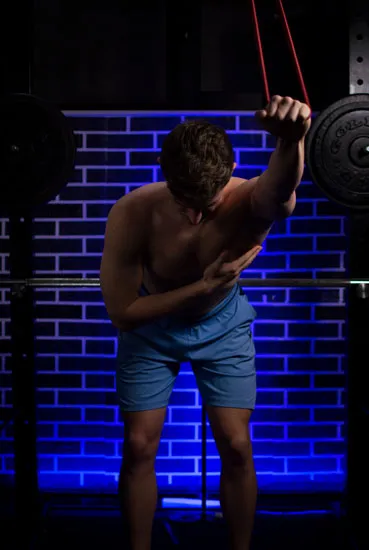
The common mistake is arching your lower back so the ribs flare up. Breathe out and keep your ribs down.
Pair them with strength work
In those pec minor trials, static stretching alone did little, and adding strengthening did better. So pair your stretches with upper-back work: the full training week is in pectus excavatum exercises, and a short daily routine is in my guide to pectus posture.
Cheung’s three trunk stretches (an untested suggestion)
Cheung suggested these to loosen the spine and chest wall. I couldn’t find a study that tested them, so they’re optional. His dose for each: hold 8 seconds, 20 repetitions, four sessions a day, as a starting point to adjust to what you tolerate. My coaching: start with one session a day. If you’re very flexible, stay in the middle of your range.
Forward arm stretch, kneeling. Kneel facing a low bar or other stable support about 2 to 3 feet (60 to 90 cm) high, hands on it. Slowly lower your upper body, shoulder blades sinking toward the floor, until you feel it at the front of your armpits and shoulders. Yoga poses have their own guide: yoga for pectus excavatum.
After the Nuss procedure, skip this next one, and any other twist, until your team clears you. Royal Papworth rules out twisting at the waist for three months.
Upper body rotation, standing. Stand at an angle to a wall and put your nearer hand on it, a little above shoulder height. Keep the hand there and turn your hips away from the wall until you feel a stretch at the front of your shoulder and upper chest. Do both sides. Children’s Mercy has a lying-down twist instead, 3 sets of 10 once a day: on your back, knees bent, slowly lower your knees to one side, keeping your back and shoulders on the floor. It’s still a twist, so the same surgery rule applies.
Side bend, seated. Sit on a chair, reach one arm over your head and bend sideways away from it until you feel it along the raised-arm side. Don’t fold forward.
Foam rolling: what it does and how to do it
Foam-rolling research is on healthy adults, mostly their legs. In the reviews I checked, I found no study of rolling the chest or upper back, let alone in pectus.
- Right after rolling: a 2020 meta-analysis of 26 trials found more range of motion than doing nothing, but no more than stretching.
- Over weeks: in a 2024 meta-analysis of 85 studies, stretching and rolling programmes gave similar gains, and over four weeks or less, stretching did better.
- Performance and recovery: a 2019 meta-analysis found the effects small and partly negligible, though rolling after exercise eased how sore muscles felt.
- Pain: in 16 people rolling the front of the thigh, hard pressure at 8 out of 10 pain gave no more range than moderate pressure.
If you only have time for one, stretch. And rolling doesn’t need to hurt.
How I coach the upper back. Lie with the roller across your upper back, under your shoulder blades, hands behind your head, hips on the floor. Roll slowly with moderate pressure. I found no study-based time for this area, so stop when it feels looser.
Where not to roll (my coaching): your lower back, your neck, your lower ribs and your sternum. Never roll over a Nuss bar, and ask your team before you lie on a roller while one is in. Lower ribs that stick out are rib flare, and rolling them isn’t the answer: see rib flare exercises.
When to stretch: lifting days and vacuum bell sessions
In a 2016 review of studies in healthy, active people, holds of 60 seconds or more per muscle cut performance more (about 4.6%) than shorter holds (about 1.1%). The extra range usually lasted under 30 minutes, and stretching had no clear effect on injuries. The authors recommend stretching inside a warm-up followed by active movement.
On lifting days: short holds in your warm-up, then move. Longer holds go after training or in a separate session.
For the vacuum bell, I couldn’t find a study of stretching before a session. Eckart Klobe, the engineer who developed the modern vacuum bell, writes in his instructions that the bell is better after sport than before, at times when no muscle work follows. In my view, a few easy stretches first are fine if they help you relax. More in how to use a vacuum bell.
How to tell it’s working
Not by the dip. These checks are my coaching, not tests from a study:
- End range. Does the doorway stretch feel easier at the same position?
- Reach. Can you reach higher overhead with your ribs down and your lower back flat against a wall?
- A side-on photo. Same light, same distance, once a month. Check whether your shoulders sit further back.
Measure the dip separately, once a month, lying flat and without pressing, as my measurement guide shows. Stretching isn’t expected to change that number.
My reading of the tolerance research: most of the gain is comfort, so treat stretching as a habit you keep, not a project you finish.
Where stretching fits
Stretching supports strength and posture work, but it doesn’t reach the sternum. Without surgery, the tool aimed at the sternum itself is the vacuum bell. It’s what moved my chest, over about three years of daily use alongside training. While I used it, I did weights and yoga three to five times a week. All the non-surgical options are on my pectus excavatum page.
If you want to know where your chest stands and what to do first, take my free 1-minute quiz.
Sources
- Kandemir B, Yagci G, Uysal S, Akkas Y, Erbahceci F. The effects of Schroth-based exercise therapy in adolescents with pectus excavatum: a controlled clinical trial. Prosthet Orthot Int. 2026 (online ahead of print). Read it
- Cheung SYK. Exercise therapy in the correction of pectus excavatum. J Paediatr Respirol Crit Care. 2005;1(2):10-13. Read it
- Weppler CH, Magnusson SP. Increasing muscle extensibility: a matter of increasing length or modifying sensation? Phys Ther. 2010;90(3):438-49. Read it
- Jarosz M, et al. Kardiochir Torakochir Pol. 2013;10(1):72-78. Read it
- Garber CE, et al. American College of Sports Medicine position stand: quantity and quality of exercise for developing and maintaining cardiorespiratory, musculoskeletal, and neuromotor fitness in apparently healthy adults. Med Sci Sports Exerc. 2011;43(7):1334-59. Read it
- Pectus excavatum exercises (patient handout). Children’s Mercy Kansas City. [cited 2026 Oct 20]. Read it
- Sternum popping. Healthline. Updated 2023 May 19. Read it
- Physiotherapy information after pectus surgery (PI 155, version 2). Royal Papworth Hospital NHS Foundation Trust. 2024 Feb. Read it
- Therapy after pectus surgery (teaching sheet). Children’s Healthcare of Atlanta. 2024 Jul. Read it
- Physical activity key takeaways. The Marfan Foundation. 2026. Read it
- Joint hypermobility. NHS 111 Wales. [cited 2026 Oct 20]. Read it
- How you can fix a dowager’s hump. Cleveland Clinic Health Essentials. 2023 Apr 11. Read it
- Borstad JD, Ludewig PM. Comparison of three stretches for the pectoralis minor muscle. J Shoulder Elbow Surg. 2006;15(3):324-30. Read it
- Lai CC, Chen SY, Yang JL, Lin JJ. Effectiveness of stretching exercise versus kinesiotaping in improving length of the pectoralis minor: a systematic review and network meta-analysis. Phys Ther Sport. 2019;40:19-26. Read it
- Hasan S, Iqbal A, Alghadir AH, Alonazi A, Alyahya D. The combined effect of the trapezius muscle strengthening and pectoralis minor muscle stretching on correcting the rounded shoulder posture and shoulder flexion range of motion among young Saudi females: a randomized comparative study. Healthcare (Basel). 2023;11(4):500. Read it
- Wilke J, et al. Acute effects of foam rolling on range of motion in healthy adults: a systematic review with multilevel meta-analysis. Sports Med. 2020;50(2):387-402. Read it
- Konrad A, Alizadeh S, Anvar SH, Fischer J, Manieu J, Behm DG. Static stretch training versus foam rolling training effects on range of motion: a systematic review and meta-analysis. Sports Med. 2024;54(9):2311-26. Read it
- Wiewelhove T, et al. A meta-analysis of the effects of foam rolling on performance and recovery. Front Physiol. 2019;10:376. Read it
- Grabow L, et al. Higher quadriceps roller massage forces do not amplify range-of-motion increases nor impair strength and jump performance. J Strength Cond Res. 2018;32(11):3059-69. Read it
- Behm DG, Blazevich AJ, Kay AD, McHugh M. Acute effects of muscle stretching on physical performance, range of motion, and injury incidence in healthy active individuals: a systematic review. Appl Physiol Nutr Metab. 2016;41(1):1-11. Read it
- Klobe E. The Eckart Klobe Vacuum Bell for Non-Invasive Lifting of Funnel Chest: Instructions for use (the inventor’s instructions for his own bell). 2010 Nov 3. Read it
Not a list of exercises. Sixteen weeks of programmed posture, breathing and mobility work, in the order that actually shifts a chest.
- 16 weeks, gym and home versions
- Programmed sets, reps and progressions
- The lifts to avoid while you correct

This article is for educational purposes only and does not constitute medical advice. Always consult a qualified healthcare professional before starting any treatment plan. View full disclaimer →