Contents · 10 sections
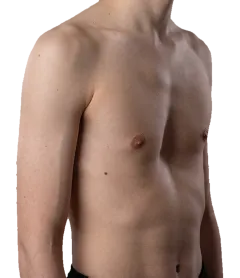
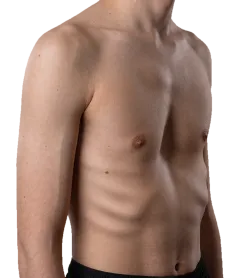
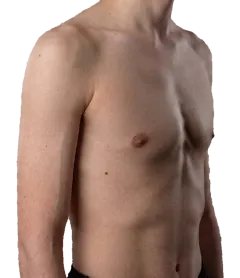
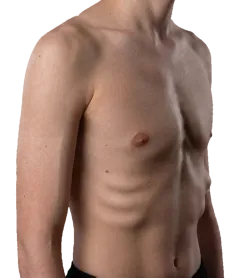
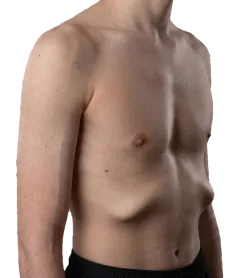
You came here for exercises that flatten the bump. The honest answer first: exercise won’t push a pectus carinatum back in. The bump comes from overgrown cartilage, the firm, bendy tissue that joins your ribs to your breastbone, and training can’t reshape it. What training changes is everything around the bump: your upper back, shoulders, posture, breathing and strength. That’s worth doing, because teenagers with carinatum measure more rounded in the upper back than their peers. (Pigeon chest is the everyday name for the same condition.)
A note on me. I had pectus excavatum, the sunken kind, not carinatum. I was diagnosed at 15 and corrected it without surgery over about three years. The change was visible and measurable, but not complete. I’m a Level 5 certified personal trainer, not a doctor. Where a dose or cue is my coaching rather than a source’s, I say so.
What exercise can and can’t change
| Training can change | Training can’t |
|---|---|
| Strength and muscle in your back, shoulders, core and chest | Reshape the overgrown cartilage behind the bump |
| How rounded your upper back and shoulders are | Correct the bump itself |
| Your breathing pattern and control of your lower ribs | Replace a brace or surgery |
| How freely your upper back moves, and your confidence | Guarantee how your chest will look |
Both columns follow Pectus Clinic, a surgeon-led London clinic, which says physiotherapy can’t correct the deformity itself. Brazilian orthopaedist Sydney Haje and his co-author wrote that lifting, swimming or other exercise alone don’t correct a pectus deformity, and that muscle growth “can only occasionally disguise it”. A 2025 rehabilitation review found no clear consensus on the role of exercise training in pectus.
Without surgery, what moves the bump is a brace: steady pressure on the cartilage, held for months. Every option is on my pectus carinatum page.
Why your back and posture are worth the work
Thoracic kyphosis is the forward curve of your upper back. In carinatum there tends to be more of it.
- In a single-centre review of physical exams of 85 patients aged 10 to 18 with carinatum (co-authored by Prof. Yüksel, the site’s medical reviewer), clinicians recorded a forward head in 90.6%, rounded shoulders in 83.5%, increased upper-back rounding in 92.1% and uneven shoulders in 80.2%. These were examination findings, not X-rays.
- Measured with a device rolled along the spine, 22 teenagers with carinatum averaged 45.5 degrees of upper-back curve, against 32.4 in 21 healthy peers, and their spines moved less.
Both are associations, not proof that one caused the other.
Tight chest muscles? Pectus Clinic suggests that rounding the shoulders to hide the bump can, over time, tighten the chest and weaken the upper back. That’s a clinic observation. In a small Dutch study of 21 patients before surgery, 5 with carinatum, none had shortened chest muscles. So treat stretching as comfort and range, not a fix.
My view as a trainer: a stronger upper back and a more upright stance usually make a bump less obvious. I haven’t found a study that measured that, so take it as coaching.
What the studies found
There are two small trials of exercise in carinatum, both from Istanbul, both in boys, both with a brace in the picture. Both were randomised controlled trials: patients were put into groups by chance, which makes the comparison fairer.
Brace hours, with exercise for everyone. In a 2021 pilot trial, also co-authored by Prof. Yüksel, boys aged 7 to 17 with carinatum were assigned to wear a brace 23 hours a day, 8 hours a day, or no brace. Every group did an hour of exercise a day for three weeks (five days a week, per the trial registration): posture, deep breathing, rib mobilisation and core work. All three groups showed significant changes in how far the chest stood out. The 23-hour group improved most.
That can sound as if exercise alone moved the bump. Read the limits first. The abstract doesn’t give the size of the no-brace group’s change and I couldn’t get the full paper, so how much it changed is unknown. It lasted three weeks. The trial registration lists 27 boys, all with the lower type (the bump on the lower half of the breastbone), and the no-brace group came from the brace waiting list. The authors note a lack of evidence on the benefits of exercise.
Brace alone, or brace plus physiotherapy. In a 2020 trial, also co-authored by Prof. Yüksel, 30 boys aged 11 to 18 with carinatum wore a brace, and one group also did physiotherapy. Both groups improved. The physiotherapy group improved more in maximum protrusion (how far the highest point stands out) and one other chest measurement, and did better on how they saw their chest, posture, psychological quality of life and satisfaction. The authors call it preliminary and say long-term results still need clarifying. The abstract doesn’t list the exercises or doses.
My reading: the biggest improvements in both trials came in braced groups, and in one, adding exercise to a brace helped on some measures. Neither trial tested months of exercise alone, and I couldn’t find a study that did. So in this evidence, training is the support act to a brace, not a replacement.
A daily home routine from a children’s hospital
Children’s Mercy Kansas City, a US children’s hospital, publishes a home exercise handout for carinatum. The seven moves and doses below are the handout’s, each once a day, seven days a week. You need a light band and somewhere to anchor it. Four of the moves use shoulder-blade retraction: squeezing your shoulder blades back toward each other.
| Move | What you do | Dose | The handout’s cue |
|---|---|---|---|
| Band pull-apart (standing horizontal abduction) | Straight arms in front, pull your hands apart to your sides | 3 sets of 10 | Arms level, squeeze the shoulder blades, don’t shrug |
| Band shoulder extension, palms forward | Band anchored high in front, pull straight arms down to your sides | 3 sets of 10 | Elbows and back straight, don’t shrug |
| Standing shoulder-blade squeeze | Arms by your sides, squeeze, relax | 3 sets of 10 | Back relaxed, don’t shrug |
| Band shoulder-blade squeeze | Elbows bent at your sides, band anchored in front, squeeze back and down | 3 sets of 10 | Back straight, don’t shrug |
| Plank on elbows | Hips up in a straight line, elbows under shoulders, hold | “30” (unit not stated) | Back straight, gentle chin tuck |
| Bird dog | On all fours, reach one arm and the opposite leg out level, return | 3 sets of 10 | Abs tight, hips level |
| Kneeling push-up | Knees down, lower slowly, push back up | 3 sets of 10 | Back straight, gentle chin tuck |
I read the plank’s “30” as seconds, but the handout doesn’t say. Its safety rule: if any exercise causes pain or discomfort, stop and contact your health care provider.
My coaching: pick a band light enough that your last rep looks like your first. The block takes around 15 minutes.
Add breathing and posture work
Pectus Clinic’s programme opens every day with 5 minutes of deep breathing and rib control, then 5 minutes of posture work: chin retraction (sliding your head straight back) and scapular setting (drawing your shoulder blades gently back and down). My pectus posture guide adds more shoulder-blade work and a side-on posture check.
Rib flare is the lower edge of the rib cage sticking out. For carinatum with flared ribs, the Argentinian team behind the FMF brace encourages swimming, wind instruments, balloons and other breathing activities. The drills are in rib flare exercises.
If your chest feels tight, add a doorway chest stretch held 20 to 30 seconds, the hold Cleveland Clinic suggests. It’s for comfort and range, not the bump.
If lying face down hurts
Prone means lying face down. The FMF team lists chest pain or discomfort “especially when lying in prone position” among carinatum symptoms, and the Canadian brace maker Braceworks notes that sleeping face down can be uncomfortable. The plank and kneeling push-up both start face down.
My coaching: if the floor presses on a tender bump, plank with your forearms on a bench, and swap the kneeling push-up for an incline push-up against a bench or wall.

How to build your week
The frequency comes from the World Health Organization’s 2020 guidelines:
- Ages 5 to 17: an average of 60 minutes a day of moderate to vigorous activity, with vigorous and muscle- and bone-strengthening work on at least 3 days a week.
- Adults: 150 to 300 minutes a week of moderate activity (or 75 to 150 vigorous), plus muscle-strengthening on 2 or more days.
From here on, this section is my coaching as a trainer, not research, unless I name a source.
- Do the home block every day, as your warm-up on strength days.
- Lift 2 to 4 days a week, full body. Teenagers, aim for at least 3, in line with WHO.
- Pull at least as much as you push. Match every pushing set with a pulling set. If your shoulders round forward, do up to two pulls per push.
- Start with 3 sets of 8 to 12 reps, resting 60 to 90 seconds, and finish each set with a rep or two still in the tank.
- Progress slowly. When every set reaches 12, add a little weight.
| Pattern | Gym | Home |
|---|---|---|
| Horizontal pull | One-arm dumbbell row or cable row | Inverted row or band row |
| Vertical pull | Pull-ups or lat pulldown | Door-bar pull-ups, band-assisted if needed |
| Upper back | Cable face pull | Band face pull or band pull-apart |
| Push | Incline dumbbell press or push-ups | Incline push-ups, working down to the floor |
| Squat | Goblet squat or back squat | Split squat |
| Hinge | Romanian deadlift | Single-leg Romanian deadlift, backpack in hand |
| Core | Dead bug, side plank | Dead bug, side plank |
A simple three-day week alternates two sessions, with a rest day between. Day A: one-arm row, incline press or push-up, goblet squat, face pull. Day B: pulldown or pull-up, push-up, Romanian deadlift, a second row.
For the rest of your activity minutes, walking, cycling and swimming all count. Haje’s group prescribed freestyle and backstroke for chest flexibility and posture.
Lifting and bodybuilding with pectus carinatum
The sources disagree on whether lifting, and chest work in particular, can make a carinatum stand out more.
Haje’s view is that weight training without a brace “can aggravate a protruding chest and contribute to its stiffness.” That’s the authors’ opinion from their practice, not something they measured. Their braced patients still trained the chest: a pec deck (chest fly machine) three times a week, in the brace, light, adding reps rather than load, to move the rib cage rather than build muscle.
Other programmes do load the chest. The Children’s Mercy routine has kneeling push-ups, Pectus Clinic’s has incline press-ups, and a London bracing provider runs a chest “loading class”.
Will bench press make the bump stick out more?
Unknown. I couldn’t find a study that measured whether bench pressing changes how far a carinatum stands out.
My coaching while that stays open:
- Press with moderate weights in the 8 to 12 range rather than chasing heavy singles.
- Stop any press that hurts at the breastbone, and try dumbbells or a shorter range instead.
- If you’re braced, ask your clinician about Haje’s light-chest approach before heavy pressing.
If you’d rather follow a written plan, my own Pectus Carinatum Workout Program is 16 weeks, four workouts a week, with a gym track and a home track. Like this page, it works on the frame around the bump, not the bump.
Training with a brace
If you’re braced, your clinician’s protocol comes first. Here’s how the published ones handle exercise and sport.
- Exercise in the brace. Haje’s method calls it essential: taught by a trained physiotherapist, done daily or at least five days a week.
- Brace off for sport and washing. Children’s Mercy says the brace is worn day and night except for bathing and sports. The FMF team and KidsHealth, a US parents’ guide, say off for sports and the shower. In the Giray trial, the 23-hour group took it off for sport, exercise and bathing.
- Contact sport and swimming. The London Orthotic Consultancy says to remove it for swimming and contact sport, and Braceworks says its brace isn’t for contact sport. Haje’s group prescribed swimming without the brace.
Children’s Mercy also says people with carinatum should keep doing the activities they enjoy: some symptoms can get worse with activity, but the activity itself isn’t a health risk.
Who suits a brace and the hours are in my pectus carinatum brace guide, and prices are compared in my carinatum brace buyer’s guide. I also sell a carinatum brace, built to your measurements, with free worldwide tracked shipping. That guide judges it on the same checklist as the others, shortfalls included.
Uneven chest, high bump, teen or adult
Uneven (asymmetric) carinatum
Uneven shoulders showed up in 80.2% of the 85 patients in that exam review. In a study of 740 braced patients, those with asymmetric chests were more likely to give up the brace. One registered trial protocol from Istanbul adapts segmental breathing (directing the breath into one part of the chest) to where the bump sits. That’s a plan on file, not a result.
One-arm rows and presses let each side work on its own, so the stronger side can’t take over. How one-sided bumps are classified is in asymmetrical pectus carinatum.
Upper-type carinatum
The upper type (chondromanubrial) is a bump high up, just below the collarbones. The Giray trial excluded it, so what exercise does for it is unknown. One UK clinic lists it as less suitable for bracing, and in an 11-patient series, half reached the maintenance stage of bracing. My coaching: same routine, same week.
Teens and adults
Teenagers. The 2024 European pectus guidelines say bracing works less well the older you start. Children’s Mercy puts the ideal start at about 11 to 14. On lifting, a 2006 review found supervised resistance training before or early in puberty didn’t affect growth, and injuries were rare: three across the ten studies that tracked them. My coaching: learn each lift light, from someone who knows the technique.
Adults. Pectus Clinic says a programme can still reduce posture changes in adults, but less change is possible once you’ve stopped growing. Brace results are lower too: Haje’s 32-year series of brace plus exercise, counting carinatum and excavatum together, reported good results in 60.6% of children and teenagers against 27% of adults.
See a doctor before training if you have…
- chest pain, especially when you exert yourself
- fainting or nearly fainting
- breathlessness at rest, or far out of proportion to the effort
- palpitations or an irregular heartbeat
- a diagnosed heart or lung condition
- Marfan syndrome or Ehlers-Danlos syndrome, or a doctor has raised either
- previous chest surgery
- symptoms nobody has checked yet
- broken, sore or inflamed skin under your brace
During a session, stop and get checked if chest pain, palpitations, dizziness or breathlessness don’t settle. Pectus Clinic says chest pain should always be assessed, especially if it’s new, severe or comes with breathlessness.
For most people with carinatum, the heart and lungs aren’t the problem. In 76 teenagers with pectus, 46 with carinatum, lung function wasn’t affected in the carinatum group. In a small exercise-test study of 13 carinatum and 10 excavatum patients aged 10 to 18, exercise capacity was mildly lower in both, which the authors thought more likely due to being out of condition than to the chest shape.
Marfan is different. A 2025 sports cardiology review says people with Marfan syndrome or a related inherited aortic condition should avoid intensive exercise, contact sport and strength training, so get your cardiologist’s plan before you lift.
After carinatum surgery, return to training is your surgeon’s call, and hospitals differ. For example, an NHS hospital’s leaflet after pectus surgery puts gym work at three to six months and contact sport at six months or later.
How to track it
Once a month, measure your bump height and take a side photo, as my guide to what pectus carinatum is describes: the highest point of the bump against the ribs beside it, at the end of a full breath out, in the same light. Keep a strength log too.
Be honest with the timeline. Pectus Clinic says more substantial posture change typically takes three to six months of regular work. Change in the chest itself, with a brace, is measured in months and years.
If you’re not sure your chest is carinatum, or which route fits it, my free 1-minute quiz is the place to start.
Sources
- Pectus, posture and physiotherapy. Pectus Clinic, London. [cited 2026 Oct 20]. Read it
- Haje SA, Haje DP. Rev Bras Ortop. 2009;44(3):191-8. Read it
- Sonel Tur B, Genç A. Turk J Phys Med Rehabil. 2025;71(2):131-8. Read it
- Kahraman Esen H, Yüksel M. Med Sci Monit. 2026;32:e952511. Read it
- Mete O, et al. Pediatr Surg Int. 2024;40(1):178. Read it
- Schoenmakers MA, et al. J Pediatr Surg. 2000;35(10):1440-3. Read it
- Giray E, Ermerak NO, Bahar-Ozdemir Y, Kalkandelen M, Yuksel M, Gunduz OH, Akyuz G. Eur J Pediatr Surg. 2021;31(2):147-56. Read it
- NCT03559244 (trial registration for the Giray study). ClinicalTrials.gov. [cited 2026 Oct 20]. Read it
- Alaca N, Alaca İ, Yüksel M. Pediatr Surg Int. 2020;36(7):789-97. Read it
- Pectus carinatum (home exercise handout). Children’s Mercy Kansas City. Printed 2020 Sep 25 [cited 2026 Oct 20]. Read it
- Martinez-Ferro M, et al. Non-surgical treatment of pectus carinatum with the FMF Dynamic Compressor System. J Vis Surg. 2016. Read it
- How you can fix a dowager’s hump. Cleveland Clinic Health Essentials. 2023 Apr 11 [cited 2026 Oct 20]. Read it
- Pectus carinatum FAQs. Braceworks Custom Orthotics. [cited 2026 Oct 20]. Read it
- Bull FC, et al. World Health Organization 2020 guidelines on physical activity and sedentary behaviour. Br J Sports Med. 2020;54(24):1451-62. Read it
- Pectus carinatum. Children’s Mercy Kansas City. [cited 2026 Oct 20]. Read it
- Pectus carinatum: bracing. Nemours KidsHealth. [cited 2026 Oct 20]. Read it
- Malina RM. Weight training in youth-growth, maturation, and safety: an evidence-based review. Clin J Sport Med. 2006;16(6):478-87. Read it
- Ramadan S, et al. BMJ Open Respir Res. 2021;8(1):e001020. Read it
- Abushahin A, et al. Pediatr Pulmonol. 2025;60(1):e27414. Read it
- Małek Ł, Lemańska A, Śpiewak M. Pectus Excavatum: A Frequent but Often Neglected Entity in Sports Cardiology. Diagnostics (Basel). 2025;15(23):2956. Read it
- Physiotherapy information after pectus surgery (PI 155). Royal Papworth Hospital NHS Foundation Trust. Read it
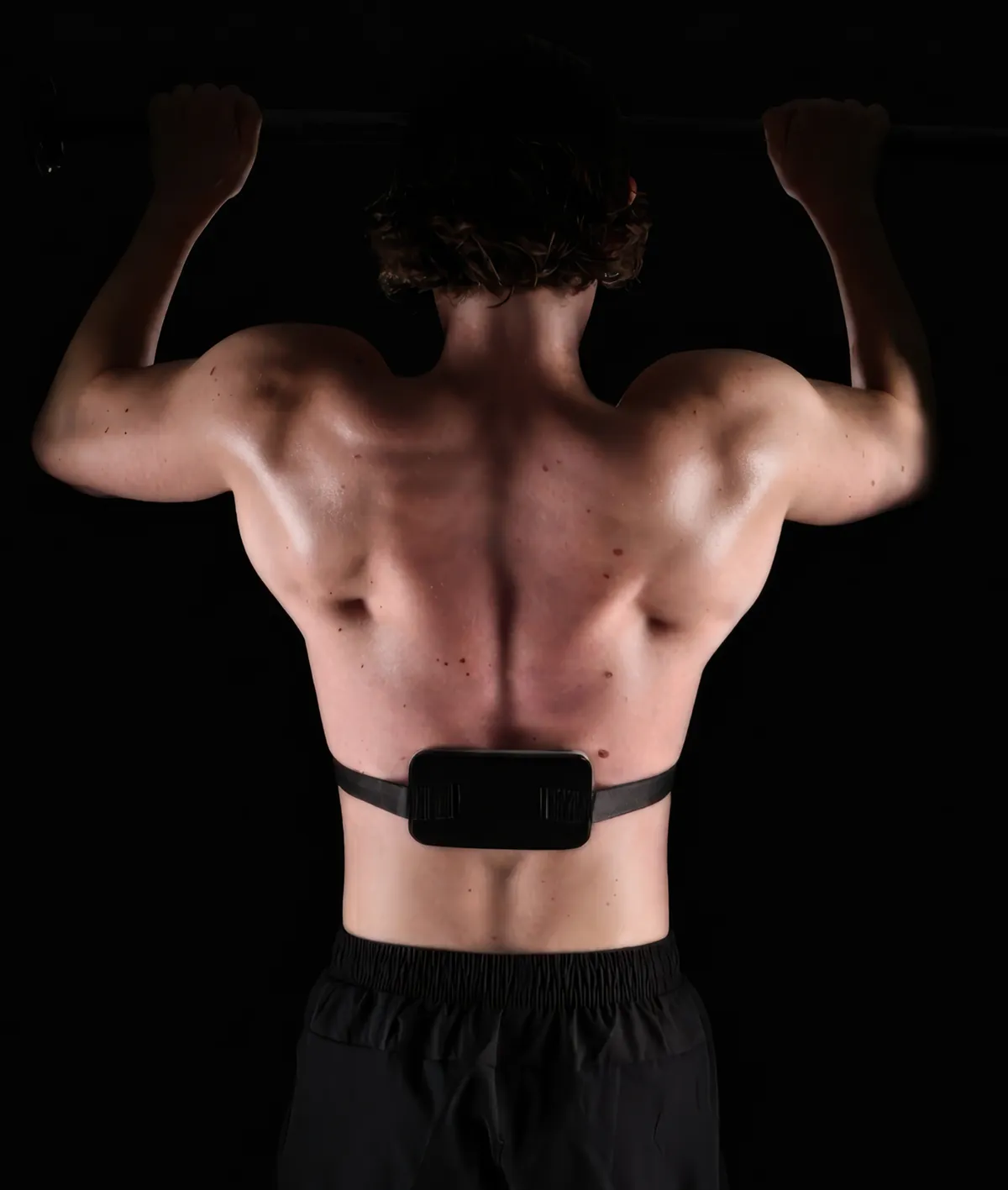
Sixteen weeks of full-body training for pectus carinatum, with a gym track and a home track. It builds the back, shoulders and posture around the bump. It won't push the bump in.
- 16 weeks, 4 workouts a week
- Gym and home tracks of every workout
- A daily 10-minute core plan on top
This article is for educational purposes only and does not constitute medical advice. Always consult a qualified healthcare professional before starting any treatment plan. View full disclaimer →