Contents · 9 sections
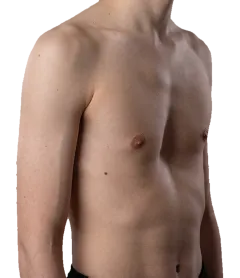
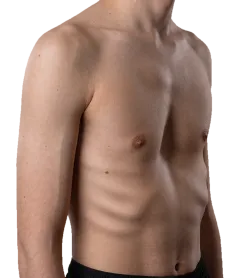
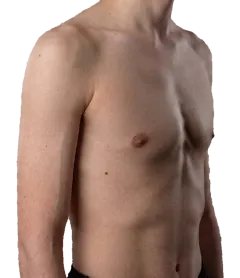
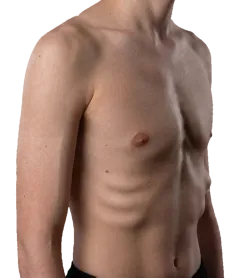
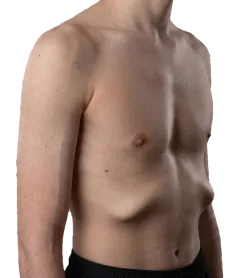
With pectus excavatum, a belly that sticks out is often the lower ribs flaring forward and the dip sitting right above the belly, made more obvious by posture. It can also be a gap in the abdominal wall (diastasis recti), and ordinary belly fat or bloating can look exactly the same from the side, so the first job is working out which one you have.
Have pain, a lump or other symptoms? Skip to when to see a doctor.
I’m not a doctor. Every medical point below comes from a named study or hospital page, and where I couldn’t find research, I say so.
Why your belly sticks out with pectus
There isn’t one cause. These are the five that come up, and more than one can be true at once.
1. Rib flare. Cincinnati Children’s Hospital (page updated March 2026) explains that “the lower ribs can stick out and give the appearance of a potbelly in younger children.” The Pectus Clinic, a surgeon-led clinic in London, describes pronounced flare as lower ribs that project beyond the line of the abdominal wall, seen most often with pectus excavatum or carinatum. My full guide to it is flared ribs.
2. Where the dip sits. In the common type of pectus, the deepest point sits where the chest meets the abdomen, as a Brazilian surgical team (more on their work below) describes it. My interpretation: seen side-on, the belly is the first thing in front of that hollow, so even a normal belly can look as if it sticks out further than the chest. If you’re not sure what kind of pectus you have, start with what pectus excavatum is.
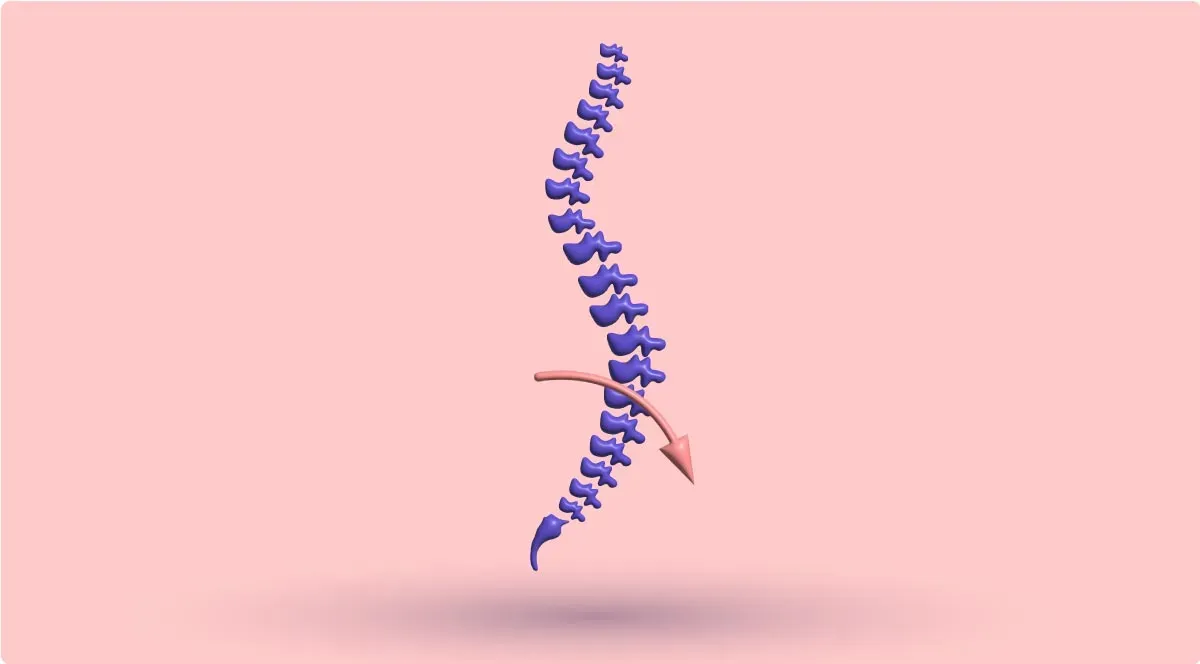
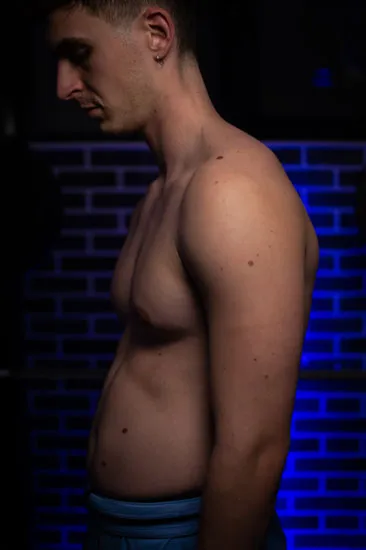
3. Posture. A patient handout from McMaster Children’s Hospital in Canada describes a typical “pectus posture”: shoulders sloping forward, a rounded upper back and a belly pushed forward, which makes the pectus look worse than it is. In a records review of 268 teenagers aged 10 to 18 assessed for chest wall deformities at one centre in Istanbul between 2018 and 2024, about half of those with pectus excavatum (54.1%) had an increased curve in the lower back and about a quarter (27.1%) a forward-tilted pelvis. Teens with pectus carinatum had the lower-back curve more often (72.3%) and a forward-tilted pelvis about as often (24.7%), and there was no group without a chest deformity to compare with. One of its two authors is Prof. Mustafa Yüksel of Pectus Clinic Istanbul.
A forward-tilted pelvis on its own isn’t a pectus problem. Among 120 healthy young adults in the UK (2011), 85% of the men and 75% of the women had one. More on standing and sitting in pectus posture.
4. A lean frame. In several studies, people with pectus weighed less on average than their peers, though many aren’t underweight. My interpretation: on a lean torso the outline of the ribs and belly shows more. The numbers, and how to gain safely, are in pectus excavatum and weight gain.
5. Fat or bloating. Neither has anything to do with pectus, but both look the same from the side. Bloating comes and goes; fat is there all day.
What about the old idea that the sunken breastbone “pushes down” on the upper belly? I couldn’t find a study that measured it, so I’ve left it out. I also couldn’t find a study that compared belly shape in people with pectus against people without it.
Which one is it? A 5-minute self-sort
These checks help you sort, not diagnose. Do them standing side-on to a mirror, then lying down.
| What you notice | Quick check | Points to | What usually helps |
|---|---|---|---|
| The bottom edge of your ribs juts out | Breathe out fully. Do the lower ribs settle flat, or still stick out? | Rib flare: settles = how you hold your ribs; still sticks out = structural | Ribs-down breathing and core work; compression for structural flare in teens |
| Belly flattens a lot when you stand tall | Stand against a wall, then lie on your back with your lower back resting down. Big change? | Posture | Posture work |
| A ridge or dome down the middle when you sit up or strain | The finger test below | Diastasis recti | A physiotherapist |
| Belly is bigger some days, feels full or gassy | Is it worse after meals or by evening? | Bloating | Diet changes; a doctor if it won’t settle |
| Soft and pinchable, the same all day | Is your waist more than half your height? (an NHS flag) | Fat | Body composition, not ab exercises |
If you tick more than one row, that’s normal. Start with the one you can change most easily.
Is it diastasis recti?
Diastasis recti is a widening of the line down the middle of your abs, so the two halves of the six-pack muscle sit further apart than usual.
The only pectus-specific data I found come from one team in São Paulo, Brazil. They examined 10 men aged 17 to 32 with untreated pectus who were having implant surgery between 2017 and 2019 (published 2022). All 10 had a diastasis: 7 in the upper abdomen just below the breastbone and 3 along its whole length, 2 of them with an umbilical hernia. The authors suggest checking the abs before pectus surgery.
Ten men chosen for surgery, with no comparison group, can’t tell you how common this is. Diastasis is common in men anyway: among 1,575 men at one hospital in Wenzhou, China (2024), 29.8% had a gap wider than 2 cm and 10.2% wider than 3 cm. So it’s worth checking, but nobody knows how common it is in pectus overall.
The finger test, from Cleveland Clinic (updated April 2025):
- Lie on your back with your knees bent and feet flat.
- Lift your shoulders slightly, as in a small sit-up, supporting your head with one hand.
- Put the fingers of your other hand just above your belly button and feel for a gap between the muscles.
- Two or more finger widths, or any pain, is a reason to see a doctor or physiotherapist.
My suggestion with pectus: also feel higher up, just below the breastbone, because that’s where the Brazilian team found most of the gaps. A bulge, cone or dome along the middle when you tense your abs is another sign, per Cleveland Clinic. In women the main cause is pregnancy; pectus excavatum in women covers pregnancy and the ribcage.
What helps
Each line says whether it rests on research or on my view.
- Bring the ribs down. A 2010 physical therapy clinical commentary describes the abdominal muscles pulling the lower ribs down and in. That’s clinical reasoning, not a trial result. I couldn’t find a trial of exercise for flared ribs in pectus. The breathing and core routine is in rib flare exercises, and there’s a free non-surgical rib flare plan.
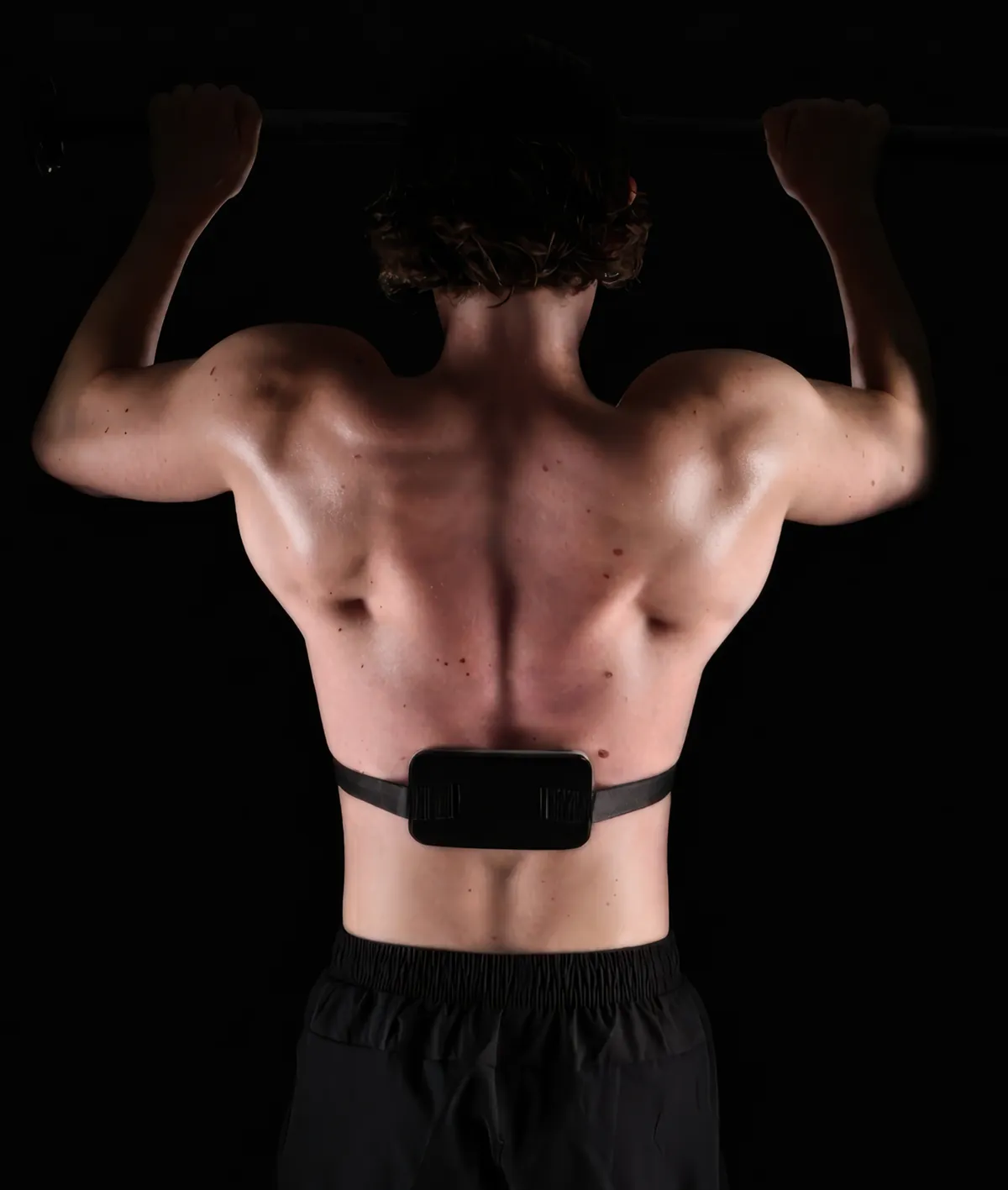
- Compression for structural flare. The Pectus Clinic finds bracing works best in adolescence, while the chest wall is still flexible, and says that in adults the bony structure is fixed, though the look can change with posture and body composition. I couldn’t find any brace with published results for the belly. Types and prices are compared in my rib flare braces guide. A disclosure: I make and sell a rib flare brace, and it has no published outcome data either.
- Work on posture. In a 2026 controlled trial of 35 teenagers in Ankara, Turkey, all using a vacuum bell, adding Schroth-based exercise, a posture-focused method, improved head, upper-back and lower-back angles more than the bell alone. It didn’t change how severe the dip was. My view: posture changes the look, not the bone.
- See a physiotherapist for diastasis. Cleveland Clinic recommends deep-core work with breathing. The evidence is thin: a 2021 review of 7 trials in 381 women after childbirth rated it very low quality, and nobody has tested it in men with pectus.
- Change body composition, if fat is the issue. Overall weight and diet move belly fat; ab exercises alone didn’t in the trial below. My interpretation: if you’re lean and gaining weight, expect a little of it at the waist too.
What doesn’t help
- Crunches to burn belly fat. In a US trial of 24 inactive adults (2011), six weeks of ab exercises, five days a week, made no difference to belly fat or waist size. Endurance improved.
- Crunches, sit-ups and unmodified planks if you have a diastasis. Cleveland Clinic lists these, and any move that makes the belly dome, as ones that can make a diastasis worse.
- A waist binder or belt as the fix. Cleveland Clinic says a binder can’t heal a diastasis or strengthen the core, though a belly band can give some support.
- Expecting a hip-flexor stretch to fix the belly. Among 23 healthy men in the UK (2021), one session of hip-flexor stretching reduced pelvic tilt by 1.2 degrees and didn’t change the lower-back curve.
- Expecting surgery for the dip to flatten the belly. Among 1,571 patients after the Nuss procedure in Korea (2012), flared ribs improved in children aged 11 and under, but not in those aged 12 and over. The Nuss procedure moves the breastbone. I couldn’t find a study showing that a vacuum bell or surgery changes how the belly looks.
The old version of this page said you shouldn’t stretch tight hamstrings and that stretching makes a pot belly worse. I couldn’t find a source for either, so both are gone.
Teens and adults
Teens. Cincinnati Children’s notes that pectus often gets worse during growth spurts and usually stops changing once the skeleton stops growing. That growing window is also when the Pectus Clinic finds bracing works best. In younger children, Cincinnati Children’s puts the potbelly look down to the lower ribs sticking out. Any child with pectus is worth a check by a doctor.
Adults. The ribs and breastbone are set, but how the belly looks can still change with posture and body composition, per the Pectus Clinic. My view: expect slower and smaller changes than in a teen.
When to see a doctor
See a doctor before you start any device, brace or exercise program if any of these apply to you:
- chest pain
- fainting or nearly fainting
- breathlessness at rest or with light effort
- palpitations or an irregular heartbeat
- a diagnosed heart or lung condition
- Marfan syndrome or Ehlers-Danlos syndrome, or a doctor has raised either
- previous chest surgery
- a Haller index above 3.25 together with symptoms
- symptoms that nobody has checked yet
None of these means you’ll need surgery. They mean someone should look at your heart and lungs before you go further. An index above 3.25 is a common referral threshold, not an emergency.
Belly signs that need a doctor too:
- a lump that gets bigger when you cough or sneeze and smaller when you lie down, which can be a hernia. The NHS says to get urgent help if it hurts, or comes with a bloated tummy, feeling sick or vomiting, constipation, a fever or sudden confusion
- bloating that keeps coming back, doesn’t settle after diet changes, or comes with weight loss you can’t explain or blood in your poo (NHS)
- pain, clicking or catching at the edge of the lower ribs
- a gap of two or more finger widths in the finger test, or any pain there
Call 911 (999 in the UK) or your local emergency number now if you have any of these. Don’t drive yourself.
- palpitations that won’t stop
- palpitations with chest pain, shortness of breath, feeling faint or fainting
- sudden chest pain or pressure that doesn’t go away
- chest pain that spreads to your arm, neck, jaw or back
- chest pain with sweating, feeling sick, light-headedness or breathlessness
The NHS also says to call 999 if bloating and a swollen tummy come with sudden, severe belly pain or vomiting blood.
Where to start
- No red flags, lower ribs stick out: do the exhale check, then start the rib flare routine. Treatment options are gathered on the rib flare page.
- Belly flattens when you stand tall: posture first.
- Ridge, dome or a wide gap in the finger test: a physiotherapist before any ab work.
- Soft and the same all day: body composition, not crunches.
- Not sure which applies, or you have a dip and flare together: the free 1-minute quiz points you to the right plan.
Sources
- Pectus Excavatum. Cincinnati Children’s. [cited 2026 Oct 30]. Read it
- Rib Flare. The Pectus Clinic. [cited 2026 Oct 19]. Read it
- Pectus excavatum: exercise instructions. Hamilton Health Sciences, McMaster Children’s Hospital. [cited 2026 Oct 19]. Read it
- Kahraman Esen H, Yüksel M. Med Sci Monit. 2026;32:e952511. Read it
- Herrington L. Man Ther. 2011;16(6):646-8. Read it
- Anger J, de Campos JRM. Plast Reconstr Surg Glob Open. 2022;10(1):e4028. Read it
- Zhu C, et al. Hernia. 2024;29(1):31. Read it
- Diastasis Recti. Cleveland Clinic. [cited 2026 Oct 30]. Read it
- Obesity. NHS. [cited 2026 Oct 20]. Read it
- Boyle KL, et al. N Am J Sports Phys Ther. 2010;5(3):179-88. Read it
- Kandemir B, et al. Prosthet Orthot Int. 2026. Read it
- Gluppe S, et al. Braz J Phys Ther. 2021;25(6):664-75. Read it
- Vispute SS, et al. J Strength Cond Res. 2011;25(9):2559-64. Read it
- Preece SJ, et al. J Manipulative Physiol Ther. 2021;44(4):289-94. Read it
- Park HJ, et al. Eur J Cardiothorac Surg. 2012;42(4):667-72. Read it
- Hernia. NHS. [cited 2026 Oct 30]. Read it
- Bloating. NHS. [cited 2026 Oct 20]. Read it
A slim frame makes a sunken chest look deeper. This is how to eat enough to fill the frame when your appetite works against you.
- A 12-week gain plan with real numbers
- The Blender Protocol for low appetite
- Macros set for your body, not a calculator
This article is for educational purposes only and does not constitute medical advice. Always consult a qualified healthcare professional before starting any treatment plan. View full disclaimer →