Contents · 10 sections
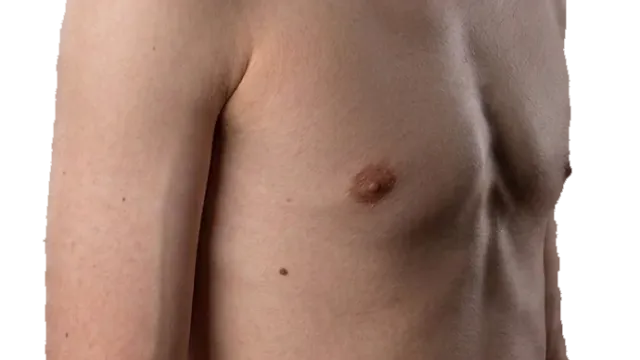
The textbook picture of pigeon chest is one even ridge down the middle. Yours might not look like that. Maybe one side sits higher than the other, maybe the bump is high up under your collarbones, or maybe there’s a bump on one side and a dip on the other.
There’s no single official list of pectus carinatum types. Any carinatum chest can be described with two questions: where on the breastbone the peak sits, and how balanced the chest is from side to side. The lower type is by far the most common, and lopsided chests are common too.
I had pectus excavatum, the sunken kind, not carinatum, and I’m not a doctor. So the medical points below come from named studies and hospital pages. If you want to see real chests, carinatum included, my results page has real before-and-after photos.
The two questions behind every type
Pectus carinatum has been sorted in several ways, and none has won. A 2024 review of 147 articles concluded that every classification has its limits and that one based on objective shape measurements is still awaited.
The clearest way through is to treat it as two questions, the way a 2019 review from Buenos Aires lays them out.
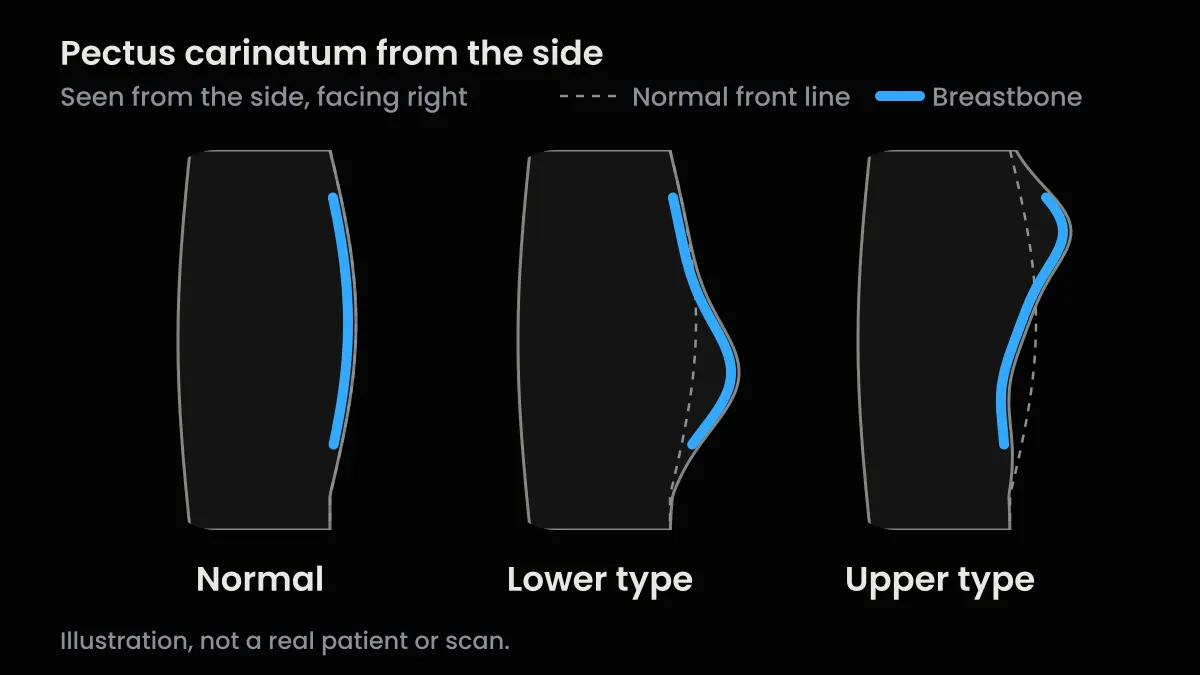
Where is the peak? Your breastbone (sternum) has a short top section, the manubrium, and a longer body below it, joined at a ridge called the sternal angle. The ribs attach to it through costal cartilage, the flexible cartilage at the front end of each rib. If the sharpest forward angle is on the body of the breastbone, it’s the lower type (chondrogladiolar). If it’s at the manubrium, it’s the upper type (chondromanubrial).
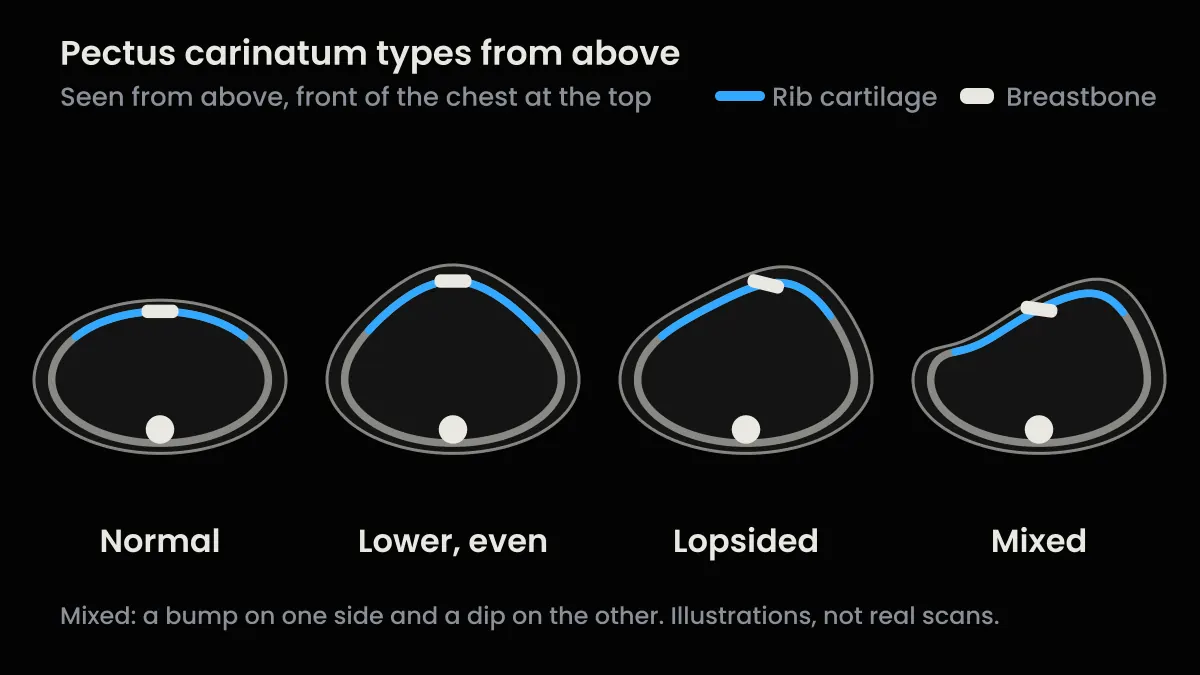
How balanced is it? The same review lists three options: symmetric, asymmetric with the breastbone turned to the left or right (sternal rotation), and mixed, with carinatum on one side and excavatum on the other.
So each chest gets two answers, such as “lower and even” or “lower and lopsided”.
Other schemes fold the two questions into one list. Cleveland Clinic uses Type I (lower, both sides), Type II (upper, both sides) and Type III (one side, sometimes with a dip on the other). A Brazilian orthopaedic group sorts by where the highest point is: inferior, lateral (one-sided) and superior.
Types at a glance
| Shape | Where the peak is | From the side | How common | What it changes |
|---|---|---|---|---|
| Lower, even (chondrogladiolar, symmetric) | Middle or lower breastbone, centred | A keel: the breastbone angles forward in its lower half | The lower type, even or lopsided, is 92.3% to 95% of children with carinatum (review) | Best brace results in one large Brazilian series |
| Lower, lopsided (asymmetric) | One side of the lower chest, breastbone turned | A keel, higher on one side | About a third to most patients, depending on the clinic | Braces can work; lopsided chests quit more often in one cohort |
| Mixed (carinatum and excavatum) | Bump on one side, dip on the other | Depends which side you look from | 2.7% to 9% in referral and surgical series | Both sides assessed, sometimes with a scan and heart ultrasound |
| Upper (chondromanubrial) | Just below the collarbones | A high bow at the top, lower breastbone set back | About 1 in 20 carinatum chests or fewer | Good brace results less often |
| Pectus arcuatum (look-alike) | High, stiff bump at the top of the breastbone | Arched, sometimes S-shaped | 17 of 1,510 children evaluated at one Chicago hospital (1.1%) | Side X-ray or CT confirms it; bracing failed in 3 of 3 in one series |
Lower carinatum (chondrogladiolar)
Lower carinatum (chondrogladiolar) is the classic pigeon or keel chest, with the peak over the middle or lower breastbone. A 2007 Brazilian review by Coelho and Guimarães describes the middle and lower breastbone standing out, almost always with dips beside it at the lower ribs.
It’s the common one. A review from St. Louis Children’s Hospital puts it at 92.3% to 95% of children with carinatum, so about 9 in 10 or more.
The 2024 review calls the lower type “usually symmetric”. The series in the next section counted plenty of lopsided chests, so I’d read “usually” loosely.
Carinatum is usually noticed around 10 to 15 and gets more obvious through the growth spurt. In Boston’s surgical series, almost half weren’t identified until after the 11th birthday, and in a UK clinic girls’ bumps showed up earlier than boys’, at 10 against 14.
Lopsided carinatum (asymmetric)
Lopsided carinatum (asymmetric, or lateral) is a pigeon chest where one side stands higher than the other, and the breastbone is often turned. In one-sided cases, Coelho notes, a CT scan (a detailed 3D X-ray) shows the breastbone sitting at an angle to the body instead of facing straight ahead. The other side can sit flatter: in the UCLA series below, 36% of all 260 patients had some dip on one or both sides of the lower chest.
How common it is
| Who was counted | Lopsided |
|---|---|
| 152 patients operated on at Boston Children’s Hospital, 1973 to 1985 | 49 (32%), against 89 even and 14 mixed |
| 260 patients with symptoms, operated on by one surgeon at UCLA, from 1970 | 126 (48%) |
| 430 children seen by one surgeon in Southampton, UK, 1998 to 2022 | Most were lopsided bump-only chests, but the abstract’s own numbers don’t add up, so I can’t give an exact share |
Two are surgical series and the third a specialist clinic. None counted everyone with carinatum, and I couldn’t find a population-wide figure.
My interpretation: the spread says more about who each clinic counted than about your odds. Either way, lopsided carinatum is common. If yours is uneven, you’re not an outlier.
Which side, and why
In the Southampton group, bump-only chests were more often higher on the right. Chests with a bump and a dip went the other way and were more often left-dominant: 10 of 15, against 2 of 15 right-dominant.
Why one side grows higher, nobody’s sure. In a 3D CT study of 22 Korean patients with lopsided carinatum, cartilage and rib lengths didn’t differ between the higher side and the other, and the authors concluded that cartilage overgrowth can’t explain the lopsidedness.
The spine can be involved too. In a 2024 study at an Istanbul clinic, 23 of 117 people with carinatum had a spinal deformity, such as scoliosis, a sideways curve of the spine. Prof. Mustafa Yüksel, who reviews medical content on this site, co-authored the study. That’s an association seen in one clinic. It doesn’t show that the spine tips the chest, or the other way round. Still, if your chest is lopsided, have your back checked too.
Mixed carinatum and excavatum
Mixed pectus is a bump on one side of the chest and a dip on the other: carinatum on one side, excavatum on the other. It’s uncommon, and how uncommon depends on where it was counted:
- 14 of 152 operated patients (9%) at Boston Children’s
- 41 of 1,510 children evaluated for a chest wall deformity at Lurie Children’s in Chicago (2.7%), 2017 to 2021
- 6.4% of 268 patients aged 10 to 18 at an Istanbul clinic, 2018 to 2024, in a study co-authored by Prof. Yüksel
Tests matter most here. The St. Louis review says most children with carinatum need only front and side chest X-rays, but a CT or MRI scan and an echocardiogram (a heart ultrasound) are particularly important for mixed chests. The dip side is excavatum, which my pectus excavatum guide covers.
One naming trap: a high bump with a sunken lower breastbone is sometimes called “mixed” too. That’s the upper type, next.
Upper carinatum and pectus arcuatum
Upper carinatum (chondromanubrial) puts the peak high, just below the collarbones, while the lower breastbone sits back. From the side, Coelho describes the breastbone as arched, sometimes S-shaped. Older names include “pouter pigeon” breast and Currarino-Silverman syndrome.
It’s rare: about 1 in 20 carinatum chests or fewer in the series I found. Because the lower breastbone looks sunken next to the high bump, it can be mistaken for excavatum.
Pectus arcuatum overlaps with the upper type so much that the names get used for each other. The segments of the breastbone fuse early, leaving a high, stiff bump. A French study of 34 patients describes it as often mistaken for a type of carinatum, and confirmed the early fusion with a side chest X-ray or CT.
Whether it counts as carinatum at all is still argued. The 2024 review says it was once a carinatum subtype and is now seen as a separate condition. A 2025 systematic review of 455 cases across 65 studies calls it distinct from both carinatum and excavatum, and often confused with either or with a mixed chest. But a 2026 Istanbul series of 27 patients still calls it a very rare variant of carinatum. Either way, it’s often treated as its own condition.
A 2000 review by Fokin adds that about a third of people with pouter pigeon breast also have a dip in the lower third of the breastbone, and that heart defects are associated with it, so he advises an echocardiogram for everyone with it.
Not every high bump is carinatum. Normal landmarks and joints at the top of the breastbone can stick out too, and my sternum sticking out guide maps them by where the bump sits.
Which type looks like mine?
Shirt off, in good light, look in a mirror from the front and then side-on. Four questions:
- Where’s the highest point? On the middle or lower breastbone points to the lower type. Just under the collarbones points to the upper type.
- Is one side higher? That’s lopsided.
- Is there a dip anywhere? Dips at the lower ribs on both sides are common with the lower type. A dip on one side with a bump on the other is mixed. A lower breastbone that sits back below a high bump fits the upper type.
- Is the bump high under the collarbones and hard? That could be pectus arcuatum.
This narrows it down. It doesn’t settle it. A doctor confirms the type, and arcuatum needs a side X-ray or CT. Whether your bump gives under gentle pressure is a separate question, and the press test in my complete guide to pectus carinatum covers it, along with causes, symptoms and every treatment.
Not carinatum: look-alikes
- Rib flare. The bottom edge of the ribcage sticks out, not the breastbone or the cartilage beside it. That’s flared ribs, a different shape, though it can come with carinatum.
- Uneven muscle or breast tissue. One side can look bigger because of the chest muscle or, in girls and women, the breast. My uneven chest guide helps you tell muscle from ribcage and explains Poland syndrome, which turned up in 4 of Boston’s 152 carinatum patients. My pectus carinatum in women guide covers how breasts change the look.
- A single cartilage bump. Coelho lists isolated rib-cartilage bumps, on one side or both, as a separate form.
Does your type change what works?
It can. The largest comparison by type I found comes from one Brazilian clinic (Haje and Haje, 2009) that treated children and teens with a brace plus exercises, then re-checked the patients who came back:
- Lower type: a good result in 604 of 781, about three in four
- Lateral (one-sided): 281 of 454, about six in ten
- Upper: 20 of 69, under a third
Only patients who came back were counted, so the gaps show a direction. They can’t tell you your own odds.
Is lopsided harder to brace? The evidence pulls both ways. In Amsterdam, among 740 braced children, those with lopsided chests were more likely to give up on the brace. That’s quitting, not the brace failing. In Scotland’s national chest wall service, among 612 under-20s with the lower type whose wear time was recorded by data loggers, being lopsided wasn’t linked to the outcome. Wear time was the strongest predictor.
My interpretation: a lopsided chest isn’t a reason to skip bracing, but it may be a reason to plan for the long haul. The details are in pectus carinatum brace therapy.
The high, stiff shapes are different. In the French arcuatum series, bracing was tried in 3 patients and worked in none. The St. Louis review says bar-based minimally invasive surgery isn’t useful for the upper type either.
Lopsided and mixed chests raise their own surgical questions. In a surgical series of 58 patients repaired with bars inside and outside the chest, 14 had lopsided and 37 mixed chests, and the authors note that simple outside pressure has its limits for those shapes. My guide to finding a chest wall surgeon can help.
My view: get a high, hard bump seen by a specialist before buying any brace.
When to get your type checked
Some shapes deserve a specialist look whatever else you do:
- A high, stiff bump under the collarbones. A side X-ray or CT shows whether it’s arcuatum, which also calls for a heart check.
- A bump beside a dip. Both sides need assessing, sometimes with a CT or MRI and a heart ultrasound.
- A curved back or uneven shoulders. Have your spine checked as well.
See a doctor before you start a brace or an exercise plan if you have:
- chest pain that is new or getting worse
- real breathlessness, not just being unfit
- palpitations
- a bump that is changing fast
- a diagnosed heart or lung condition
- Marfan syndrome or Ehlers-Danlos syndrome, or a doctor has raised either
- previous chest wall surgery
- symptoms nobody has checked yet
What to do next
Pick the line that sounds like you.
- You want to see real chests. Besides my results page, linked at the top, there are clinical photos and drawings in figure 2 of the 2024 review, figure 2 of the 2019 Buenos Aires review (drawings of the lower and upper types), and a 2021 case series on Currarino-Silverman.
- You want your options side by side. The pectus carinatum page lays them out.
- You want to know where you stand. Take my free 1-minute quiz.
Whatever your type, changing the shape of a chest without surgery is measured in months and years, not weeks.
Sources
- Janssen N, et al. J Thorac Dis. 2024;16(2):1687-1701. Read it
- Martinez-Ferro M, et al. Afr J Thorac Crit Care Med. 2019;25(3). Read it
- Pectus Carinatum. Cleveland Clinic. [cited 2026 Oct 21]. Read it
- Coelho MdeS, Guimarães PdeS. J Bras Pneumol. 2007;33(4):463-74. Read it
- Desmarais TJ, Keller MS. Curr Opin Pediatr. 2013;25(3):375-81. Read it
- Shamberger RC, Welch KJ. J Pediatr Surg. 1987;22(1):48-53. Read it
- Fonkalsrud EW. J Pediatr Surg. 2008;43(7):1235-43. Read it
- Bough GM, et al. Pediatr Surg Int. 2025;42(1):56. Read it
- Park CH, et al. Interact Cardiovasc Thorac Surg. 2013;17(5):757-63. Read it
- Şirazi S, Heydar AM, Bezer M, Yüksel M. Spine Deform. 2024;12(6):1615-22. Read it Co-authored by Prof. Mustafa Yüksel.
- Pitt JB, et al. J Surg Res. 2024;293:451-7. Read it
- Kahraman Esen H, Yüksel M. Med Sci Monit. 2026;32:e952511. Read it Co-authored by Prof. Mustafa Yüksel.
- Abdellaoui S, et al. J Pediatr Surg. 2023;58(9):1679-85. Read it
- Zeineddine RM, et al. JAMA Surg. 2025. Read it
- Lacin T, et al. Thorac Cardiovasc Surg. 2026;74(5):420-9. Read it
- Fokin AA. Chest Surg Clin N Am. 2000;10(2):377-91. Read it
- Haje SA, Haje DP. Rev Bras Ortop. 2009;44(3):191-8. Read it
- de Beer S, et al. J Pediatr Surg. 2023;58(8):1440-5. Read it
- Dargie D, Johnstone A, Davis C. J Pediatr Surg. 2026;61(9):163252. Read it
- Park HJ, Kim KS. Ann Cardiothorac Surg. 2016;5(5):434-9. Read it
- Gritsiuta AI, et al. J Thorac Dis. 2021;13(5):2968-78. Read it
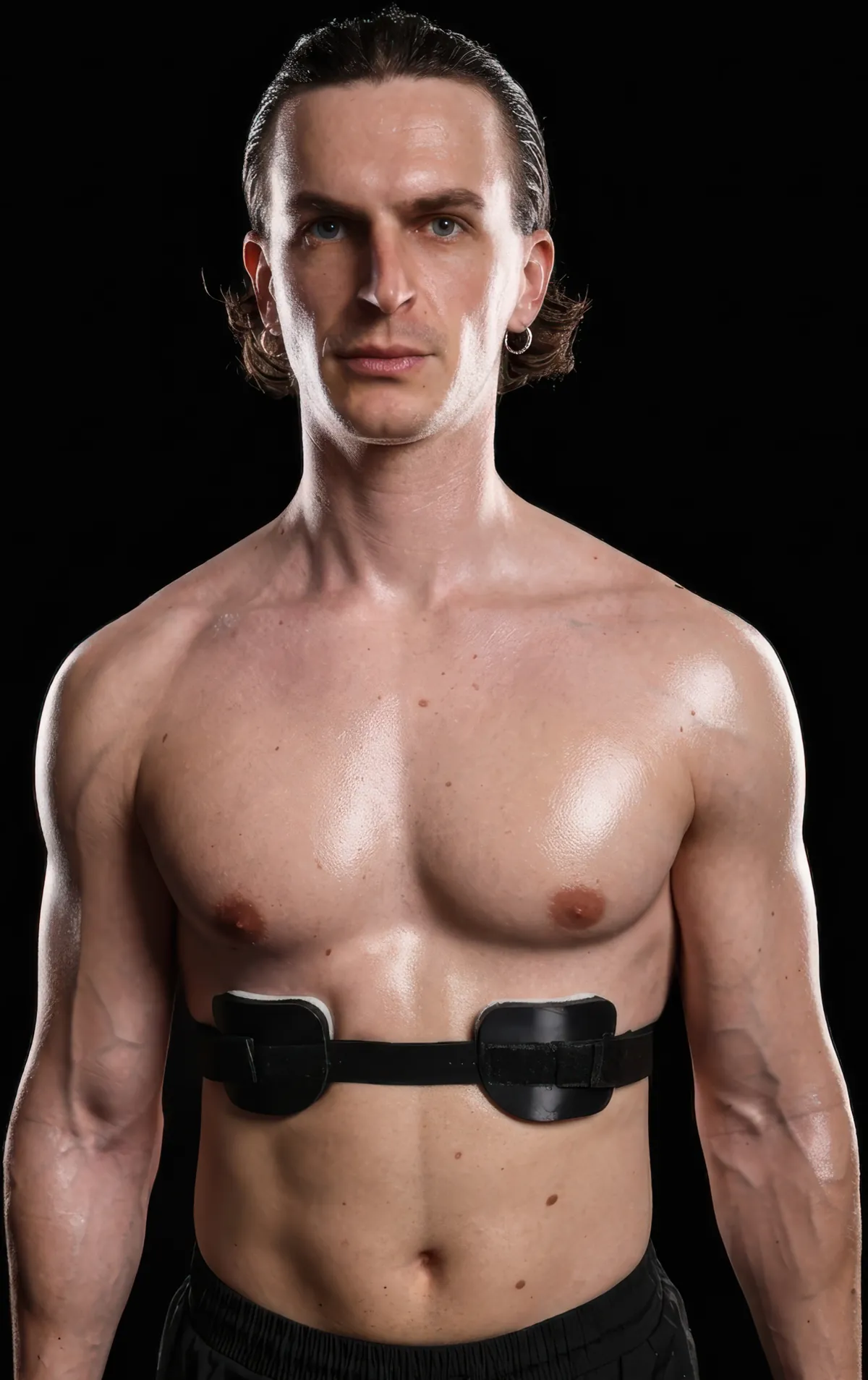
Compression alone is a device. The course is the fitting, the pressure calibration and the wear schedule that turn it into correction.
- Fitting and pressure calibration
- The wear schedule people actually hold
- The exercise pairing that keeps the result

This article is for educational purposes only and does not constitute medical advice. Always consult a qualified healthcare professional before starting any treatment plan. View full disclaimer →