Contents · 16 sections
Maybe it was a word on a referral letter: pectus, Poland, arcuatum. Maybe it was a code like Q67.6 on an insurance form. Or maybe your chest just looks different and you want a name for it.
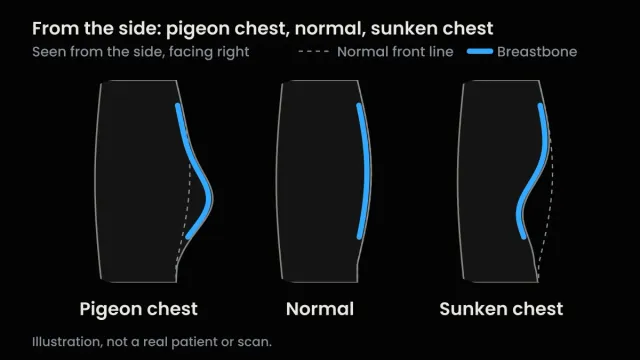
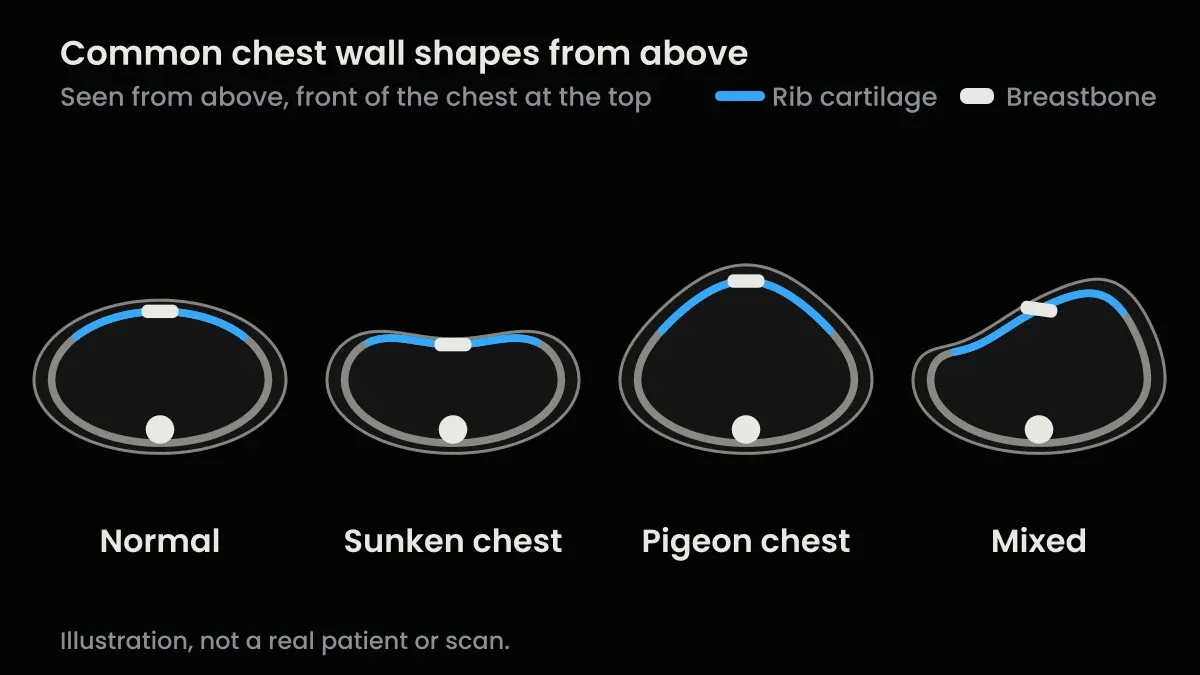
A chest wall deformity is a difference in the shape of the breastbone, the rib cartilage, the ribs or the chest muscles. There’s no single official list of types. Two pectus shapes, the sunken chest and the pigeon chest, cover most people. The rest are rare, and a doctor confirms which one you have.
Find yours in the table below. Chest pain, trouble breathing or a baby with a gap in the breastbone? Skip to when to see a doctor.
I had pectus excavatum and corrected it without surgery over about three years, but I’m not a doctor, so the medical points here come from studies, hospital pages and the official code lists.
Which chest wall deformity do I have?
This table narrows it down by what you see. It can’t tell you what you have; a doctor’s exam does that.
| What you see | Where | Likely name | How it’s confirmed | Read next |
|---|---|---|---|---|
| A dip or hollow | Middle or lower breastbone | Pectus excavatum (sunken chest) | Doctor’s exam, a scan if needed | Pectus excavatum |
| A ridge or bump pushing forward | Middle or lower breastbone | Pectus carinatum (pigeon chest) | Doctor’s exam | Pectus carinatum |
| A bump higher on one side | Beside the breastbone | One-sided pectus carinatum | Doctor’s exam | Pectus carinatum |
| A high, stiff bump, often with a dip below | Upper breastbone, just below the neck | Pectus arcuatum, or upper-type carinatum | Side chest X-ray or CT | Pectus arcuatum |
| A dip and a bump together | Both | Mixed chest | Specialist exam | Mixed chests |
| The bottom of the ribcage juts out | Lower rib edge | Rib flare | Resting check, then a doctor | Rib flare |
| One side flat, chest muscle partly missing, maybe a hand difference | One side | Poland syndrome | Exam, sometimes X-ray, CT or MRI | Poland syndrome |
| A gap in a baby’s breastbone, maybe a visible heartbeat | Middle of the chest | Sternal cleft | Usually at birth | Sternal cleft |
| A narrow chest with short or fused ribs in a baby | Whole ribcage | Jeune or Jarcho-Levin syndrome | Specialist team in infancy | Rare types |
| A broad, rounded chest that looks stuck mid-breath | Whole chest | Barrel chest, usually a lung sign | Doctor checks the lungs | Look-alikes |
If yours doesn’t fit a row
A single lump, a collarbone end, a point at the breastbone’s tip or a bump after heart surgery: see my sternum sticking out guide. One pec smaller but an even ribcage: my uneven chest muscles guide. Not sure anything is different: pectus excavatum vs a normal chest.
What chest wall deformities are
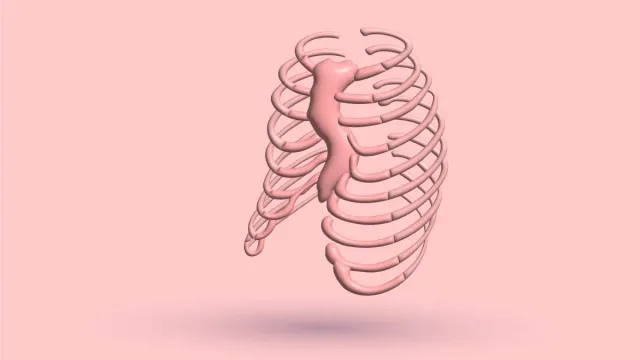
Four structures can be involved: the breastbone (sternum), whose top piece below your neck is the manubrium; the costal cartilage, the bendy strips joining your ribs to it; the ribs; and the chest muscles. Most differences are congenital (present from birth), even if nobody notices until the teen growth spurt. A few are acquired later, for example after early heart surgery or rickets.
There’s no agreed way to classify them. StatPearls, a clinical reference, says so and reviews seven: pectus excavatum, pectus carinatum, Poland syndrome, sternal clefts, ectopia cordis, Jeune syndrome and Jarcho-Levin syndrome. They can appear alone or as part of a genetic syndrome.
I group them by what’s involved, because that decides what can change. Boston Children’s Hospital explains sunken and pigeon chests as rib cartilage growing unevenly. That doesn’t explain Poland syndrome, mainly a muscle difference, or a sternal cleft, where the breastbone’s two halves never joined. It’s why a brace can matter for one type and not another.
How common each type is
True rates aren’t well established, since there’s no large population study, as a 2024 review of 147 articles notes. The best figures I found:
- All pectus shapes together: about 1 in 250 people, according to the 2024 Pectus Care Guidelines, a consensus of UK-led specialist societies.
- Pectus excavatum: about 1 to 8 per 1,000 people, more often boys (Cleveland Clinic). It’s 65 to 95% of chest wall deformities, depending on the population (2024 review).
- Pectus carinatum: about 1 in 1,000 people, possibly as many as 1 in 300 (Cleveland Clinic).
- Poland syndrome: roughly 1 in 20,000 to 30,000 births (below).
Rarer types show up in clinic mixes: who was sent to one clinic, not rates in everyone.
| Chicago children’s hospital | Istanbul clinic | |
|---|---|---|
| Who | 1,510 children, 2017 to 2021 | 268 adolescents aged 10 to 18, 2018 to 2024 |
| Pectus excavatum | 50.0% | 61.8% |
| Pectus carinatum | 43.3% | 31.8% |
| Mixed | 2.7% | 6.4% |
| Currarino-Silverman (arcuatum) | 1.1% | Not listed |
| Poland syndrome | 0.7% | Not listed |
Prof. Mustafa Yüksel, who reviews medical content on this site, co-authored the Istanbul study.
What “pectus” means
Pectus is Latin for chest. The second word describes the shape.
| Medical name | Latin meaning | Everyday names |
|---|---|---|
| Pectus excavatum | hollowed-out chest | sunken chest, funnel chest, concave chest |
| Pectus carinatum | keel-shaped chest, from carina, a ship’s keel | pigeon chest, keel chest |
| Pectus arcuatum | curved or arched chest | Currarino-Silverman; one London clinic says “pouter pigeon chest” |
So the medical term for a sunken chest is pectus excavatum, and for a pigeon chest pectus carinatum. “Pectus deformity” covers any of them.
Pectus excavatum
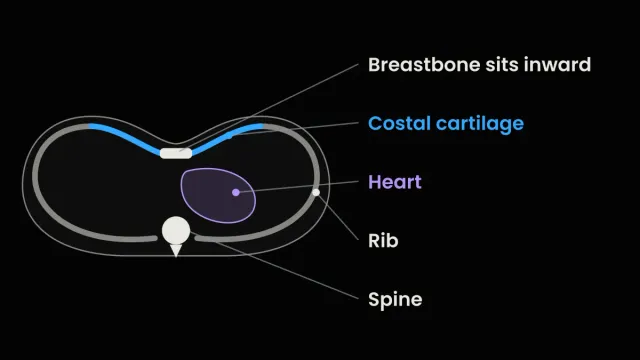
Pectus excavatum, the sunken or funnel chest, is a breastbone sitting back toward the spine, leaving a dip in the middle or lower chest. It’s present from birth but often shows or deepens in the teen growth spurt. Most cases are mild and well tolerated, the Pectus Care Guidelines say, and a small number of people have physical limits. Causes, severity and options are in my pectus excavatum guide.
Pectus carinatum
Pectus carinatum, the pigeon or keel chest, is a breastbone that pushes forward, often with the cartilage beside it. Cleveland Clinic describes a common lower type and a rarer upper type; the 2024 review puts the lower type at up to 95%. A third pattern affects one side, sometimes with a dip on the other: see pectus carinatum asymmetry.
A 2024 review says carinatum has a potential psychological impact but no demonstrated physical one, and that a brace works in a chest that’s still flexible. Types and options are in my pectus carinatum guide.
Pectus arcuatum
Pectus arcuatum, also called Currarino-Silverman syndrome, is a short breastbone whose segments fused too early. That gives a high, stiff bump on the upper chest, often with a dip below it. It was 1.1% of the Chicago clinic’s children. The other name comes from Currarino and Silverman, who described it in the journal Radiology in 1958.
Older papers counted it as a type of carinatum; the 2024 review says it’s now seen as its own condition. Yet a 2025 review of 455 cases found it’s often confused with carinatum and excavatum, with naming and criteria varying between studies. StatPearls uses Currarino-Silverman for upper-type carinatum, and one London clinic calls a mixed shape the “horseshoe (Currarino-Silverman)” deformity. So if two doctors use different words for your chest, that’s why. A side chest X-ray or CT showing the early-fused breastbone is what separates arcuatum.
In one French series of 34 patients, bracing was tried in three and helped none. Three is too few to say bracing never works, and I couldn’t find another study of non-surgical treatment for arcuatum. In that French series, 35% had another condition, most often Noonan syndrome, and the team operated at the end of growth. Across the 455 cases in the 2025 review, surgical results were good and similar to other pectus repairs.
My rule: for a high, rigid bump, see a chest wall specialist before you buy any brace.
Mixed chest wall deformities
A mixed chest has a dip and a bump together: 2.7% of the Chicago children, 6.4% of the Istanbul adolescents. In a 548-patient study from Istanbul, co-authored by Prof. Yüksel, every patient with a mixed chest had a spinal deformity, so it’s worth asking for your back to be checked too.
CHKD, a US children’s hospital, lists the vacuum bell, bracing or surgery, decided case by case. The operations are in my pectus excavatum surgery guide.
Flared ribs, bumps and look-alikes
Rib flare is the lower edge of the ribcage angling forward and outward. It often comes with pectus excavatum. A lean but normal rib edge can look similar; the resting check in my flared ribs guide sorts the two.
A barrel chest is broad and rounded, as if you breathed in and never out. Cleveland Clinic calls it usually a sign of a lung condition, such as asthma, COPD or emphysema, not a birth shape. It isn’t dangerous itself, but the cause needs a doctor.
Some shapes come later: a breastbone can stick out after early heart surgery, and rickets can leave a sunken or pigeon chest. These have their own codes (see the table).
Poland syndrome
Poland syndrome is a rare condition, present from birth, in which part of the main chest muscle on one side is underdeveloped or missing, so that side can look flat or hollow. Cleveland Clinic lists Poland sequence and Poland anomaly as other names.
It affects roughly 1 in 20,000 to 30,000 births: MedlinePlus Genetics estimates 1 in 20,000 newborns, and an Italian team that treated 245 patients about 1 in 30,000. MedlinePlus says it’s more than twice as common in males and may be underdiagnosed.
The cause is unknown; the leading idea is disrupted blood flow to the developing chest and arm around the sixth week of pregnancy. Cleveland Clinic lists smoking during pregnancy as a risk factor, along with other exposures and being male, but a risk factor isn’t proof of what caused any one child’s condition. Genetic cases are rare.
Poland syndrome: ribs and hands
Usually the missing part is the section of the pectoralis major (the big chest muscle) running from the upper arm to the breastbone, MedlinePlus says. The same side can also have:
- a smaller or missing breast or nipple
- less fat under the skin, so the ribs show more
- shorter or underdeveloped ribs or rib cartilage
- less armpit hair
- a hand difference: short fingers (brachydactyly), joined fingers (syndactyly) or short, webbed fingers (symbrachydactyly), sometimes with a shorter forearm
It’s almost always one side, the right about twice as often as the left (Cleveland Clinic). StatPearls, my only source here, says the affected ribs are usually the second to fourth or third to fifth, sometimes with a pectus dip. Rarely a lung or kidney is underdeveloped, or a left-sided case has the heart on the right (dextrocardia). MedlinePlus says the chest differences usually don’t cause health problems or affect movement.
Mild Poland syndrome
You may see “minor Poland syndrome”, but I couldn’t find it defined as a formal type. The sources do describe mild cases: part of the muscle missing, no hand difference. These may not show until puberty (MedlinePlus), especially in girls as the breasts develop (Cleveland Clinic). StatPearls calls soft-tissue-only cases “simple”. A doctor can tell muscle from ribcage with an exam, sometimes adding an X-ray, CT or MRI.
Poland syndrome in men and women
In males it usually shows as a flat or hollow side of the chest. StatPearls, again a single source, puts it on the right in 60 to 75% of men, with no side tendency in women. In women it can also mean a smaller or missing breast, and doctors must tell it apart from ordinary breast asymmetry. Boys may have chest surgery as early as 13; girls usually wait until breast development is complete (Cleveland Clinic). Breast and chest shape in women is also covered in pectus carinatum in women.
Poland syndrome treatment
Many people need no treatment, and life expectancy is normal, Cleveland Clinic says. When it’s wanted, it’s mostly reconstructive surgery (reshaping the chest wall, moving muscle or fat, or an implant), with breast reconstruction for women and hand surgery in early childhood if needed. Therapy and counselling are also options.
Training can’t build a muscle that isn’t there, and I couldn’t find a study on training in Poland syndrome. My view: train to get stronger overall, not to fill the gap. If the muscle is there but smaller, see the uneven chest muscles guide under the first table.
Rare types found in babies
These are usually found before birth or in the first months, and the baby’s medical team is the right source. For a dip in a young child’s chest, see my guide for parents.
Ectopia cordis, the heart partly or fully outside the chest through a gap in the breastbone, is extremely rare (about 5.5 to 7.9 per million live births, per StatPearls). Jeune syndrome (asphyxiating thoracic dystrophy) is an inherited bone-growth condition with a narrow, bell-shaped chest, short ribs and short limbs, in about 1 in 100,000 to 130,000 people. It can cause serious breathing problems in infancy, which can improve with age. Jarcho-Levin syndrome, or spondylocostal dysostosis, means fused or malformed vertebrae, fused or missing ribs, a short trunk and often scoliosis; its exact prevalence is unknown. Specialist teams manage all three from the start.
Sternal cleft
A sternal cleft is a complete or partial gap in the breastbone because its two halves didn’t join before birth. A review of 93 patients, from published series plus the authors’ own, found 62% were girls and a partial gap at the top was the most common form (67%). Most (74%) had no symptoms; 72% had other differences, including PHACES syndrome. The authors prefer closing the gap in the newborn period, and CHKD says early surgery is best.
Associated conditions
A 2014 genetics review names Marfan and Noonan syndromes as the most frequent single-gene syndromes with pectus excavatum or carinatum. If a doctor finds no other features, the pectus counts as isolated and further genetic tests don’t seem needed.
- Marfan syndrome, a connective tissue condition in about 1 in 5,000 people, where a sunken or protruding chest is a common feature (MedlinePlus).
- Noonan syndrome, in about 1 in 1,000 to 2,500 people, who often have a sunken or protruding chest (MedlinePlus).
- Ehlers-Danlos syndromes, connective tissue conditions in at least 1 in 5,000 people (MedlinePlus). I couldn’t find how often they come with a chest wall deformity.
- Scoliosis, a sideways curve of the spine. In the 548-patient Istanbul study, 13% of those with excavatum and 19% with carinatum had a spinal deformity, as did every patient with a mixed chest, a syndrome or a rib anomaly. More in scoliosis and pectus.
Family history and genetics are in what causes pectus excavatum.
ICD-10 codes
A code on a referral or insurance form names the category of condition, not how severe it is. You may meet three systems:
- ICD-10-CM, the US version, updated each 1 October; codes below are from the CDC’s FY2027 edition, in effect from 1 October 2026
- ICD-10, WHO’s international version (2019)
- ICD-11, WHO’s newer system (note below)
| Condition | ICD-10-CM (US, FY2027): code and official title | WHO ICD-10 |
|---|---|---|
| Pectus excavatum (congenital funnel chest) | Q67.6 Pectus excavatum | Q67.6 |
| Pectus carinatum (congenital pigeon chest) | Q67.7 Pectus carinatum | Q67.7 |
| Other congenital chest shapes (chest wall deformity NOS) | Q67.8 Other congenital deformities of chest | Q67.8 |
| Sternal cleft, absent breastbone | Q76.7 Congenital malformation of sternum | Q76.7 |
| Missing, fused or extra ribs | Q76.6 Other congenital malformations of ribs | Q76.6 |
| Poland syndrome | Q79.8 Other congenital malformations of musculoskeletal system (lists Poland syndrome) | Q79.8 |
| Jeune syndrome | Q77.2 Short rib syndrome (lists asphyxiating thoracic dysplasia [Jeune]) | Q77.2 |
| Ectopia cordis | Q24.8 Other specified congenital malformations of heart (where the index sends ectopia cordis) | Not checked |
| Acquired shapes, including barrel chest | M95.4 Acquired deformity of chest and rib | M95.4 |
| A sunken or pigeon chest from rickets | E64.3 Sequelae of rickets | E64.3 |
| Pectus arcuatum, Currarino-Silverman, Jarcho-Levin | No separate entry in the index; a coder chooses from the findings | Not checked |
NOS means “not otherwise specified”. A few notes:
- Syndromes. Q67 excludes syndromes classified under Q87, such as Marfan syndrome, so the syndrome is coded instead. Marfan syndrome is Q87.40, or Q87.43 with skeletal manifestations; Noonan syndrome is Q87.19; Ehlers-Danlos syndromes are Q79.60 to Q79.69 (hypermobile type Q79.62).
- No separate entry. I won’t guess a code for arcuatum, Currarino-Silverman or Jarcho-Levin.
- Insurance. Whether an insurer covers treatment depends on what’s documented, such as the Haller index for a sunken chest, not on the code alone.
- ICD-11. In WHO’s ICD-11 browser (January 2026 release), a search lists pectus excavatum and carinatum under LB73.13 (structural developmental anomalies of sternum), Poland syndrome under LB73.10 and acquired shapes under FC00.2. These come from search results, not the full entries. The US still uses ICD-10-CM.
Codes as of 1 October 2026. Your doctor or coder chooses the code.
What can change without surgery
| Type | What’s usually tried | What the evidence says | Read next |
|---|---|---|---|
| Pectus excavatum | Watching, exercise, a vacuum bell; surgery for some | Results vary by chest | Vacuum bell therapy |
| Flexible pectus carinatum | A brace | The usual treatment while flexible | Brace therapy |
| Rib flare | Check if it’s structural; a brace for some | Depends on the cause | Rib flare |
| Pectus arcuatum | Specialist; surgery at the end of growth | Bracing helped none of 3 in one series | Arcuatum |
| Mixed chest | Bell, brace or surgery | Case by case; check the spine | Mixed chests |
| Poland syndrome | Often nothing; reconstruction | Training can’t replace missing muscle; no study found | Poland treatment |
| Sternal cleft | Surgery, ideally as a newborn | Newborn closure preferred | Sternal cleft |
| Jeune, Jarcho-Levin, ectopia cordis | Specialist care from birth | Specialist teams | Your child’s medical team |
| Barrel chest | Care for the lung condition | Usually a lung sign | Your doctor |
My plans cover pectus excavatum, pectus carinatum and rib flare. For any other type, start with a doctor.
When to see a doctor
See a doctor before you start any device, brace or exercise program if any of these apply to you:
- chest pain
- fainting or nearly fainting
- breathlessness at rest or with light effort
- palpitations or an irregular heartbeat
- a diagnosed heart or lung condition
- Marfan syndrome or Ehlers-Danlos syndrome, or a doctor has raised either
- previous chest surgery
- a Haller index above 3.25 together with symptoms
- symptoms that nobody has checked yet
None of these means you’ll need surgery. They mean someone should look at your heart and lungs before you go further. An index above 3.25 is a common referral threshold, not an emergency.
Call 911 (999 in the UK) or your local emergency number now if you have any of these. Don’t drive yourself.
- palpitations that won’t stop
- palpitations with chest pain, shortness of breath, feeling faint or fainting
- sudden chest pain or pressure that doesn’t go away
- chest pain that spreads to your arm, neck, jaw or back
- chest pain with sweating, feeling sick, light-headedness or breathlessness
That list follows the NHS advice on chest pain and palpitations, as in my heart problems guide.
Who to see. Start with your family doctor. If they find something, or your chest is severe and you have symptoms, ask for a referral to a pediatric or thoracic (chest) surgeon who works with chest wall conditions.
Also see a doctor if:
- you have a new or fast-changing lump on your chest
- part of a chest muscle seems missing, or there’s a hand difference on the same side
- a baby has a gap in the breastbone, or you can see the heartbeat through it
What to do next
Pick the line that sounds like you.
- A sunken chest, a pigeon chest or flared ribs. Read your guide, then take my free 1-minute quiz to see which route fits.
- A high, stiff upper bump, or a dip and a bump together. See a chest wall specialist before you buy any brace.
- One side flat, with part of the muscle missing. Ask your doctor about Poland syndrome.
- A baby with a chest difference. Your baby’s medical team comes first.
- A code on a form. Find it in the code table and ask your doctor what was documented.
A name is a starting point. A doctor confirms it, and then you can decide what to do about it.
Sources
- Rea G, Sezen CB. Chest Wall Deformities. StatPearls. Updated 2023 Aug 8 [cited 2026 Oct 21]. Read it
- Chest Wall Deformities. Boston Children’s Hospital. [cited 2026 Oct 21]. Read it
- Janssen N, et al. J Thorac Dis. 2024;16(2):1687-1701. Read it
- Dunning J, et al. Pectus Care Guidelines. Eur J Cardiothorac Surg. 2024;66(1):ezae166. Read it
- Pectus Excavatum. Cleveland Clinic. [cited 2026 Oct 21]. Read it
- Pectus Carinatum. Cleveland Clinic. [cited 2026 Oct 21]. Read it
- Pitt JB, et al. J Surg Res. 2024;293:451-7. Read it
- Kahraman Esen H, Yüksel M. Med Sci Monit. 2026;32:e952511. Read it Co-authored by Prof. Mustafa Yüksel.
- Notrica DM, McMahon LE, Jaroszewski DE. Adv Pediatr. 2024;71(1):181-94. Read it
- Zeineddine RM, et al. JAMA Surg. 2025. Published online 2025 Jul 23. Read it
- Abdellaoui S, et al. J Pediatr Surg. 2023;58(9):1679-85. Read it
- Şirazi S, Heydar AM, Bezer M, Yüksel M. Spine Deform. 2024;12(6):1615-22. Read it Co-authored by Prof. Mustafa Yüksel.
- Poland Syndrome, Cleft Sternum and Other Rare Chest Wall Conditions. Children’s Hospital of The King’s Daughters (CHKD). [cited 2026 Oct 21]. Read it
- Barrel Chest. Cleveland Clinic. [cited 2026 Oct 21]. Read it
- Poland Syndrome. Cleveland Clinic. [cited 2026 Oct 21]. Read it
- Poland syndrome. MedlinePlus Genetics, US National Library of Medicine. [cited 2026 Oct 21]. Read it
- Romanini MV, et al. Semin Pediatr Surg. 2018;27(3):189-99. Read it
- Asphyxiating thoracic dystrophy. MedlinePlus Genetics, US National Library of Medicine. [cited 2026 Oct 21]. Read it
- Spondylocostal dysostosis. MedlinePlus Genetics, US National Library of Medicine. [cited 2026 Oct 21]. Read it
- Torre M, et al. Eur J Cardiothorac Surg. 2012;41(1):4-9. Read it
- Cobben JM, Oostra RJ, van Dijk FS. Eur J Med Genet. 2014;57(8):414-7. Read it
- Marfan syndrome. MedlinePlus Genetics, US National Library of Medicine. [cited 2026 Oct 21]. Read it
- Noonan syndrome. MedlinePlus Genetics, US National Library of Medicine. [cited 2026 Oct 21]. Read it
- Ehlers-Danlos syndrome. MedlinePlus Genetics, US National Library of Medicine. [cited 2026 Oct 21]. Read it
- ICD-10-CM Browser Tool, FY2027. National Center for Health Statistics, CDC. [cited 2026 Oct 21]. Read it
- ICD-10 Version 2019. World Health Organization. [cited 2026 Oct 21]. Read it
- ICD-11 for Mortality and Morbidity Statistics, 2026-01 release. World Health Organization. [cited 2026 Oct 21]. Read it
- Chest pain. NHS. [cited 2026 Oct 21]. Read it
Reading about the condition is one thing. Knowing which one you have, how severe it is and what to do first takes about a minute.
- Your condition named, not guessed
- A severity read you can act on
- The exact next step for your case

This article is for educational purposes only and does not constitute medical advice. Always consult a qualified healthcare professional before starting any treatment plan. View full disclaimer →