Contents · 8 sections
Pectus excavatum doesn’t go away by itself, apart from a few rare cases in children. The dip usually deepens most during the teenage growth spurt. For most people it then stops changing once growth ends, though in some it keeps getting deeper into adulthood. What can change later is how it feels. Some adults notice symptoms appear or increase with age.
So your stage of life matters: a toddler, a teenager in the growth spurt and a 35-year-old wondering if it’s too late get different answers.
I was diagnosed with pectus excavatum at 15. I declined surgery and corrected it over about three years of daily vacuum bell use and structured training. The change was visible and measurable, but not complete. I’m not a doctor, so every medical point here comes with the study or hospital guide behind it.
| Stage | The dip | Symptoms | What to do |
|---|---|---|---|
| Babies and toddlers | Often there early, often missed | Usually few | Mention it at check-ups. Noisy or labored breathing needs a doctor |
| Childhood | Tends to change slowly | Usually few | Keep an eye on it and start a simple record |
| Growth spurt | Often deepens fastest, can become uneven | Can start here | Measure monthly. Options work best now |
| After growth ends | Usually stops changing, keeps deepening in some | Varies | Keep measuring monthly |
| Adulthood | Usually stable | Can appear or increase in some | Take new symptoms to a doctor |
| Older age | Little data | Easy to blame on something else | Mention your chest if you’re breathless or tired |
Does pectus excavatum go away on its own?
Not in the usual case. A KidsHealth care sheet for parents says it “doesn’t get better without treatment”. Cleveland Clinic goes further and says you’ll have it “until you have an operation to fix it.”
Take that second line as one hospital’s framing. The 2024 Pectus Care Guidelines back the vacuum bell, a suction cup that lifts the breastbone while it’s on, as a safe non-surgical treatment. What none of the sources behind this page describes is an established dip flattening out because someone waited.
There is one rare exception on record, in a few old case reports. A 1981 report describes two children with enlarged adenoids and tonsils, breathing trouble and a sunken chest. Once the adenoids and tonsils came out, both the breathing problem and the chest deformity were relieved. A few other old case reports describe similar cases. The lesson isn’t that kids grow out of it. A young child with noisy or labored breathing and a sunken chest should see a doctor, because the airway can be part of the story.
Why do some people swear theirs got better? My read, an interpretation rather than a study finding: posture, muscle and the soft tissue over the chest can make a dip look shallower without the bone moving. More on that below.
Does it get worse with age? Depth and symptoms are two questions
“Does it get worse?” usually means one of two things. Is the dip getting deeper, or am I going to feel worse? Those run on different clocks.
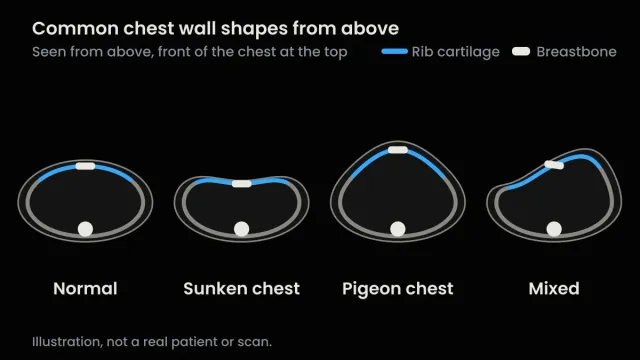
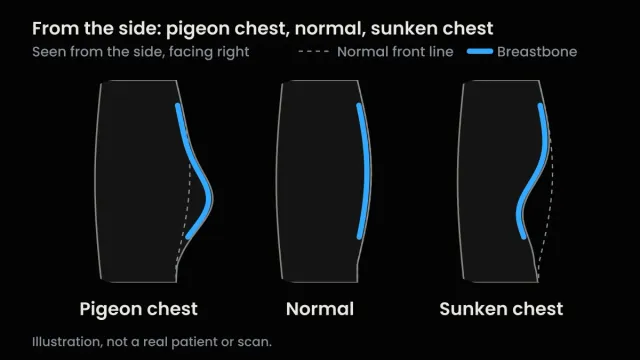
Depth follows growth. The dip comes from the breastbone and the costal cartilage, the flexible strips joining the ribs to it, growing inward. Cincinnati Children’s says it often gets worse during growth spurts and “usually stops changing after the child’s skeleton stops growing.” Mayo Clinic adds the exception: in some people the dip can keep getting deeper into adulthood.
Symptoms can move later. Cleveland Clinic says you may develop more symptoms over time, partly from normal aging and partly because it gets harder for your body to make up for what the dip does to the heart and lungs.
The two don’t track each other closely. Severity is usually measured with the Haller index, a number from a chest scan: the width of the chest divided by the distance from the back of the breastbone to the spine. About 2.5 is average and 3.25 or more is usually called severe. In PCAPES, a Mayo Clinic Arizona survey of 432 adults referred for surgery (median age 30), the symptom score correlated only weakly with the Haller index (r = 0.16).
A 2026 review for family doctors adds that even mild-looking chests can press on the heart, so doctors should put symptoms ahead of how the chest looks. “Mine looks the same” and “I feel the same” are two separate checks.
What happens at each age
Babies and toddlers
Mayo Clinic says a sunken breastbone can often be seen shortly after birth. Yet the surgeons at the Children’s Hospital of The King’s Daughters in Norfolk, Virginia, write that in their experience only 22% are noticed in the first decade of life. The same paper quotes a 1996 estimate that 90% are noted within the first year. So it’s often there early but often noticed only later.
Younger children typically have fewer symptoms, according to Cincinnati Children’s. If your child is a baby or toddler, my guide to sunken chest in babies and children covers what to watch and when to see a doctor.
Childhood
Once it’s noticed, it tends to progress slowly until puberty, according to the Norfolk surgeons, and symptoms are usually few. It’s a good time to start a baseline before the growth spurt: a measurement and a photo, taken the same way each time (method below).
The growth spurt
This is the fast phase. The Norfolk surgeons write that during puberty “a mild deformity may become severe in less than 6 to 12 months.” It can also become more complex and more uneven. Patients there say things like “my chest suddenly started to cave in a few months ago.” That speed is one big center’s clinical experience rather than a measured study, though Mayo and Cincinnati also say it often gets worse during growth spurts.
Around puberty the chest also becomes more rigid, and that’s when the same surgeons see heart and lung symptoms start to show.
It’s also the window when the options work best. The Norfolk center recommends surgery at about 12 to 14, while the chest is still flexible and so the bar stays in through the rest of puberty. Cleveland Clinic gives 10 to 14 as the best age for repair. With the vacuum bell, the people who did best in the published studies tended to be younger, with a shallower and more flexible chest, and wore it more hours a week.
I was diagnosed at 15, right inside this window.
If you’re a teen and the dip seems to be changing, measure it monthly. A few months of numbers will tell you more than the mirror on a bad day.
After you stop growing
For most people, this is where the dip settles. KidsHealth’s care sheet says it usually doesn’t change much more after growth. Mayo’s exception, a dip that keeps deepening in some adults, still applies.
The gap: I found no long-term study measuring how the depth of an untreated dip changes in adults. The “usually stops” answer rests on hospital guides and surgeons’ experience.
What does change is the chest wall itself. A 2023 review by Mayo Clinic Arizona surgeons describes more calcification and rigidity in adult chest walls, and says that as patients age the chest wall can become less flexible, leading to symptoms progressing. Treat that as the surgeons’ explanation, not something measured directly in people with pectus.
Adulthood
For some adults, symptoms become the story rather than depth. Cleveland Clinic says that in adults, limits on activity may not be obvious until the late 30s or 40s.
The figures below are real, but read who was counted first. Every one comes from adults who went looking for help, usually from a surgeon. People without symptoms rarely end up in these studies, so the percentages likely run higher than they would across everyone with a sunken chest.
- Adults referred for surgery. In PCAPES, 86% of those 432 adults said their symptoms had progressed with age. The 2026 family-doctor review, drawing on surgical-referral studies including PCAPES, reports that 36% of adult patients had new symptoms start after age 20, and over 53% had symptoms progress after 18.
- Older patients with symptoms. In a 2011 series of 42 senior patients with symptomatic pectus excavatum, the serious complaints of 19 of them (45%) had started only in their fourth or fifth decade of life, meaning their 30s or 40s. In 12 of those 19, the complaints had been labeled “unexplained cardiovascular complaints”.
If you’re an adult with no symptoms, none of this is a forecast for you. If breathlessness, tiredness, palpitations or chest pain do show up, don’t write them off as being out of shape. Get them checked, and mention your chest. The wider picture is in pectus excavatum symptoms.
Older age
Data is thin here. A Dutch study of 117 older patients whose chest X-rays showed pectus excavatum found 32% had symptoms that might come from it, and the authors said doctors should consider it as a cause of breathlessness, tiredness or palpitations in older patients.
The reassuring side, from Dr. Robert Shmerling at Harvard Health Publishing in May 2026: reach your 40s or 50s with no symptoms and no need for surgery, and you likely face little or no risk from it, though a doctor should still assess your own case. Cleveland Clinic adds that there’s no evidence it limits life expectancy or causes progressive damage to the heart and lungs over time. Lifespan, military and disability questions are in pectus excavatum later in life.
What changes it, and what doesn’t
| What | Changes the look? | Changes the bone? | What the evidence says |
|---|---|---|---|
| Waiting | No | No, in the usual case | Hospital guides say it doesn’t get better without treatment |
| Posture | Yes | Not shown | The dent’s depth didn’t change between standing and lying CT scans |
| Exercise and training | Can, by building the frame around the dip (my view) | Not shown | No study has shown a change in the dip |
| Body fat | Possibly | Not shown | Not studied directly. Interpretation from bell imaging |
| Vacuum bell | Yes | Partly, in some people | Best results young, shallow, flexible, with many hours |
| Surgery | Yes | Yes | Moves the breastbone forward directly, harder in adults |
Posture. In a CT study of 21 people with pectus and 35 without, scanned standing and lying down, the dent stayed 3.4 cm deep in both positions. That’s standing against lying, not slouching against standing tall. A McMaster Children’s Hospital handout says poor posture can make a mild pectus look severe, and calls posture’s role in actual worsening uncertain. More in pectus posture.
Exercise. In a 2026 controlled trial in adolescents, Schroth-based posture exercises added to the bell improved posture and quality of life, not the chest’s severity. Seattle Children’s says no exercises have ever been shown to improve pectus excavatum. My view: training builds the chest, shoulders and back around the dip, and a fuller frame makes it less noticeable. That’s the look, not the bone, and still worth doing. See pectus excavatum exercises.
Body fat. No study has looked at weight and how deep the dip looks. The closest evidence is bell imaging. In a 2026 CT study of 47 children, after a year of bell use the surface dip improved by 4.0 mm and the bony dip by 1.4 mm, and fat over the chest had increased in 95.7%. My interpretation: soft tissue can change the surface without the bone moving much. That doesn’t show that weight changes your dip either way.
Vacuum bell. With months of regular use, the aim is for the chest to hold more of the bell’s lift on its own. The Norfolk surgeons call it a 1 to 2 year commitment, and results vary widely. The evidence is in vacuum bell therapy.
Surgery. The Nuss and Ravitch operations move the breastbone forward directly. The adult trade-offs are below.
Is it too late as an adult?
No. My view is that being an adult changes how hard and how slow correction is, not whether any change is possible.
Vacuum bell. In Haecker and Mayr’s 2006 Basel study of patients aged 6 to 52, the lift was more obvious in children. In adults it lasted 30 to 60 minutes after the bell came off, and adults showed a slower but continuous decrease of the dip. The 2024 guidelines say the bell becomes less effective as the chest gets stiffer with age. I found no outcome study of adults alone, so adult expectations borrow from mixed-age series.
Bracing. Dr. Sydney Haje’s group in Brazil, who treat both sunken and pigeon chests with braces, reported good results in 60.6% of children and teenagers against 27% of adults. Both chest types are counted together, so that isn’t a rate for sunken chests alone. Lower for adults, not zero.
Surgery. In a Mayo Clinic Arizona series of 361 adults who had a modified Nuss, the repair succeeded in 88.7% of those aged 30 and over, against 96.5% of those aged 18 to 29. Complications rise with age. In US national hospital data on 360 Nuss patients from 2016 to 2018, any complication was recorded in 30.6% of 12 to 17 year olds, 45.2% of 18 to 29 year olds and 62.1% of those 30 and over. The counts come from billing codes and include minor problems. The Norfolk surgeons report successful repairs in patients in their 40s and 50s, and the Mayo Arizona review says adults there often keep their bars 3 to 3.5 years because the chest wall is more rigid.
Put together: an adult chest is stiffer, change comes more slowly, a complete correction is less likely and surgery carries more risk. None of that closes the door, but expect months to years, not weeks. If your chest is severe, symptomatic and rigid, an honest assessment may point you toward surgery, and there’s no failure in that. Costs, recovery and risks are in my pectus excavatum surgery guide.
If you’re a teen or an adult and want a sense of how significant yours is and which route fits, take my free 1-minute quiz.
How to tell if yours is changing, and when to see a doctor
Measure once a month, the same way every time: lie flat on your back, rest a ruler across the dip without pressing it in, and measure straight down to the deepest point, on the same breath. Take a front and a side photo the same day, and judge the trend over several months instead of comparing each reading with the last. That ruler number is your own tracking number, not a Haller index. The full method is in measuring pectus excavatum at home.
See a doctor before you start any device, brace or exercise program if any of these apply to you:
- chest pain
- fainting or nearly fainting
- breathlessness at rest or with light effort
- palpitations or an irregular heartbeat
- a diagnosed heart or lung condition
- Marfan syndrome or Ehlers-Danlos syndrome, or a doctor has raised either
- previous chest surgery
- a Haller index above 3.25 together with symptoms
- symptoms that nobody has checked yet
None of these means you’ll need surgery. They mean someone should look at your heart and lungs before you go further. A Haller index of 3.25 is a common threshold for a surgical referral, not an emergency. Ask for a pediatric surgeon or a thoracic (chest) surgeon who works with chest wall conditions.
Also get checked if a dip appeared for the first time as an adult, or after chest surgery. For everything else about the condition, start with my guide to what pectus excavatum is.
Quick answers
Can a mild case go away?
Not by itself, in the usual case, apart from the rare airway cases above. Most cases are mild and well tolerated, according to the 2024 guidelines, and for a mild chest with no symptoms, leaving it medically alone is a legitimate choice. Keep measuring through the growth spurt, when even a mild dip can change fast.
Does pectus carinatum get worse with age too?
It follows a similar arc. A pigeon chest doesn’t usually flatten by itself, often grows more prominent during the growth spurt and mostly stays after growth. I cover it in when pectus carinatum appears and whether it gets worse.
Did slouching or lifting weights make mine worse?
Probably not, going by what’s published. Slouching can make a mild chest look worse, but the McMaster handout calls its role in actual worsening uncertain, and none of the sources here describes training making the dip deeper. If yours changed in your teens, my guess is the growth spurt.
Sources
- Pectus Excavatum: How to Care for Your Child. Nemours KidsHealth. [cited 2026 Oct 20]. Read it
- Pectus Excavatum. Cleveland Clinic. Updated 2023 Aug 11 [cited 2026 Oct 20]. Read it
- Dunning J, et al. Pectus Care Guidelines. Eur J Cardiothorac Surg. 2024;66(1):ezae166. Read it
- Fan L, Murphy S. Am J Dis Child. 1981;135(6):550-2. Read it
- Pectus Excavatum. Cincinnati Children’s. [cited 2026 Oct 20]. Read it
- Pectus excavatum: Symptoms and causes. Mayo Clinic. [cited 2026 Oct 20]. Read it
- Jaroszewski DE, et al. J Thorac Dis. 2024;16(12):8565-81. Read it
- Odeh NB, et al. Diagnosis and Management of Pectus Excavatum in Primary Care. J Am Board Fam Med. 2026;39(1):157903. Read it
- Nuss D, Obermeyer RJ, Kelly RE. Ann Cardiothorac Surg. 2016;5(5):493-500. Read it
- Aly MR, Farina JM, Botros MM, Jaroszewski DE. J Thorac Dis. 2023;15(9):5150-73. Read it
- Kragten HA, et al. Neth Heart J. 2011;19(2):73-8. Read it
- Winkens RA, et al. ISRN Fam Med. 2013:373059. Read it
- Shmerling RH. Does pectus excavatum increase my risk of lung or heart problems in midlife? Harvard Health Publishing. 2026 May 12. Read it
- Suzuki T, et al. Eur J Cardiothorac Surg. 2024;66(5):ezae408. Read it
- Pectus excavatum exercise instructions (patient handout). Hamilton Health Sciences, McMaster Children’s Hospital. [cited 2026 Oct 20]. Read it
- Kandemir B, et al. Prosthet Orthot Int. 2026 (online ahead of print). Read it
- Pectus Excavatum. Seattle Children’s. [cited 2026 Oct 20]. Read it
- Zhang, et al. J Pediatr Surg. 2026;61(7):163131. Read it
- Haecker FM, Mayr J. Eur J Cardiothorac Surg. 2006;29(4):557-61. Read it
- Haje SA, Haje DP. Rev Bras Ortop. 2009;44(3):191-8. Read it
- Jaroszewski DE, et al. Ann Thorac Surg. 2016;102(3):993-1003. Read it
- Mack SJ, et al. J Thorac Dis. 2022;14(4):952-61. Read it
Reading about the condition is one thing. Knowing which one you have, how severe it is and what to do first takes about a minute.
- Your condition named, not guessed
- A severity read you can act on
- The exact next step for your case

This article is for educational purposes only and does not constitute medical advice. Always consult a qualified healthcare professional before starting any treatment plan. View full disclaimer →