Contents · 9 sections
Maybe you’re in your 30s and wondering what the dip in your chest means for the next few decades. Maybe you’re about to see a recruiter and worried the medical exam will end it before it starts. Or you’re a parent thinking ahead.
Here’s the short version. There’s no good evidence that pectus excavatum shortens your life. Most adults with a mild chest have no problems from it. A smaller group notice more symptoms as they get older, and they’re the ones who should get checked. The military and disability rules mostly turn on your symptoms and function, not on how deep the dent is. Every rule below comes from the official source, with its country, date and link, as checked in October 2026.
I was diagnosed with pectus excavatum at 15. I declined surgery and corrected it over about three years of daily vacuum bell use and structured training. The change was visible and measurable, but not complete. I’m not a doctor, so every medical point and rule here comes with its source.
| Question | Short answer | Who decides | Rule or source, and date |
|---|---|---|---|
| Will it shorten my life? | No good evidence it does. The data is thin. | Your doctor, for your own risk | Cleveland Clinic (updated 2023); Johns Hopkins autopsy series (2005) |
| Will it get worse? | In some adults the dip deepens and symptoms become more noticeable | Your doctor | Mayo Clinic; Cleveland Clinic |
| Can I join the US military? | Not by the dent alone. Symptoms, limited exertion, a surgery recommendation or trouble wearing equipment disqualify. Waivers can be considered. | The military’s entrance medical review; ask your recruiter who handles waivers | DoD Instruction 6130.03, Vol. 1, Change 6, effective 3 Feb 2026 |
| Can I join the UK armed forces? | Fit with no symptoms, normal exercise capacity and a normal exam and ECG. More tests if mildly limited or after surgery. | Armed forces medical staff, under JSP 950 | JSP 950, leaflet 6-7-7, v3.3, effective 16 Jul 2026 |
| Can I join the police? | US: no single national standard found. England and Wales: case by case, no automatic exclusion. | The hiring agency or force | EEOC ADA guidance (1995); Home Office circular 59/2004 |
| Social Security (US)? | Only if it stops you working for 12+ months. No listing names pectus excavatum. | Social Security Administration | SSA rules and Blue Book 3.00 (checked 19 Oct 2026) |
| VA benefits (US veterans)? | A rating code (6842) exists, rated by lung function. Linking it to service is the hard part. | Department of Veterans Affairs | 38 CFR 4.97 and 3.303 (eCFR, current 15 Oct 2026) |
| UK benefits? | Depends on how much it limits day-to-day life | Department for Work and Pensions, for PIP | Equality Act 2010; gov.uk PIP rules (checked 19 Oct 2026) |
Will pectus excavatum shorten your life?
This is the “can pectus excavatum kill you” question, and the straight answer is that there’s no good evidence it does. Cleveland Clinic puts it plainly: “There’s no evidence that pectus excavatum limits life expectancy.” The page dates from 2023, and none of the newer studies cited here contradicts it.
The caveat is that there’s very little data either way. No large study has followed people with pectus excavatum through life. The closest thing is a 2005 autopsy series from Johns Hopkins: researchers searched 50,496 autopsies done between 1889 and 2001 and found pectus excavatum in 62. The results point both ways:
- As a group, the people with pectus excavatum tended to die younger than comparison patients.
- But those who lived past 56 tended to outlive the comparison patients.
- 18 were babies under a year old who died of unrelated causes, many of the others had other conditions or syndromes, and nobody could tell how severe their chests had been.
The authors called the findings “consistent with the theory that this condition can impact survival”. That’s a careful phrase, and it’s as far as the data goes. It can’t tell you how long someone with your chest will live, so the blunt claims you’ll see online, in either direction, are ahead of the evidence.
If your real worry is the risk of surgery itself, the numbers are in my pectus excavatum surgery guide.
Does it get worse as you get older?
For some people, yes. Mayo Clinic says the dip may deepen in early puberty and can keep getting deeper into adulthood, and its symptom list includes a loss of endurance that becomes worse over time. Cleveland Clinic says you may develop more symptoms over time, and that in adults the limits on activity may not be obvious until the late 30s or 40s.
Part of the reason is that the chest wall stiffens with age. In a series of 320 adults aged 19 to 67 who had open repair at UCLA, every patient reported symptoms getting worse in adolescence and more severe in adulthood, and the surgeons concluded that uncorrected chests often bring worsening symptoms with age. But those were adults bothered enough to seek surgery. They don’t tell you about the many adults who never do.
There’s more in does pectus excavatum get worse with age.
Heart and lungs in your 30s, 40s and beyond
Most sunken chests are mild and well tolerated, according to the 2024 Pectus Care Guidelines, a consensus from cardiothoracic, pediatric surgery, orthopedic and Marfan societies. Only a small number of people are physically limited, and symptoms at rest happen only in extreme cases.
Severity is measured with the Haller index, a ratio from a chest scan: the width of the chest divided by the distance between the back of the breastbone and the spine. About 2.5 is average, and 3.25 or more is usually called severe. In a German study of 99 otherwise healthy patients, mostly young, exercise results only started to differ as the index rose: a higher heart rate at the anaerobic threshold above 3.25, and a lower maximum oxygen uptake (the standard measure of aerobic fitness) only above 4.0.
With age, symptoms can surface late and get blamed on something else. A Dutch study of older patients whose chest X-rays showed pectus excavatum found 32% had symptoms that might come from it, and symptoms tracked how severe the chest looked on the X-ray. The authors said doctors should consider it as a possible cause of breathlessness, tiredness or palpitations in older patients.
One case report describes a healthy 59-year-old man with years of worsening palpitations, tiredness and breathlessness when he bent over, until a CT scan showed his breastbone pressing on his heart. After a modified Ravitch, an open operation to reshape the chest, he improved quickly. One man isn’t a pattern, but symptoms in your 50s deserve a look rather than a shrug.
On the other side, Dr. Robert Shmerling of Harvard Health Publishing gave a useful rule of thumb in May 2026: if you reach your 40s or 50s with no symptoms and no need for surgery, you likely face little or no risk from it, though your doctor still needs to evaluate you to know your own risk.
If you do have symptoms, will repair help your heart and lungs? The research disagrees:
- A 2025 meta-analysis of 21 studies and 1,087 patients, mean age 18.9: resting heart output, stroke volume and exercise oxygen uptake improved after repair; breathing measurements didn’t.
- Another 2025 meta-analysis of 15 non-randomized studies, all at serious or critical risk of bias: no significant improvement in peak oxygen uptake.
- A small Danish study of 15 adults: no change in cardiac output or maximum oxygen uptake a year after the Nuss procedure.
So nobody can honestly promise that surgery will fix your breathing, or that it won’t. There’s more on the heart side in pectus excavatum and heart problems, and on breathing in pectus excavatum and shortness of breath.
When to see a doctor first
See a doctor if any of these apply to you:
- chest pain
- fainting or nearly fainting
- breathlessness at rest or with light effort
- palpitations or an irregular heartbeat
- a diagnosed heart or lung condition
- Marfan syndrome or Ehlers-Danlos syndrome, or a doctor has raised either
- previous chest surgery
- a Haller index above 3.25 together with symptoms
- symptoms that nobody has checked yet
None of these means you’ll need surgery. They mean someone should look at your heart and lungs. A mild, symptom-free chest doesn’t usually need a routine CT scan just to be safe.
Can you join the military with pectus excavatum?
Usually it depends on your symptoms and function, not on the dent. Below are the US and UK rules, quoted from the official documents as they stood on 19 October 2026. Rules change, so confirm the current version with your recruiter. This is a guide to the published rules, not legal or medical advice, and the decision belongs to the people named in each section.
The US rule, word for word
The US medical standards for joining are in Instruction 6130.03, Volume 1, “Medical Standards for Military Service: Appointment, Enlistment, or Induction”, a Department of Defense Instruction (DoDI). The current version, Change 6, effective 3 February 2026, renames the department the Department of War. One standard covers enlistment and officer appointment in every service and component: Army, Navy, Air Force, Marine Corps, Space Force, National Guard and Coast Guard. Here is paragraph 6.10.i of the official DoDI 6130.03 text:
“Current chest wall malformation, including but not limited to pectus excavatum or pectus carinatum which has been symptomatic, interfered with vigorous physical exertion, has been recommended for surgery, or may interfere with wearing military equipment.”
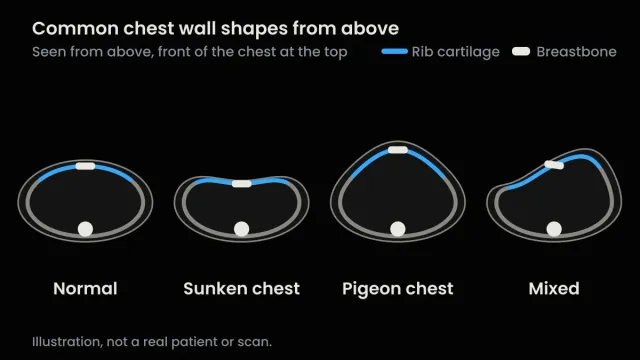
My plain reading of that text: having pectus excavatum isn’t disqualifying by itself. It becomes disqualifying if any one of four things is true:
- it has caused symptoms
- it has interfered with vigorous physical exertion
- a doctor has recommended surgery for it
- it may interfere with wearing military equipment
Notice the third one: it’s about whether surgery was recommended, not whether you had it. And the rule names no Haller index or cut-off number. If you read online that a particular index disqualifies you, that isn’t in this text.
Other paragraphs in the same document can matter for people with pectus excavatum:
- 6.10.m: “History of thoracic surgery including open and endoscopic procedures.”
- 6.10.q: “History of chest wall surgery, including breast, during the last 6 months, or with persistent functional limitations.”
- 6.19.f: “Current orthopedic implants or devices to correct congenital or post-traumatic orthopedic abnormalities.”
- 6.11.b: mitral valve prolapse, a heart valve whose flaps bulge back as they close, is disqualifying when it comes with mild or greater leakage (regurgitation), heart or lung symptoms, or medical treatment.
If you’ve had surgery or still have a bar
The Nuss procedure places one or more curved metal bars behind the breastbone to push it forward, and the bars come out in a later operation. Here’s how I read the rules above. It’s my interpretation, not an official one:
- A past Nuss or Ravitch looks like a “history of thoracic surgery” under 6.10.m.
- A bar still in place looks like a “current orthopedic implant” under 6.19.f.
- If the operation was within the last 6 months, or left you with lasting limits, 6.10.q applies as well.
You may read that the bar must come out before you can apply, followed by a fixed waiting period. The instruction’s text doesn’t say that. Ask your recruiter how your branch handles it, and if removal is coming up anyway, see pectus bar removal.
Waivers and MEPS: what to bring
A disqualifying condition isn’t always the end. The DoDI says applicants who don’t meet the standards may be considered for a medical waiver, a case-by-case exception, unless the condition is on the ineligible list. The Military Health System keeps a list of select conditions that can’t be waived for entry, last updated 30 September 2026. It includes ALS, cystic fibrosis, current epilepsy and a solid organ transplant, but nothing about chest wall malformations, pectus or chest surgery. That means a waiver can be considered. It doesn’t mean you’ll get one.
For most applicants the entrance medical exam happens at MEPS, the Military Entrance Processing Station. The DoDI doesn’t spell out who handles a waiver request in your branch, so ask your recruiter who reviews it and what they’ll want to see.
There’s some reassuring evidence from people already in uniform. A 2026 study in Military Medicine looked at 95 active-duty service members with pectus excavatum who had lung function tests at one US military medical center between 2005 and 2020. The authors recommended evaluation with lung function tests, chest and heart imaging and exercise testing, and concluded that without other heart or lung findings, “the presence of PE itself usually does not affect military service”. They were already serving, and only the abstract was available to check, so it doesn’t predict an entry decision.
What I’d do if I were applying:
- Answer the medical history questions truthfully. Don’t leave pectus excavatum or a past operation off the form.
- Bring your records: chest imaging, lung function tests (spirometry), an echocardiogram (heart ultrasound), any exercise test, and operation and bar removal notes if you had surgery.
- Know your symptom history. The rule turns on symptoms and hard exercise, so be ready to describe both honestly.
UK armed forces (JSP 950)
In the UK the rule is in JSP 950 (Joint Service Publication 950), the armed forces’ medical policy. Medical Policy Leaflet 6-7-7, the Joint Service Manual of Medical Fitness, version 3.3, effective 16 July 2026, names chest wall abnormalities “including pectus excavatum and pectus carinatum” directly. They need a clinical and functional assessment, partly to make sure you can wear protective kit such as combat body armour:
- No breathing symptoms, normal exercise capacity, no other functional limits, and a normal exam and ECG: fit.
- Mild to moderate impairment, or a surgical correction: further tests (normal spirometry, an echocardiogram and a chest X-ray) and a referral for a final decision.
- Still growing: entry deferred until your skeleton matures, generally 16 for women and 18 for men.
- Significant impairment of function: unfit.
This is the minimum across all three services, and a single service may set a higher one. Armed forces medical staff carry out the assessment.
Pectus carinatum and other countries
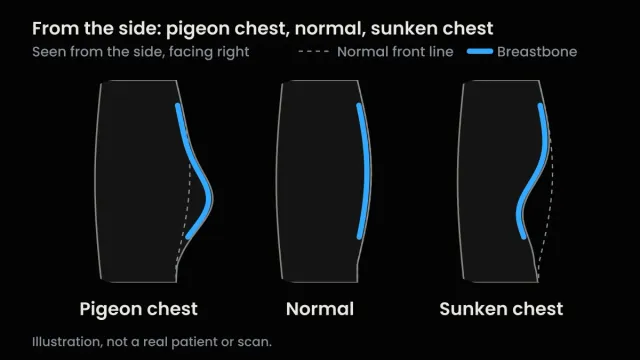
Both the US and UK rules name pectus carinatum, where the breastbone pushes outward, alongside pectus excavatum, so the same tests apply.
No official published chest wall standard turned up for India’s armed forces, and other countries weren’t checked. Every country sets its own rules, so ask the recruiter for the current medical standard in writing and take the same approach: records, honest history, and a doctor’s view of your function.
Can you become a police officer with pectus excavatum?
In the US, no single national medical standard for police recruits turned up; my reading is that each agency and state sets its own. What does apply nationally is the Americans with Disabilities Act (ADA). Under EEOC guidance from 1995, which still describes the core rule, employers, police departments included, can ask disability-related questions and require a medical exam only after a conditional job offer. If the exam is then used to screen you out, the reason has to be job-related and consistent with business necessity, or meet the ADA’s direct-threat standard. The hiring agency makes the decision.
In England and Wales, the Home Office circular 59/2004 on medical standards for police recruitment says each case is assessed individually on its merits, with no automatic exclusion. Its breathing section looks at persistent disease that impairs exercise capacity and doesn’t mention pectus excavatum. The circular dates from 2004, so check the current standard with the force you’re applying to.
If there’s a fitness test and breathing hard is your weak point, start training early with these breathing and lung capacity guide.
Is pectus excavatum a disability?
It depends on the program, and on how much it limits you. The programs below mostly look at what it does to your breathing, your work or your daily life, rather than at the dent.
US Social Security (SSDI)
Social Security Disability Insurance (SSDI) pays only for total disability. The Social Security Administration calls it a “strict definition of disability”: you can’t work at the substantial gainful activity level, can’t do your previous work or other work, and the condition has lasted or is expected to last at least 12 months or result in death.
SSA’s Blue Book lists its medical criteria for claims. My reading of the adult respiratory and heart sections is that no listing names pectus excavatum or chest wall deformity. The respiratory section covers breathing restriction “due to any cause”, judged against lung function tables. If you don’t meet a listing, SSA assesses your residual functional capacity, meaning what you can still do despite your limits. SSA decides.
US veterans’ benefits (VA)
The VA’s rating schedule gives pectus excavatum a diagnostic code, the number it uses to rate a condition. Code 6842 in 38 CFR 4.97 covers “Kyphoscoliosis, pectus excavatum, pectus carinatum” under restrictive lung disease (eCFR, current as of 15 October 2026). It’s rated by lung function. FEV-1 is how much air you can blow out in one second, as a percentage of what’s predicted for you:
- 10% for an FEV-1 of 71 to 80% of predicted
- 30% for 56 to 70%
- 60% for 40 to 55%, or a maximum oxygen uptake of 15 to 20 ml/kg/min
- 100% for under 40%, among other criteria
A code isn’t a payment, though. Compensation needs service connection: the VA has to accept a link between the condition and your service. And 38 CFR 3.303(c) says: “Congenital or developmental defects … as such are not diseases or injuries within the meaning of applicable legislation.”
My interpretation: because pectus excavatum is something you’re born with, service connection is the hard part, and a claim would generally need to show an injury or disease during service on top of it. The VA decides, and a VA-accredited representative can tell you whether you have a case.
UK: Equality Act and PIP
In Great Britain, the Equality Act 2010 treats you as disabled if a physical or mental impairment has a substantial and long-term adverse effect, meaning 12 months or more, on your normal day-to-day activities. Personal Independence Payment (PIP) is for people aged 16 or over, usually under State Pension age, who have difficulty with daily living or getting around most of the time for at least 12 months, and the Department for Work and Pensions (DWP) assesses it.
What you can still do as an adult
Being an adult changes the options. It doesn’t close them.
Surgery works for adults, with more trade-offs. In a Mayo Clinic Arizona series of 361 adults who had a modified Nuss, the minimally invasive repair succeeded in 88.7% of those aged 30 and over, against 96.5% of those aged 18 to 29. Older and more severe chests more often needed an open approach or cuts in the bone. In the older group, right-heart output measured during the operation rose by 65.2% after repair.
Complications rise with age. In US national hospital data from 2016 to 2018 on 360 Nuss patients, any complication was recorded in 30.6% of 12 to 17 year olds, 45.2% of 18 to 29 year olds and 62.1% of those 30 and over. Pooled data from 13 studies found adults had more complications with Nuss than with the Ravitch procedure, and the 2024 guidelines say open repair should wait until the bones have fully matured. In a series of 86 people aged 15 and over who had open repair, 77.9% rated their satisfaction as excellent a year later. For a severe, symptomatic chest, surgery is a legitimate choice and not a failure.
Non-surgical options get harder with age. A vacuum bell is a suction cup that seals over the dip and lifts the breastbone while it’s on. The guidelines call it a safe conservative treatment with professional support, but say it’s less effective in older patients because the chest is less flexible. A Swiss series of 133 patients included people up to age 61 without reporting adults separately, and adult-specific data is thin. My own correction was visible and measurable but not complete, and that’s one person, not a study. The evidence is in vacuum bell therapy.
The mental side counts. The guidelines say there’s good evidence that people affected psychologically benefit from surgery. How you feel about your chest is a real effect of the condition, and there’s more on how pectus excavatum affects mental health.
For causes, severity and every option, see my guide to what pectus excavatum is.
What to do next
- Any red flag from the list above. See a doctor first, before any device or program.
- Applying to the military or police. Gather your records, answer truthfully, and ask for the current medical standard.
- Thinking about benefits. Talk to the agency, or for VA claims, a VA-accredited representative.
- A mild chest, no symptoms, and you want to improve it. Measure it the same way every month, as I explain in measuring pectus excavatum at home. Then take my free 1-minute quiz for a sense of how significant yours is and which route fits. Every non-surgical route is on the pectus excavatum treatment without surgery page.
If you go the non-surgical way as an adult, give it honest time. Structural change is measured in months and years.
Sources
- Pectus Excavatum. Cleveland Clinic. Updated 2023 Aug 11 [cited 2026 Oct 19]. Read it
- Kelly RE Jr, et al. J Pediatr Surg. 2005;40(8):1275-8. Read it
- Pectus excavatum: Symptoms and causes. Mayo Clinic. [cited 2026 Oct 19]. Read it
- Jaroszewski DE, Fonkalsrud EW. Ann Thorac Surg. 2007;84(2):429-33. Read it
- Dunning J, et al. Pectus Care Guidelines. Eur J Cardiothorac Surg. 2024;66(1):ezae166. Read it
- Abu-Tair T, et al. Ann Thorac Surg. 2018;105(2):455-60. Read it
- Winkens RA, et al. ISRN Fam Med. 2013:373059. Read it
- Winkens R, et al. Pectus excavatum, not always as harmless as it seems. BMJ Case Rep. 2009. Read it
- Shmerling RH. Does pectus excavatum increase my risk of lung or heart problems in midlife? Harvard Health Publishing. 2026 May 12. Read it
- Belgacem A, et al. J Thorac Dis. 2025;17(7):4897-908. Read it
- Media AS, et al. Sci Rep. 2025;15:26282. Read it
- Udholm S, et al. Interact Cardiovasc Thorac Surg. 2016;22(5):525-9. Read it
- DoD Instruction 6130.03, Volume 1: Medical Standards for Military Service: Appointment, Enlistment, or Induction. Change 6, effective 2026 Feb 3 [cited 2026 Oct 19]. Read it
- Accessions and Medical Standards. Military Health System (health.mil). Updated 2026 Sep 30 [cited 2026 Oct 19]. Read it
- Stoffel ST, et al. Clinical Evaluation of Pectus Excavatum in Active Duty Military Patients. Mil Med. 2026. doi:10.1093/milmed/usaf639. Read it
- JSP 950 Medical Policy Leaflet 6-7-7: Joint Service Manual of Medical Fitness, Section 4. V3.3, effective 2026 Jul 16 [cited 2026 Oct 19]. Read it
- Enforcement Guidance: Preemployment Disability-Related Questions and Medical Examinations. US EEOC. 1995 Oct 10. Read it
- National recruitment standards: medical standards for police recruitment (Home Office circular 59/2004). GOV.UK. [cited 2026 Oct 19]. Read it
- How Does Someone Become Eligible? Social Security Administration. [cited 2026 Oct 19]. Read it
- 3.00 Respiratory Disorders - Adult. SSA Blue Book. [cited 2026 Oct 19]. Read it
- 38 CFR 4.97, Schedule of ratings: respiratory system. eCFR, current as of 2026 Oct 15. Read it
- 38 CFR 3.303, Principles relating to service connection. eCFR, current as of 2026 Oct 15. Read it
- Equality Act 2010, section 6. legislation.gov.uk. [cited 2026 Oct 19]. Read it
- Personal Independence Payment (PIP). GOV.UK. [cited 2026 Oct 19]. Read it
- Jaroszewski DE, et al. Ann Thorac Surg. 2016;102(3):993-1003. Read it
- Mack SJ, et al. J Thorac Dis. 2022;14(4):952-61. Read it
- Kanagaratnam A, et al. Ann Cardiothorac Surg. 2016;5(5):409-21. Read it
- Shaalan AM, et al. J Cardiothorac Surg. 2017;12:72. Read it
- Haecker FM. Pediatr Surg Int. 2011;27(6):623-7. Read it
Reading about the condition is one thing. Knowing which one you have, how severe it is and what to do first takes about a minute.
- Your condition named, not guessed
- A severity read you can act on
- The exact next step for your case

This article is for educational purposes only and does not constitute medical advice. Always consult a qualified healthcare professional before starting any treatment plan. View full disclaimer →